Tree Removal in Madison, AL, Quoted Line by Line

Twenty years of takedowns, stump grinding and storm response across the Tennessee Valley, with the takedown, the stump and the debris haul priced as three separate lines.

Madison Tree Removal Pros has spent more than twenty years on tree removal, trimming, stump grinding and storm work in Madison, Alabama and across the wider Tennessee Valley. A job here can be a single hazardous water oak leaning over a roofline, a whole wooded lot cleared ahead of a build, or a crew out at 2:00 a.m. with a pine across a driveway. All of it is quoted the same way: the takedown, the stump and the debris haul written as three separate lines.

That itemization is not a formatting preference. Quotes in this market disagree about exactly three things — whether the stump is included, whether the wood and brush leave the property, and what becomes of the grindings — and a single lump-sum figure hides all three at once. Every estimate we write states plainly whether haul-away is in the price, and shows the firewood credit if you would rather keep the rounds cut and stacked.

We also measure access before we price the tree. Gate width, drop zone, carry distance to the truck and whether a chipper can get anywhere near the work decide the crew, the machine and the day far more than trunk diameter does. Where a bucket truck cannot reach, a tracked spider lift goes through the gate; where the tree stands over a house, the crane earns its keep.

Get Your Free Quote

Fast response • No obligation

So we can reach you about your request.

So we can send you a confirmation after you submit this inquiry form.

  • 20+ Years in the Tennessee Valley
  • Free Written Estimates
  • Crane and Narrow-Access Equipment

What we do

Our Services

Tree removal and stump grinding in Madison, Alabama

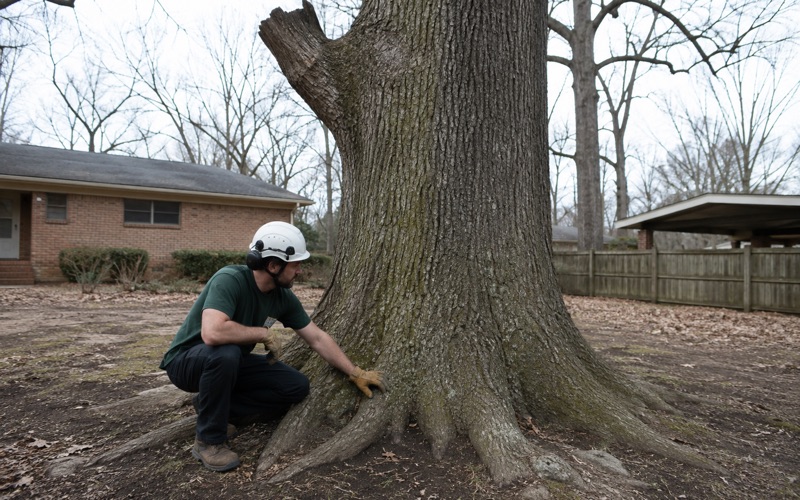
Worker testing the root flare buttress of a white oak on a settled Madison lot, the crown's deadwood above.

Arborist

Written tree risk assessments and condition reports in Madison, AL, priced as their own deliverable rather than bundled into a sales visit.

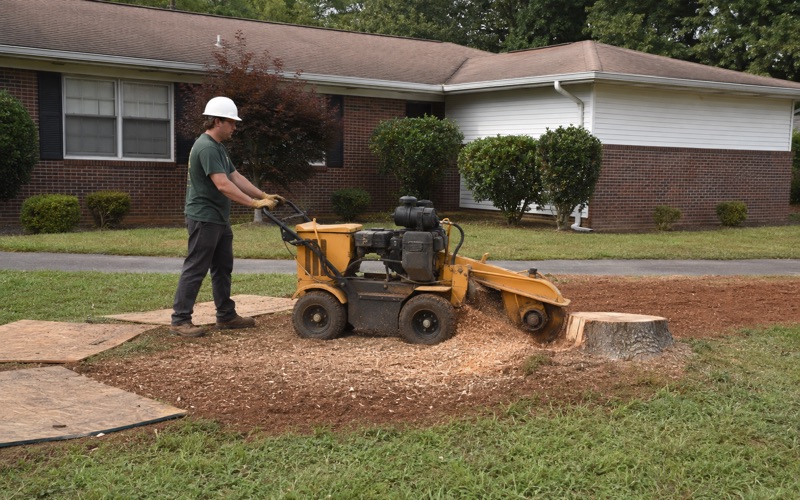
Worker sweeping the grinder wheel across a silver maple stump face in a Madison front yard.

Stump Grinding

Stump grinding in Madison, AL with the depth below grade stated on the estimate and the grindings spread, hauled or left to you.

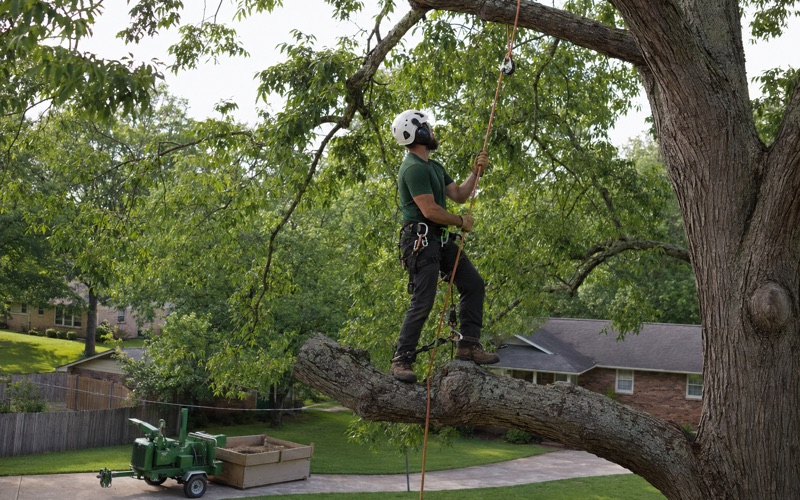
Climber holding his loaded climbing line at the bridge, tied in above the shagbark hickory limb he is standing on.

Tree Trimming

Tree trimming and pruning in Madison, AL, written to a named ANSI A300 objective rather than to whatever the crew felt like cutting.

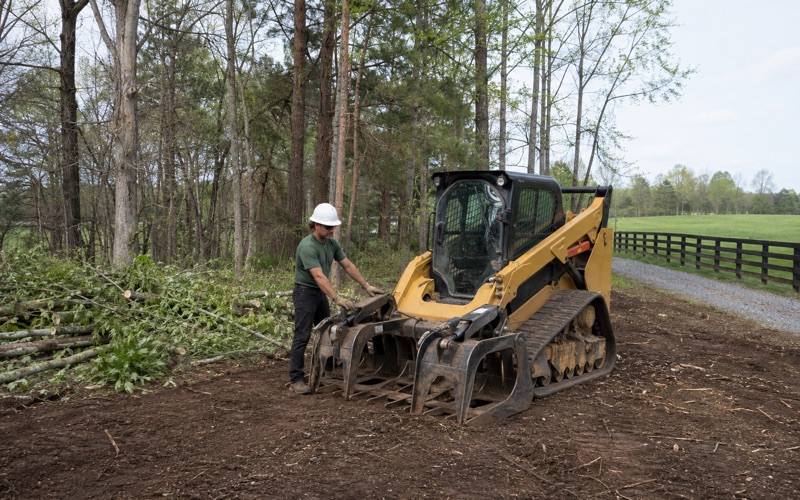
Worker guiding the loader's grounded grapple arm beside the windrow on a Madison tract part way through clearing.

Land Clearing

Land clearing and forestry mulching in Madison, AL, with the trees worth keeping fenced and protected before the machines arrive.

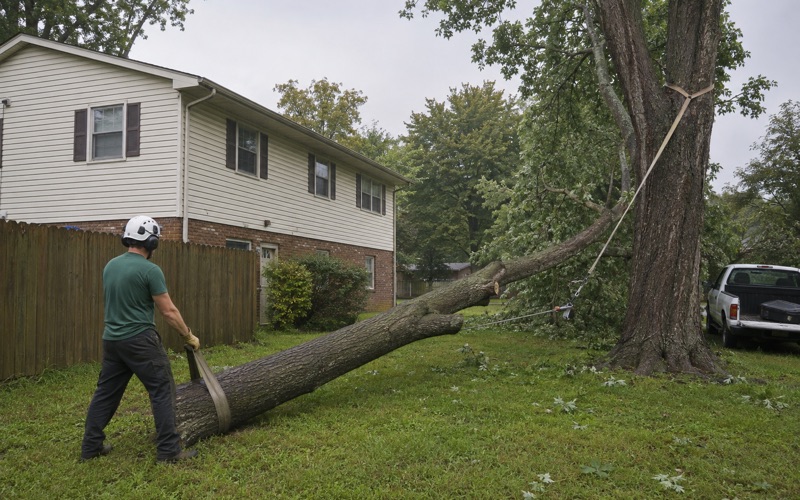
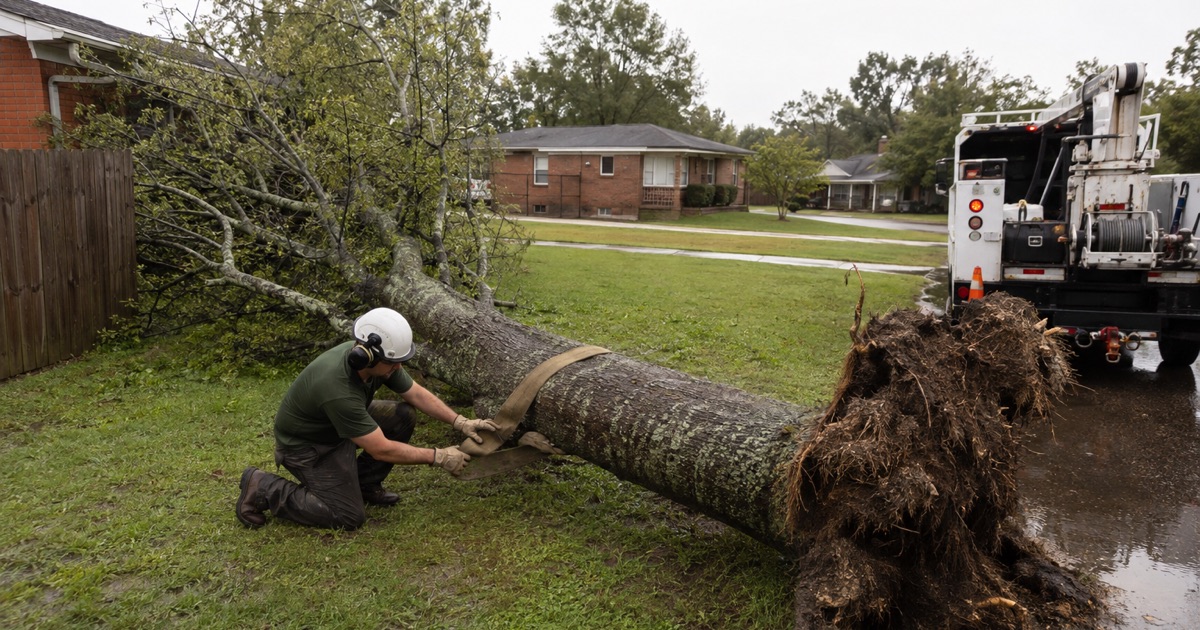
Worker passing a rigging sling around the grounded butt of a storm-hung silver maple leader in a Madison side yard.

Emergency Tree Removal

Same-day emergency tree removal in Madison, AL for trees on structures, leaners and blocked access after a storm.

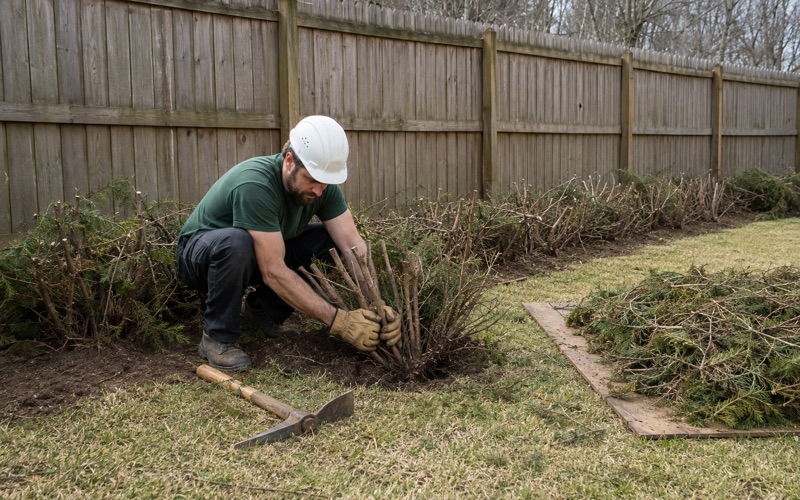
Worker rocking a cut eastern red cedar hedge stem cluster loose along a Madison boundary planting.

Shrub Removal

Shrub, hedge and brush removal in Madison, AL, root ball out and the debris hauled rather than left at the curb.

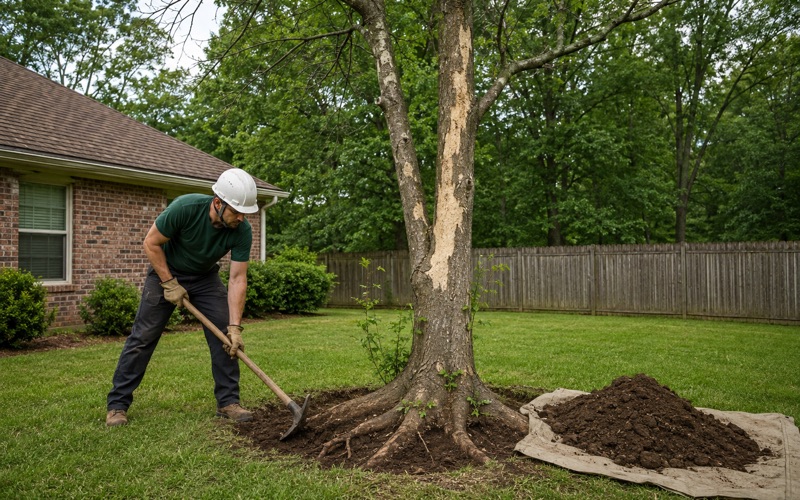
Worker opening the root collar of a declining green ash with a mattock in a Madison back yard.

Tree Disease Treatment

Tree disease diagnosis and plant health care in Madison, AL, where the cause gets named before anything is treated or removed.

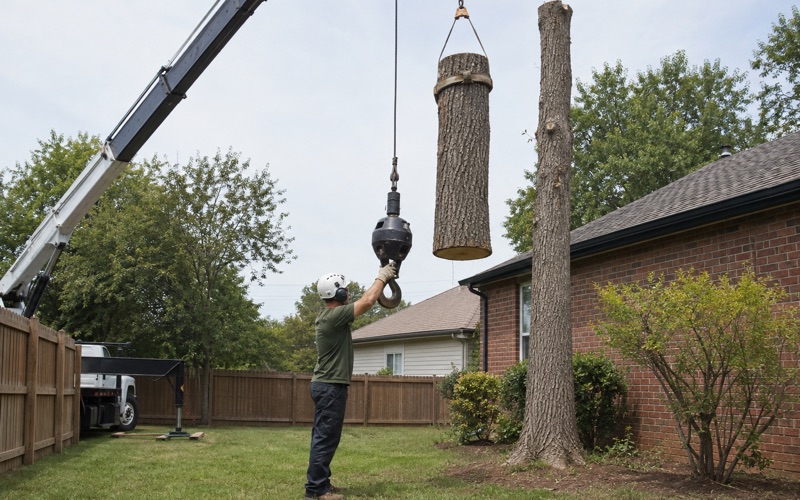
Worker steadying the crane hook block before it meets the choker on a white oak spar in a tight Madison back lot.

Crane Tree Removal

Crane-assisted tree removal in Madison, AL for trees over structures, decayed stems and yards with no drop zone.

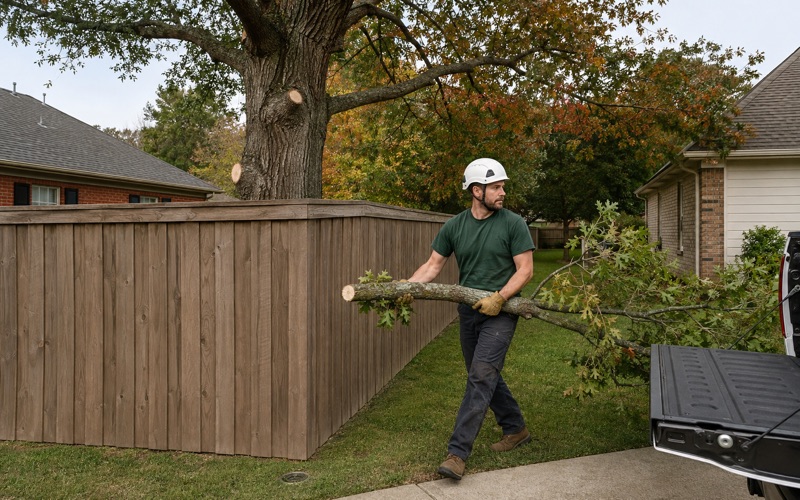
Worker carrying a cut limb butt back from a Madison boundary where the pruning stopped on the line.

Tree Removal Permit

Tree removal permits, HOA covenants and airport height overlays in Madison, AL, plus written hazard documentation for a neighbor tree.

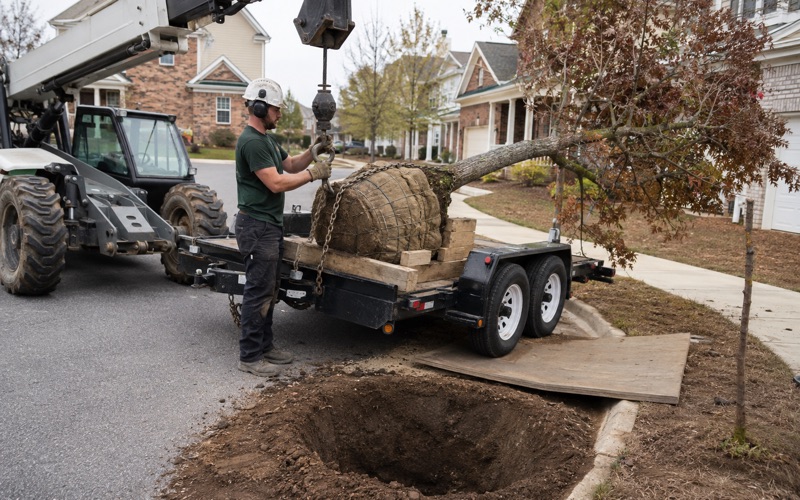
Worker bringing the chain sling hook to a balled willow oak on a trailer at a Madison street verge.

Tree Planting

Tree planting and transplanting in Madison, AL, planted at the right depth with the species matched to the site.

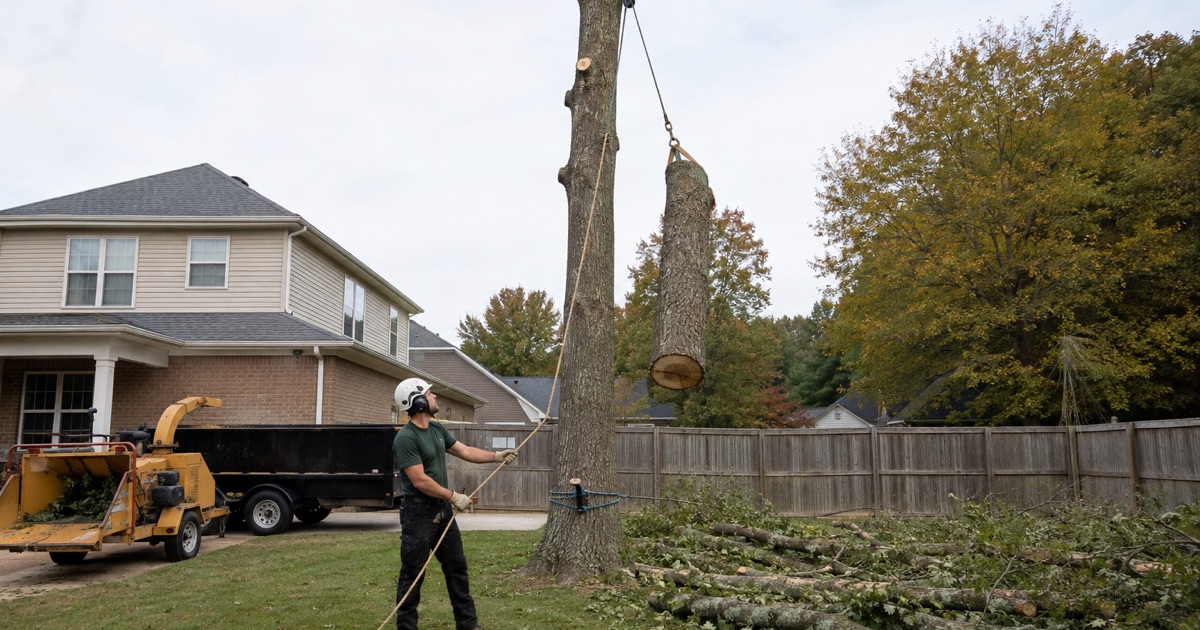
Two Decades of Tree Work in the Tennessee Valley

Worker holding three wraps on the bollard as a southern red oak section comes down beside the spar in a Madison back yard.

Twenty Years of Local Tree Removal

More than twenty years in this valley means our crews have worked both the Eastern Highland Rim floor that Madison sits on and the steeper escarpment ground east of us on Monte Sano and Green Mountain. Those are two different jobs with two different rigging plans, and the experience shows up as fewer surprises on the estimate rather than as a slogan on a truck door.

Free Written Estimates, Itemized in Three Lines

Every estimate is free, written, and split into the takedown, the stump and the debris haul, so you can hold it beside another company’s number and see exactly where the difference sits. Nothing gets folded into one figure that only makes sense to the person who wrote it, and no line appears on the invoice that was not on the estimate.

Why Choose Madison Tree Removal Pros

Access Measured Before the Tree Is Priced

Every quote starts with a tape on the gate, the drop zone and the carry distance to the truck, because a wide trunk behind a narrow side gate is a rigging job rather than a felling job. Pricing the trunk first and finding the access on the morning of the work is how a change order arrives after you have committed, rather than a number that holds.

Crane and Narrow-Access Rigging Capacity

No tree over a structure comes down on hope here: sectional dismantling with a crane, a Port-a-Wrap friction device and a rigging block inside a stated working load limit is what keeps the pieces off the roof. Where a bucket truck cannot fit a fenced Madison back yard, a tracked spider lift goes through the gate rather than a section of fence coming out first.

Haul-Away Stated in Every Quote

Republic Services collects yard debris for Madison households, and the city’s own trash brochure says outright that waste generated by hired workers cannot be put out for collection. Haul-away here is therefore not an upsell but the only lawful route for a removal’s brush pile, so every quote says in words whether it is included instead of leaving you to assume.

Service Drop Disconnects Arranged First

Never does a climber go near a service line before the drop is disconnected, and which utility does that depends on which county line you sit behind: Huntsville Utilities on the Madison County side of the city, Athens Utilities on the Limestone County side. Huntsville Utilities states plainly that clearing trees off the pole-to-house wire rests with the customer, so arranging that outage is a call we make on your behalf.

Risk Documentation Priced on Its Own

A written condition and risk report for a boundary dispute, an insurance claim or an airport-overlay question is quoted as its own deliverable, so nobody pays for a sales visit dressed up as an inspection. Every finding in it — diameter at breast height, crown condition, decay evidence — is recorded as a measurement rather than offered as a verbal opinion no adjuster can act on.

Emergency and Storm Tree Work

Worker passing a choker strap under a windthrown hackberry stem in a Madison front yard after a straight-line wind.

Straight-Line Wind Takedowns Off a Roof

A tree driven into a roof by straight-line wind is usually still loaded when we arrive, with the trunk holding weight against rafters that are already failing. We rig and cut in sections against that load rather than felling the remainder, so the structure is never asked to carry a second impact while the crew works above it.

Tornado Damage Across Madison and Limestone Counties

The April 27, 2011 outbreak produced thirty-nine tornadoes in the National Weather Service Huntsville forecast area, including an EF4 in Madison County with a 27.2-mile path 880 yards wide. After a tornado a crew’s first hour goes on identifying leaners, hangers and lifted root plates, because the tree already down is rarely the one that hurts somebody next.

Trees on Power Lines and Who Owns the Wire

The wire running pole to house is a service drop, and Huntsville Utilities states that clearing trees off customer service wires rests entirely with the customer, while the primary conductors on the poles belong to the utility. Knowing which wire a limb is resting on decides who we call first and whether the job starts today or waits for a disconnect.

A Tree on a Vehicle and the Claim That Pays

A tree that lands on a parked car is normally a comprehensive auto claim rather than a homeowners claim, because the damaged property is the vehicle. Homeowners covering the car is the most common wrong assumption we hear, so we document the tree, the failure point and the position of the vehicle for whichever adjuster ends up handling it.

Service Drop Disconnects Before Anyone Climbs

We arrange the utility disconnect before a saw goes near an energized service line, and we know which providers in this ring will schedule one and which will not. That single phone call is the difference between a crew working to a safe electrical clearance and a crew improvising around a live conductor in somebody’s back yard.

Why Crews Stop Work Near Energized Conductors

ANSI Z133, the safety standard for arboricultural operations, sets minimum approach distances to energized conductors, and high wind or an ice load makes those distances impossible to hold because the limb will not stay where you put it. We say that at the door rather than starting a job we would have to abandon halfway through the night.

Ice Load, Glazed Limbs and First Failures

Glaze on a limb adds weight the tree never grew for, and the first failures here are the fast-growing, weak-wooded species and any union with included bark between co-dominant stems. We look for those unions during an ice event rather than after it, because a stem that splits at the union takes the whole side of the crown with it.

Storm Debris Hauling the City Will Not Collect

Madison’s trash brochure refuses debris generated by commercial workers and professional lawn services outright, and separately refuses contractor waste of any kind. So once a storm-felled tree has been cut up by anyone you hired, the pile at the curb is ours to remove, and we quote that haul as its own line rather than letting you find out on collection day.

What an Alabama Homeowners Policy Usually Pays

Homeowners coverage generally responds when a fallen tree damages a covered structure, and the removal allowance is frequently capped and frequently smaller than the removal costs. A tree that falls and hits nothing is commonly not covered at all. We write the damage and the removal scope in enough detail for you to read your own policy against it rather than guessing.

Emergency Response and the Order to Call People

Same-day response on storm and hazard calls means a blocked driveway, a compromised roof or a leaner over an occupied room moves ahead of scheduled trimming. The order we recommend is the utility first if a wire is involved, then us for stabilization, then the adjuster, because a photograph taken before the tree moves is worth more than one taken after.

Tree Removal, Permits and Property Lines

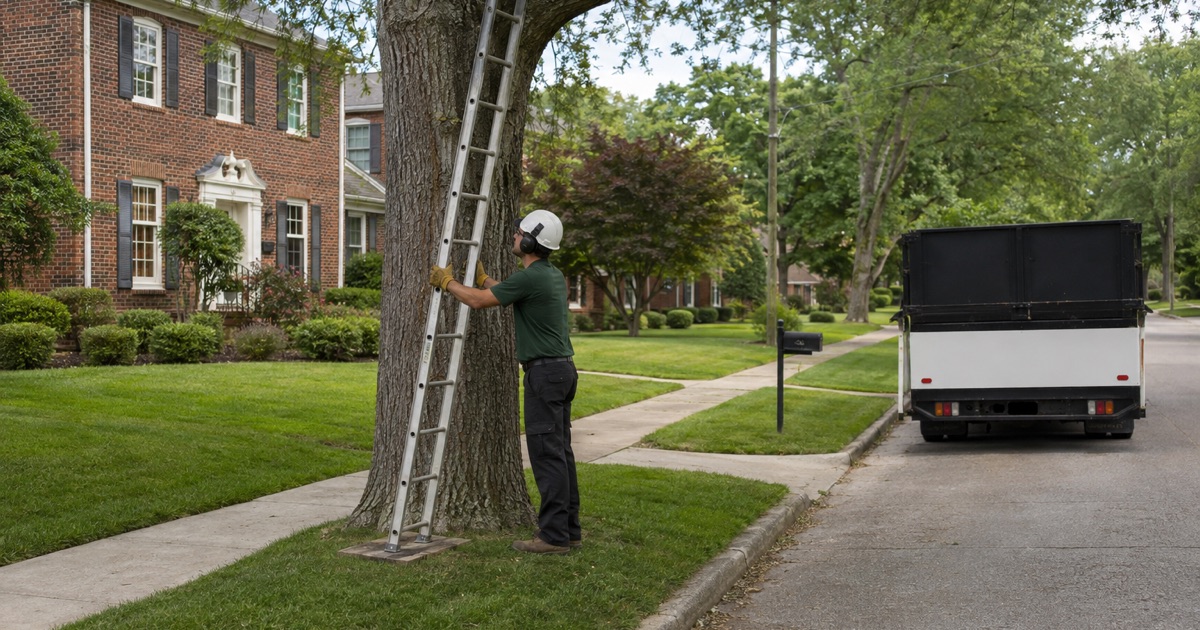
Worker bracing the ladder against a willow oak on a Madison street verge, the sidewalk and survey cap in frame.

Tree Removal Permits on a Madison Lot

The City of Madison’s Official Zoning Ordinance contains no tree preservation article, no tree removal article and no removal permit section, so no municipal permit is required to take down a tree on a finished single-family residential lot. That is a documented absence rather than an oversight: the same ordinance regulates trees in detail on development sites and inside its overlay districts.

The Six-Inch HOA Covenant Threshold

The rule that actually binds most Madison subdivisions is a covenant, not an ordinance. A recorded declaration in the area forbids removing any tree without the board’s consent except diseased or dead trees, trees less than six inches in diameter, trees that must go for safety, and trees where an approved building will stand — and the identical clause appears in a second local declaration.

Airport Height Overlays and Regulated Obstructions

Madison’s Airport Impact Overlay District regulates the height of natural objects as well as structures, running from twenty-five feet above ground level in Obstruction Free Area 1 up to two hundred feet in OFA 8. Twenty-five feet is below the mature height of nearly every shade tree planted here, so a tree that is legal while short does not stay legal forever.

Living Under Two Overlays Near Redstone Army Airfield

The Redstone Arsenal Military Compatibility Area Overlay adds a Vertical Obstruction area covering land inside the Department of Defense imaginary surfaces around Redstone Army Airfield, a Wildlife Aircraft Strike Hazard area within five miles, and a two-mile land use radius. A property can sit under both regimes at once, and the ordinance provides a variance route rather than a flat prohibition.

Unincorporated Madison County, Where No Ordinance Reaches

Much of our ring sits outside any city limits, and an unincorporated address is not covered by the City of Madison’s zoning ordinance at all. What still applies there is your recorded covenant, the utility’s easement and the federal airspace surfaces, which is why we read the plat and the deed rather than assuming a rural lot has no rules.

A Neighbor’s Tree Leaning Over Your Fence

We do not give legal readings on Alabama’s neighbor-tree rule, and we say so plainly, because the doctrine circulating online could not be verified at primary source grade during our research. What we do supply is the part any conversation or letter needs first: a written, measured account of the tree’s condition and where the risk actually sits.

Boundary Trees and Why Neither Owner Cuts Alone

A trunk straddling a property line is a shared asset, and unilateral cutting is where a fence disagreement turns into a lawsuit. We will document the stem position relative to the boundary, the crown condition and the failure risk for both parties, and we will not take a boundary tree down on one owner’s instruction without the other’s written agreement.

Written Hazard Documentation Before the Letter Goes Out

Before you send a certified letter about a neighbor’s tree, get the hazard recorded by somebody who measured it. A dated report naming the defect — a decay column, a root-flare conk, a girdling root, a split union — is the difference between a demand a neighbor can dismiss and one an insurer or an attorney takes seriously.

Dead, Dying and Hazardous Trees, and the Thresholds

The words dead, dying and hazardous carry different weight in a covenant, in an insurance claim and in a conversation with a neighbor, and only the last of them depends on what the tree could hit. We assess target, likelihood of failure and consequence separately, which is how a tree risk assessment framework separates a dead tree in a field from a declining one over a bedroom.

What Alabama Licenses in Tree Work, and What It Does Not

Alabama’s tree surgery category is narrower than most people assume: the statutory definition covers cavity filling, repair, bracing, cabling and wound treatment, and it expressly excludes pruning. Removal is not named in it at all. So cabling and bracing is a licensed act in this state while a takedown is not, and any company telling you otherwise has not read the rule.

Trimming, Pruning and Tree Health

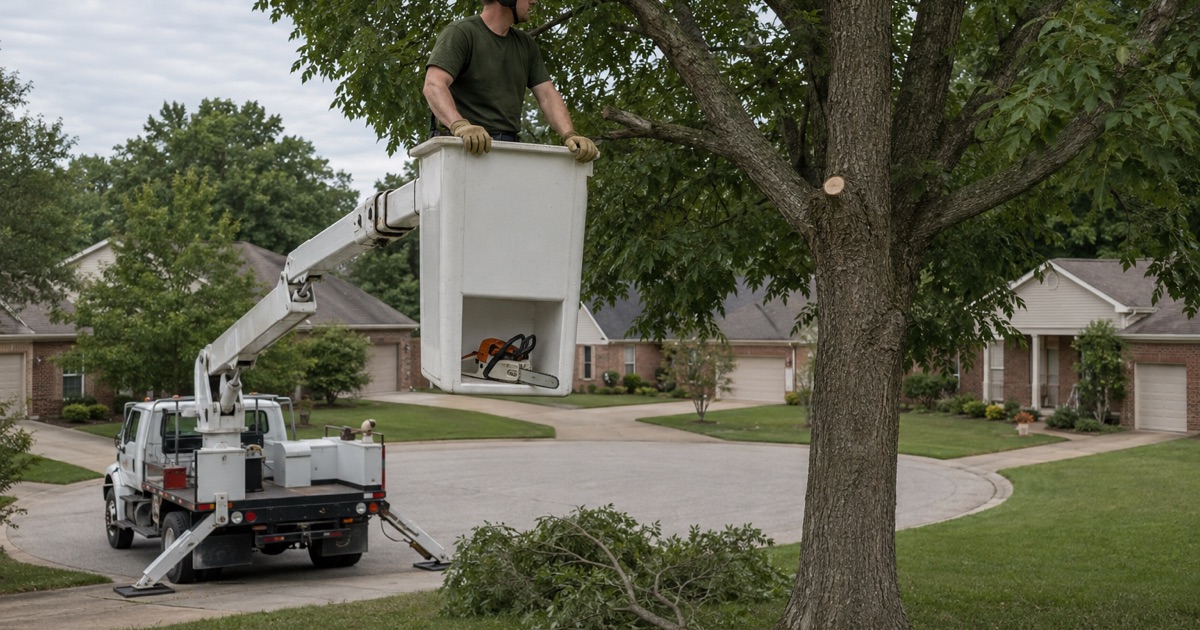
Worker in an aerial bucket sighting the next reduction cut in a pignut hickory over a Madison cul-de-sac.

Crown Cleaning, Raising, Reduction and Thinning

ANSI A300 names four distinct pruning objectives, and most callers want one specific one. Cleaning takes out dead and broken wood, raising lifts the lower limbs off a roof or a drive, reduction shortens the outer crown back to real laterals, and thinning opens the canopy. We write the objective on the work order so the crew and the customer are asking for the same cut.

Why Topping Is Not Pruning

Topping cuts a crown back to stubs with no lateral to take over, and the tree answers with a flush of epicormic sprouts attached only to the outer wood. Two years later you have a denser, heavier, weaker crown on a decaying stem, and a recurring bill. We will reduce a crown properly to laterals, and we will explain what we will not do.

Cabling and Bracing as the Alternative to Removal

A structurally significant tree with a split or weak union can sometimes keep standing on a static or dynamic cabling system, or on threaded steel bracing rods through the union. Against the cost of a takedown plus a stump plus a replacement tree, supporting the tree is often the cheaper answer, and in Alabama it is also the part of tree work the state actually licenses.

Southern Pine Beetle and the Pitch Tubes That Vanish

The Alabama Forestry Commission calls southern pine beetle the number one killer of pines in the state, with unmanaged loblolly and shortleaf stands the susceptible ones. The diagnostic trap is that under drought conditions the pitch tubes may be very small or absent, so a pine with fading needles and boring dust in the bark plates gets inspected rather than dismissed.

Sugarberry, Silver Maple and Water Oak Removals

Three species generate a disproportionate share of removal calls in this valley: sugarberry with its warty gray bark and its flatheaded hackberry borer damage, silver maple with its brittle wood and habitual co-dominant stems, and water oak, which reaches removal age far earlier than the white oaks beside it. Recognizing which one you have changes the timeline of the decision.

Leyland Cypress Screens Planted for a Hedge

Leyland cypress goes in as a fast privacy screen on centers that suit a hedge, then keeps growing into a full-size tree with a shallow root plate and a habit of throwing whole stems in wind. Add Seiridium canker running down a crowded row and the screen fails as a unit, which is why we price these by the run rather than by the tree.

Bradford Pear Branching and the Spring Storm Split

Bradford pear crowds many branches into a narrow band on the trunk with included bark in nearly every union, so the failure is structural and predictable rather than bad luck. A mature one usually splits in a spring storm, and we would far rather reduce the crown early or plan the removal than take the call about half a tree on a car.

Surface Roots Lifting a Driveway

Roots lift a drive because they grew where the soil had air and water, which is the top few inches beside a slab. Cutting them is not free: a root inside the critical root zone is holding the tree up as well as feeding it, and we will tell you which ones can go and where the cut stops being survivable.

Root Collar Excavation and Soil Decompaction

A declining tree in a settled yard is often buried at the root flare or sitting in compacted soil rather than diseased. An air-excavation device clears the collar without tearing roots so girdling roots can be found and cut, and radial trenching, vertical mulching and decompaction restore pore space. That is a treatable diagnosis, worth ruling in before a removal quote.

Edge Trees Left Standing After the Subdivision

A tree kept when the lots went in grew inside a closed stand, tall and slender with its crown high and its wind loading shared. Opened up on three sides it now takes wind it never developed wood for, which is why edge trees fail years after the grading finished. We assess those on taper and crown position rather than on how healthy the leaves look.

Stumps, Debris and Land Clearing

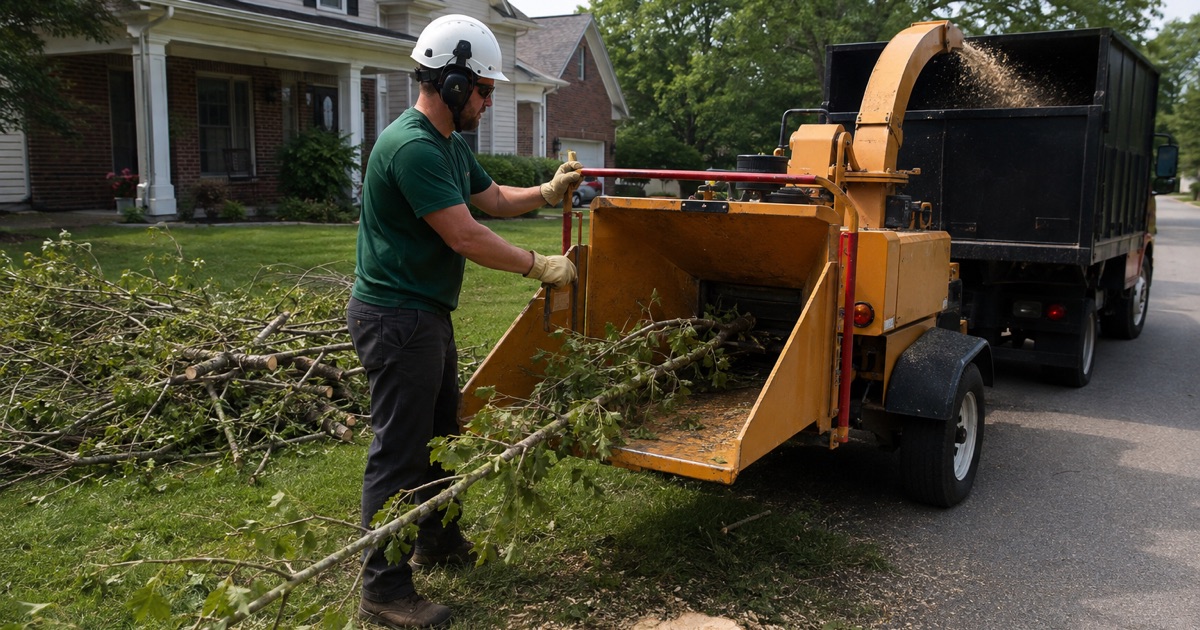
Worker at the chipper’s control bar feeding cut limbs in from the side of the infeed on a Madison driveway apron.

Stump Grinding Against Full Stump Excavation

Grinding uses a cutting wheel with carbide teeth to reduce the stump and the main flare to chips in place, leaving a mound of grindings and a shallow depression. Excavating pulls the root plate whole and leaves a genuine hole plus a disposal problem. Grinding is the right answer on almost every finished lot; excavation belongs on a site about to be graded anyway.

Grinding Depth Below Grade and Machine Class

Limestone bedrock under Madison’s dominant upland soils sits more than six feet down, so what limits a grind here is the machine, not the rock. Rated cut runs roughly 12 to 25 inches below grade depending on machine class, and because the rock is not in the way we can commit to a depth in writing rather than hedging it.

Surface Roots and the Grindings Crater

Grinding the stump does not remove the surface roots radiating out from it, and those keep showing up in a mower for years unless they are chased. The other surprise is volume: a stump produces far more grindings than the hole can hold, so the estimate says whether that mound is spread, hauled off, or left for you.

Whether Madison Will Take Your Brush

The city’s brochure is explicit that if commercial workers or professional lawn services are used, they should dispose of the waste they generate and cannot put it out for collection. So the answer for a hired removal is no, every time. Brush from your own weekend pruning is a different matter and follows the household rules below.

Volume Caps, Limb Lengths and What Sits Past Them

Republic Services collects five cubic yards per household per week in Madison, roughly a pickup bed, and limbs must be cut in lengths not exceeding eight feet with protruding branches trimmed and placed in a neat pile. Going past five cubic yards is not fined; the excess simply waits for the following week, which is a slow way to clear a fallen tree.

Landfill Gate Fees and the Separate Wood Line

Our disposal is weighed and charged at the gate, and wood, brush and chips do not price the same per load. That is why the wood line on your estimate is quoted separately from the takedown instead of buried inside it, and why choosing to keep the rounds visibly changes the number rather than vanishing into a discount.

Keeping the Wood and the Firewood Credit

Say the word and the crew leaves the trunk cut to stove length and stacked where you want it, and the estimate shows the credit for the loads that never went to the landfill. Take the wood or leave it, the arithmetic is on the page either way, so nobody is guessing what the firewood was worth.

Wood Chips Left, Hauled or Spread as Mulch

The brush chipper produces a usable mulch, and you can have it blown into a bed, dropped in a pile, or taken away entirely. Fresh chips belong on the surface around beds and trees, never dug into a planting hole and never mounded against a root flare, which is the mistake that starts the decline we were called out to stop.

Lot Clearing and Forestry Mulching

A forestry mulcher grinds standing brush and small stems into a mulch layer in one pass, with no burn pile, no hauling and no exposed soil left behind. On a wooded build site that is usually faster and cheaper than cut-and-haul, and the retained mulch layer holds the surface until the grading contractor arrives. Larger stems still come out by conventional removal.

Tree Protection Zones During Construction

Somebody is paying to keep the trees left on a construction site, and Madison’s ordinance recognizes that: an existing tree earns preservation credit only when it is marked to be saved, protected by a durable physical barrier, and kept to a grade cut or fill under eighteen inches. We set the tree protection zone before the equipment arrives, not after the roots are gone.

Areas We Serve

Madison Tree Removal Pros provides tree-removal throughout the greater Madison area, with the same crews and the same standards on every job.

Good to know

Frequently Asked Questions

What does tree removal cost in Madison, AL?

Four things drive the price, and none of them is the calendar: the tree's size and lean, what it can hit if it moves, the access a crew and its machines have to it, and where the wood, brush and grindings end up. That is why our estimate splits the takedown, the stump and the debris haul onto separate lines. A tree over a roof needing a crane and a tree in an open side yard are different jobs at the same trunk diameter.

Do I need a permit to remove a tree on my own property in Madison?

For a tree on a finished single-family residential lot inside the city, no. The City of Madison's Official Zoning Ordinance has no tree removal article and no removal permit section, and its landscaping rules apply in all districts other than single-family detached dwellings. Two things can still bind you: a recorded HOA covenant, and the Airport Impact Overlay or the Redstone Arsenal overlay if your tree reaches a regulated height.

Is the estimate free, and what does it actually include?

It is free and it is written. Each estimate itemizes the takedown, the stump and the debris haul separately, states plainly whether haul-away is included, and shows the firewood credit if you want the rounds left cut and stacked. It also records the access we measured — gate width, drop zone, carry distance — because those decide the crew and the equipment. Nothing appears on the invoice that was not on the estimate.

How quickly can you respond after a storm?

Storm and hazard calls get same-day response, and a blocked drive, a compromised roof or a leaner over an occupied room moves ahead of scheduled trimming. There are limits we state rather than talk around: crews cannot hold safe approach distances from energized conductors in high wind or an ice load, and work near a service line waits for the utility disconnect. We tell you which applies when you call.

Do you grind the stump, and how deep does it go?

Yes, with a stump grinder whose cutting wheel and carbide teeth reduce the stump and the main flare in place. Rated cut typically runs about 12 to 25 inches below grade depending on machine class. On Madison's dominant upland soils limestone bedrock sits more than six feet down, so the machine rather than the rock sets the depth, which means we can commit to a number in writing.

What happens to the wood, the brush and the grindings?

Your choice, stated on the estimate. Wood leaves with us or stays cut to stove length and stacked, with the credit shown either way. Chips can be blown into a bed as mulch, left in a pile, or hauled off. Grindings can be spread, removed, or left as the mound they make. What cannot happen is leaving the pile at the curb, because the city refuses debris generated by hired workers.

Is tree work licensed in Alabama?

Partly, and the licensed category is narrower than most people expect. Alabama's tree surgery definition covers cavity filling, repair, bracing, cabling and wound treatment, and it expressly excludes pruning; removal is not named in it at all. The industry's own credentials — the ISA Certified Arborist credential, the ISA Tree Risk Assessment Qualification, TCIA accreditation, an ASCA Registered Consulting Arborist — are voluntary qualifications rather than state licenses.

Can you work on a tree that is touching a power line?

Not until the line is dealt with. Huntsville Utilities states that clearing trees off the pole-to-house service wire rests entirely with the customer, so we arrange the disconnect before anyone climbs. Primary conductors on the poles belong to the utility and are their crews' work. Which provider you call depends on the county: Huntsville Utilities on the Madison County side, Athens Utilities on the Limestone County side.

Does the airport or Redstone Arsenal affect a tree on my lot?

It can. Madison's Airport Impact Overlay regulates the height of natural growth as well as structures, starting at twenty-five feet above ground level in the innermost obstruction free area, which is under the mature height of most shade trees planted here. The Redstone Arsenal overlay adds vertical obstruction limits inside the Department of Defense imaginary surfaces around Redstone Army Airfield, with a variance route rather than a flat ban.

How long does a removal take from the first call?

Hazard work runs same day; routine removals are scheduled, and the honest driver of the date is equipment rather than crew. A crane lift over a house has to be booked, a tracked lift for a fenced back yard has to be free, and a utility disconnect runs on the utility's calendar. We tell you which of those your job needs at the estimate, so the date you get is one we can hold.

Ready to Get Started?

Request a free quote today and we'll get back to you fast.