
Madison Tree Removal Pros does tree planting and transplanting in Madison, AL, and it is deliberately the least glamorous page on this site, because planting is where the next thirty years of a yard get decided in about an hour. Twenty years of removing trees is a useful qualification for planting them: we spend a great deal of time taking out trees that were the wrong species, in the wrong place, planted at the wrong depth.
The three failures repeat endlessly. A tree planted too deep, with its root flare buried under nursery soil and then mulch, spends a decade slowly girdling itself. A tree chosen for how fast it grows rather than for the site it is going into becomes a removal quote in twenty years. And a tree planted under a service drop or inside a height overlay is a maintenance problem the day it reaches size.
None of that is expensive to avoid. It costs a conversation about what the space actually is — soil, drainage, sun, overhead wires, distance from the foundation and the drive, what the mature canopy will reach — and then five extra minutes at the hole finding the flare. That is essentially the whole service, and it is the reason a planted tree either establishes or quietly declines.
Choosing a Species for the Site
Reading the Site Before the Catalog
The site sets the shortlist, not the other way around. Depth and drainage of the soil, hours of direct sun, competition from established canopy, the volume of soil available between a drive and a foundation, and what is overhead all narrow the options quickly. We would rather rule out half the nursery in ten minutes on site than have you fall for something that will be unhappy for its whole life.
Species Worth Thinking Twice About
Bradford pear crowds its branches into a narrow band with included bark in nearly every union and splits predictably in a spring storm. A Leyland cypress row planted tight as a fast screen sets up competition and Seiridium canker down the line. Silver maple grows quickly and breaks easily. None of these is banned; all of them should be a decision rather than a default.
Ash, Emerald Ash Borer and Replacement Planting
The Alabama Forestry Commission confirmed emerald ash borer in Madison County on June 6, 2025, which changes the calculation on planting ash here. Where an ash has been lost, the sensible replacement strategy is diversity rather than another of the same, because a street or a yard planted to one species is a street that loses its canopy all at once.
Getting the Planting Right
Finding the Root Flare Before Digging the Hole
Nursery stock frequently arrives with several inches of soil over the flare from repeated potting or balling, so the top of the root ball is not the top of the roots. We excavate down to the flare first and measure from there. Planting to the root ball rather than to the flare is how a tree ends up four inches too deep before anyone has made a mistake in the hole.
A Wide Hole, Not a Deep One
Roots spread laterally far more than they descend, so the hole wants to be two to three times the width of the root ball and no deeper than the ball measured from the flare. The sides get roughened rather than left glazed by the shovel, and the backfill is the native soil rather than a rich pocket that discourages roots from ever leaving it.
Mulch, Water and the First Two Summers
A wide, thin mulch ring that never touches the trunk, deep infrequent watering rather than daily sprinkling, and no string trimmer within reach of the bark: those three habits carry a new tree through establishment. The critical window here is the first two summers, and a tree that is watered attentively in year one and abandoned in year two frequently fails in year three.
Transplanting an Established Tree
What a Root Ball Can Realistically Carry
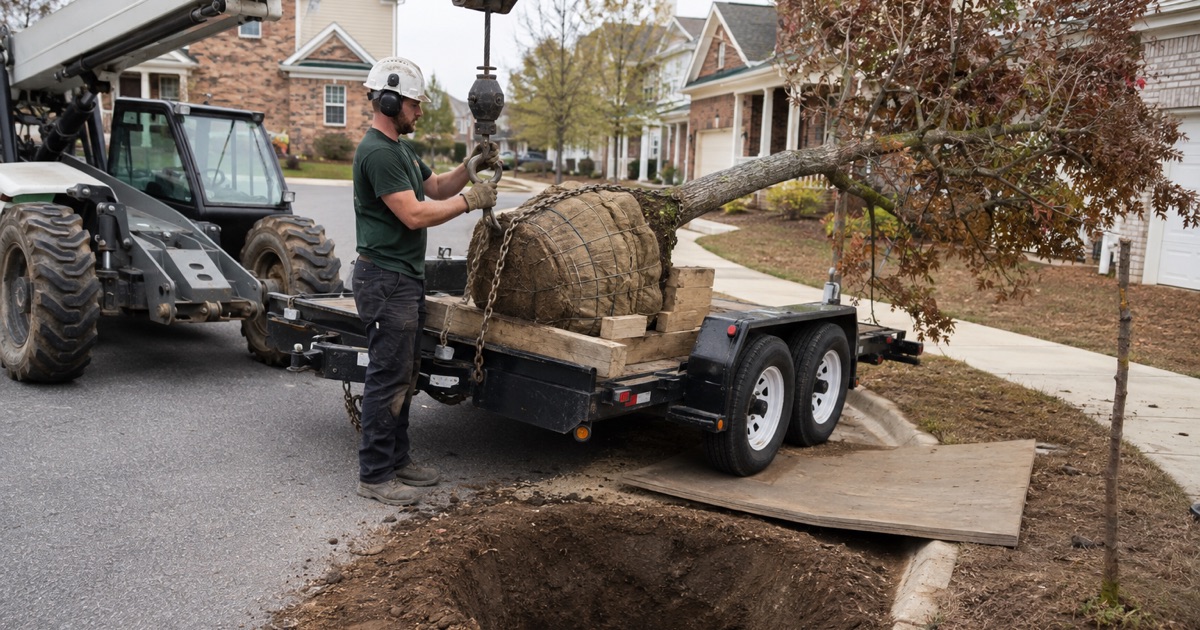
Moving a tree removes most of its absorbing roots, and the tree has to run on stored reserves until it rebuilds them. That sets a practical size limit for any given species and method, and weight sets another — a soil ball big enough to matter is extremely heavy. We will tell you where a tree sits against those limits rather than take the job and hope.
Timing, Root Pruning and the Season That Works
Transplants go best in the dormant season, when the tree is not trying to support a full canopy. Where there is time to plan, root pruning a season ahead encourages fibrous roots to develop inside the eventual ball and improves the odds considerably. Emergency moves ahead of construction are possible and carry more risk, and we say which one you are buying.
Aftercare, and Why Most Transplants Fail
The move is not the hard part; the two summers afterward are. A transplanted tree needs consistent deep watering, mulch over the root zone, and protection from any further root disturbance, and it will look thin for a season or two while it rebuilds. Staking, where it is needed at all, comes off after a year so the stem can develop its own taper.
Planting Around What Is Already There
Overhead Wires and Mature Height
A tree planted under a service drop is a pruning bill forever, and the pole-to-house wire is the customer’s responsibility to keep clear according to Huntsville Utilities. Small-maturing species go under wires; shade trees go out from under them. The five minutes spent looking up before choosing the spot is the cheapest maintenance decision available on the whole property.
Overlays, Height Limits and What May Grow
Madison regulates the height of natural growth under both the Airport Impact Overlay, which starts at twenty-five feet above ground level in its innermost obstruction free area, and the Redstone Arsenal overlay around Redstone Army Airfield. Both regulate natural objects being allowed to grow, not just structures being built. On an affected lot, mature height is a compliance question rather than a preference.
Foundations, Drives and Root Room
Roots go where the air and water are, which is why they surface beside slabs and lift drives. Giving a shade tree enough soil volume and enough distance from a foundation, a driveway edge or a septic field at planting is the only reliable fix; everything after that is management. Madison’s own preservation credit rules use a similar logic, requiring planting area and clearance from the curb.
- 20+ Years in the Tennessee Valley
- Free Written Estimates
- Crane and Narrow-Access Equipment