Madison Tree Removal Pros handles shrub removal, hedge removal and brush clearing in Madison, AL, and it is the same crew and the same equipment that does the tree work — which matters more than it sounds. Shrub jobs go wrong in exactly the places tree crews are equipped for: root balls that will not lift, stems grown into a fence, and a volume of material that turns out to be three loads rather than one.
The two decisions that set the price are whether the roots come out and where the material goes, and both get written on the estimate rather than assumed. Cutting to the ground is cheap and, on most of what grows here, temporary. Hauling is a real cost with a gate fee attached, and it is not optional after a hired job, because Madison will not collect a contractor’s pile.
What we clear ranges from a row of tired foundation plants to a fence line nobody has been able to see for three seasons. Around here that overgrowth is usually the same short list — privet, bramble, elaeagnus, honeysuckle, volunteer sweetgum and hackberry seedlings — and each of them comes back differently, so knowing what you have decides whether one visit finishes it.
Shrub and Hedge Removal, Root Ball Included
Overgrown Foundation Plantings
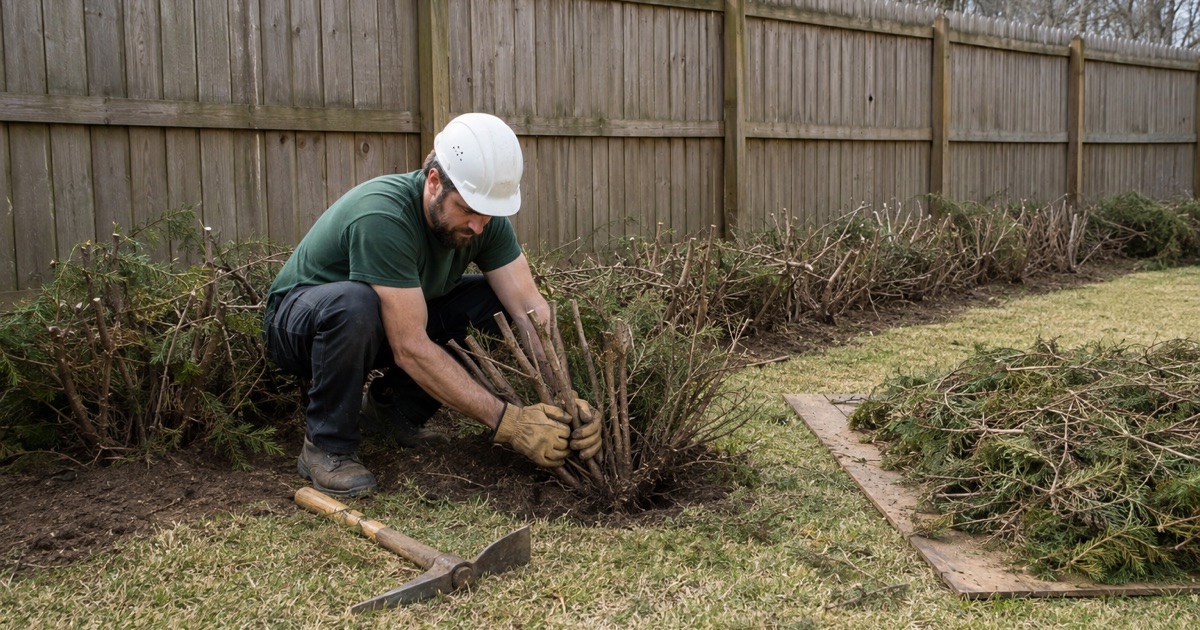
The hollies and ligustrum planted when a house was built are usually the ones now covering the windows and holding moisture against the siding. Taking them out is straightforward; doing it without hitting irrigation, downspout drains, gas service or landscape lighting is the actual skill. We locate what is in the bed before anything is dug, then lift root balls out rather than shearing stems.
Hedge Rows and Volunteer Growth
A hedge that stopped being maintained becomes a row of small trees with a shared root mass and a fence somewhere inside it. Removal means freeing the stems from the fabric, dropping them in sections where there is no room to fell, then working the root balls out along the line. Volunteer sweetgum, hackberry and mulberry seedlings in the row come out at the same time.
Roots, Regrowth and What Is Left Behind
Privet, nandina, elaeagnus and most of what grows unmanaged here will resprout enthusiastically from a cut stump, so a job that stops at ground level is a job you are paying for twice. Where a root ball genuinely cannot be lifted — against a foundation or a slab — we grind it out instead, and we tell you which method a given plant is getting.
Brush Clearing and Fence Line Recovery
Fence Lines, Ditch Banks and Property Edges
The edges are always worse than the middle, because nothing has been mowed there in years and birds have been planting seed along the wire. Clearing a fence line means cutting stems off the fabric without tearing it, pulling vine mats away by hand where the wire is fragile, and taking the material out to the truck rather than pushing it into the neighbor’s side.
Bramble, Privet and Heavy Vine Mats
Chinese privet and bramble form thickets dense enough to hide grade changes, stumps, old wire and drop-offs, which is why we walk a site on foot before quoting it. The clearing itself is straightforward; the pricing depends on stem density and on how far the material has to be carried. Both get established in the walk rather than discovered on the day.
Poison Ivy and What Gets Handled Differently
Poison ivy is not chipped and it is not burned, because both put urushiol where people breathe it, and a chipper discharge coats everything downwind. We identify it, cut and remove it separately, and warn you where it was. Large vines climbing a tree get severed at the base and again higher up, then left to die back before removal rather than pulled down green.
Where the Material Goes
Chipping On Site Against Hauling Out
Green brush chips well and the resulting mulch can stay on the property in beds or along a tree line, which removes truck movements and the gate fee with them. Where there is nowhere sensible to put it, or where the material is diseased or full of vine, it leaves. The estimate names which option you are buying and prices them differently.
Why the City Will Not Take a Contractor’s Pile
The city’s brochure refuses waste generated by commercial workers and professional lawn services outright, and separately refuses contractor material. That is not a Republic Services quirk, it is written policy, and it is the single most common misunderstanding on a clearing job. Disposal is quoted as its own line for exactly that reason rather than left as an assumption that fails at the curb.
Volume, Loads and How the Number Is Built
Brush prices by the volume it becomes, not by the area it covered, and a thicket compacts far less than people expect. We estimate loads from stem density and average height, add the carry distance from the work to the truck, and quote the clearing and the disposal separately so a change on the day — you decide to keep the chips — moves a visible number.
Replanting, Grading and What Comes Next
Leaving the Bed Ready to Replant
A bed cleared properly should be plantable, which means root balls out, the surface raked level, and the leftover woody material removed rather than turned into the soil where it would tie up nitrogen. If a replant is planned we will say what the soil needs and where the old root mass sat, so the new shrub is not put straight back into the same hole.
Bare Soil and Erosion After Clearing
Stripping a slope or a ditch bank leaves soil with nothing holding it through the next heavy rain, and this valley delivers those in volume. Where the ground falls away we leave a chip layer as temporary cover, keep the lowest band of vegetation where it is doing structural work, and tell you what to seed. Clearing to bare dirt on a bank is a decision, not a default.
- 20+ Years in the Tennessee Valley
- Free Written Estimates
- Crane and Narrow-Access Equipment