Madison Tree Removal Pros provides emergency tree removal in Madison, AL and the surrounding cities including Huntsville, Redstone Arsenal, Triana, Harvest and Athens, with more than twenty years of storm response in the Tennessee Valley behind the crews. Storm calls get same-day response, and they get something rarer: a straight account of what can be done tonight, what has to wait for a utility, and what has to wait for the wind to drop.
That honesty is the service. After a significant storm every crew in the valley is committed, and the difference between companies is not who claims to be fastest but who tells you accurately where you sit in the queue and what can be made safe in the meantime. A crew that promises an hour and arrives the following afternoon has cost you the chance to call someone who could.
The other half is knowing when not to cut. A tree that has fallen still holds enormous stored energy, a lifted root plate can drop the stem back the other way, and an energized service drop under a limb changes the job from a removal into a coordination problem. Every one of those is a reason to slow down for ten minutes, and each of them has hurt somebody who did not.
What Counts as an Emergency and What Can Wait
Trees On or Against a Structure
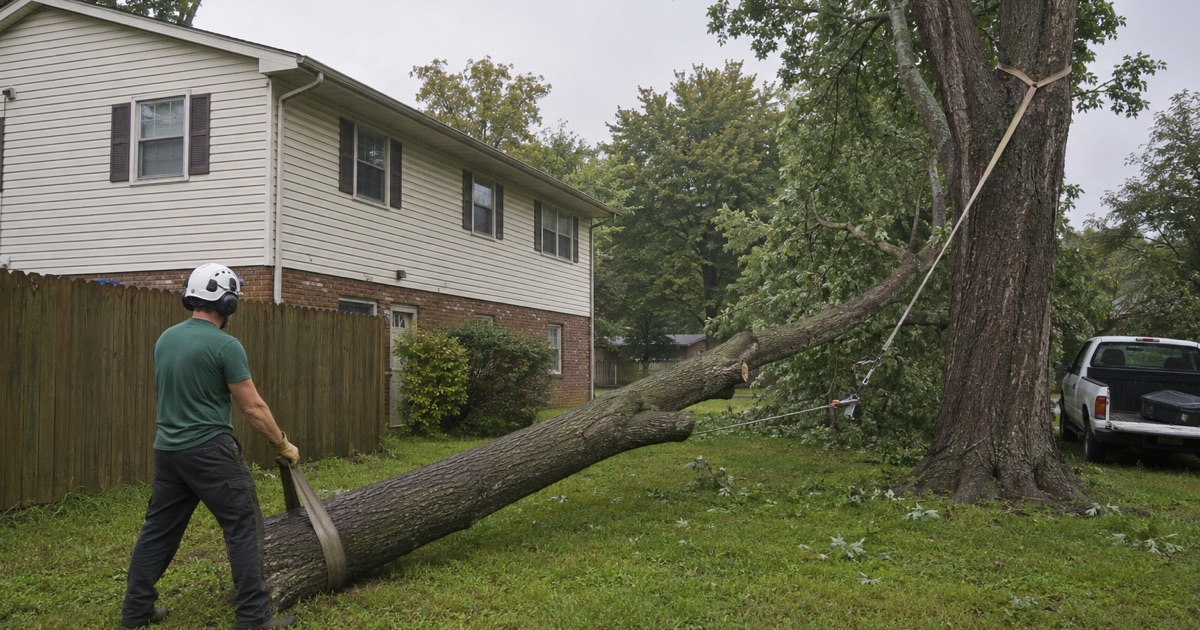
Anything resting on a roof, a wall or a deck is emergency work, because the load is live and the structure is being asked to carry it continuously. Rain entering through the breach does more cumulative damage than the impact did. We stabilize and remove in sections, and we can tarp the opening so the interior stops taking water while the rest of the job is arranged.
Leaners, Lifted Root Plates and Hangers
The tree that is still standing is often the dangerous one. Look at the ground on the side away from the lean: cracked or heaved soil means the plate has moved and the tree is mid-failure. Hangers — limbs broken out and caught in the canopy — are the other silent hazard, because they come down without warning on a still day weeks later.
Blocked Access, Utilities and Ways Out
A tree across the only driveway, over a gas meter, on a septic field or against the door of an occupied building is an emergency regardless of what it weighs. We can usually open access quickly as a first, separate visit, cutting only what is needed and leaving everything else stable, so people can get out and vehicles can get in while the full removal gets scheduled properly.
The First Hour on a Storm Site
Securing the Scene Before Any Cutting
Nothing gets cut until the scene is walked. That means identifying every wire and assuming all of them are live, marking the exclusion zone, checking for a gas meter under the debris, and looking for the second and third hazards behind the obvious one. The tree that is down has already done what it was going to do; the crew’s risk is in what is still standing.
Reading Stored Energy in a Loaded Stem
A trunk bent across a rafter, a limb pinned under its own crown, a stem holding a root plate half out of the ground: all of these are springs. Cut them in the wrong order and they release in a direction nobody planned for. The crew works out where the compression and tension are before the first cut, and cuts to release load progressively rather than all at once.
Rigging Against the Load Rather Than Felling
On a damaged structure we almost never fell the remainder — we take it apart in pieces and lower each one under control on a bull rope through a rigging block, with a Port-a-Wrap taking the friction at the base. It is slower than dropping it and it is the reason the roof does not take a second impact from the crew that came to fix the first one.
Electricity Is the Limiting Factor
Service Drops, Primary Conductors and the Disconnect
The pole-to-house service drop and the primary conductors on the poles are two different problems with two different owners. Huntsville Utilities is explicit that clearing trees off customer service wires is the customer’s responsibility, which means we arrange the disconnect and work once it is confirmed. Anything involving the primary is the utility’s crews, on their timetable, and no reputable company works around that.
Approach Distances and the Standard Behind Them
ANSI Z133, the safety standard for arboricultural operations, sets minimum approach distances to energized conductors for workers who are not qualified line clearance arborists. Those distances are not a suggestion and they are not waived because a customer is anxious to have a driveway back. When we say a job waits for a disconnect, that is the reason, and we would rather say it at the door than halfway up.
Why Wind and Ice Stop the Work
Approach distance assumes you can control where the limb goes. In a strong gust or under a glaze load you cannot: the piece moves after it is cut, and the margin that made the job safe disappears. High wind also makes climbing and crane work unsafe on its own terms. We will secure a scene in those conditions and come back, and we will not pretend that is a scheduling failure.
The Storms This Valley Actually Gets
Tornado Damage and What a Crew Does First
This area’s storm record is made of dated events rather than an average. On April 27, 2011 the National Weather Service Huntsville forecast area recorded thirty-nine tornadoes, including an EF4 in Madison County with a 27.2-mile path 880 yards wide. In that kind of damage the first hour goes on triage across a whole neighborhood: leaners, hangers and lifted plates found and marked before any single tree is cut.
Straight-Line Wind, Downbursts and Saturated Ground
Most of our storm calls are not tornadic. A downburst delivers a straight, sustained push, and after several days of rain the soil around a root plate has lost much of its grip, so trees that would have held in August come out in a March squall. Whole-tree failures cluster in saturated conditions, while dry-season storms tend to break limbs instead.
Ice Load and the Unions That Fail First
Glaze adds weight the tree never grew wood for, and it loads the outer canopy where the leverage is greatest. The first things to go are the fast-growing, weak-wooded species and any union with included bark between co-dominant stems. A union splitting takes half the crown with it, which is why we look at those unions before an ice event rather than clearing up after one.
Once the Tree Is Down
Documentation the Adjuster Can Use
We photograph the failure point, the position of the tree, what it struck and the debris field before we move anything, and the removal scope goes in writing. That record is what separates a storm failure from a defect that had been visible for years, which is a distinction your insurer will make whether or not anyone documented it. Ten minutes of photographs is the cheapest part of the claim.
Storm Debris the City Will Not Collect
Madison’s trash brochure states that waste generated by commercial workers and professional lawn services cannot be put out for collection, and separately refuses contractor material. So once a hired crew has cut a storm-felled tree up, the pile at the curb is not a city problem, and the haul is quoted as its own line. Household brush from your own pruning follows the ordinary five cubic yard rules.
- 20+ Years in the Tennessee Valley
- Free Written Estimates
- Crane and Narrow-Access Equipment