Madison Tree Removal Pros provides arborist services in Madison, AL — tree risk assessment, condition documentation and diagnosis of declining trees — serving surrounding cities including Huntsville, Redstone Arsenal, Triana, Harvest and Athens. More than twenty years of tree work in the Tennessee Valley is the credential that counts on this page, because reading a tree correctly depends on knowing what the ground under it does and what the local ordinance says about how tall it is allowed to get.
An assessment from us is a deliverable, not a sales call. It is quoted on its own, it is written down, and it stays useful whichever way the answer falls: remove the tree, cable it, treat it, or leave it alone and look again in two years. A free look from a company that only earns money by removing trees is a quote with an opinion attached, and most homeowners can feel the difference.
What ends up in the report is measurable rather than adjectival: diameter at breast height, root flare condition, decay evidence, union geometry, live crown ratio, and what stands within reach if the tree fails. In Madison that last item can be a height limit rather than a building, because the Airport Impact Overlay and the Redstone Arsenal Military Compatibility Area Overlay both regulate how tall natural growth is permitted to become.
What an Arborist Does That a Tree Cutter Does Not
Diagnosis Before a Removal Quote
A declining tree has a cause, and the cause decides whether removal is the answer or an expensive way to avoid finding out. Buried root flares, compacted soil, girdling roots, a severed root plate from a driveway pour and a genuine pathogen all produce thinning crowns that look identical from the street. We separate them before anyone quotes a takedown, because three of those five are treatable.
Reading the Root Flare, Not the Canopy
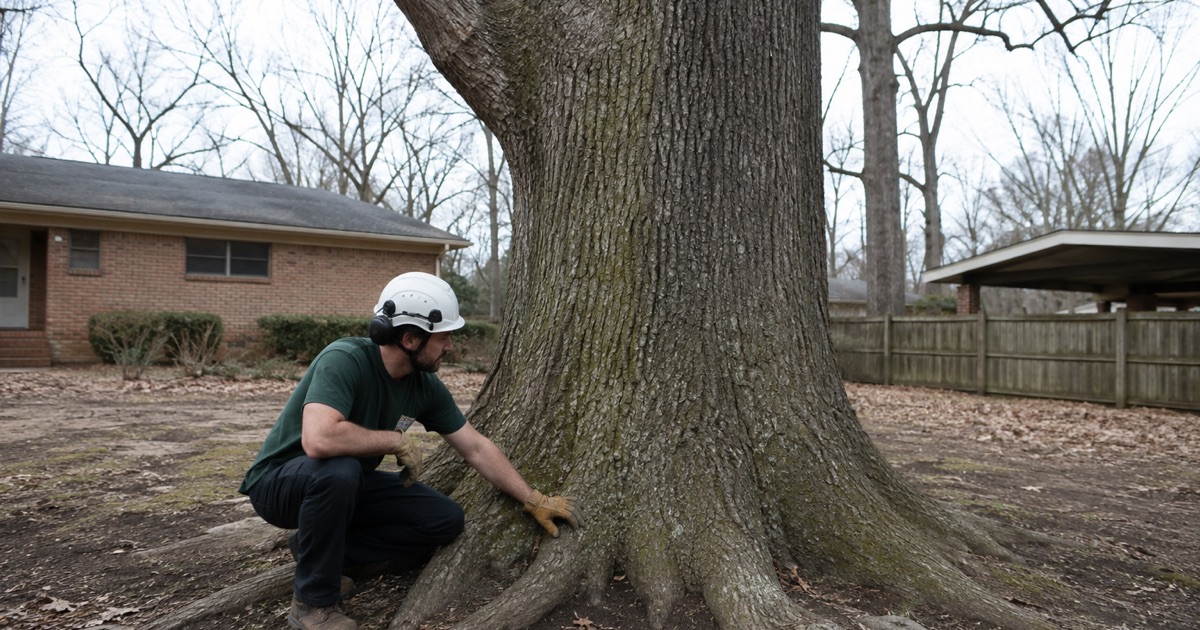
Canopy condition is the last thing to change and the first thing people look at, which is why a tree can be structurally finished while still leafing out convincingly. The root flare tells the truth earlier: a stem that enters the ground like a telephone pole is buried or girdled, and a conk at the collar means decay in the part of the tree that carries every load.
Naming the Defect Instead of the Verdict
“It looks bad” is not something a board, an adjuster or a neighbor can act on. Our findings name the specific defect — included bark between co-dominant stems, a decay column of measured extent, a lifted root plate, a hanger left from a storm — and state where it sits on the stem. A named defect can be argued with, checked, and monitored over time.
Tree Risk Assessment, Target by Target
Target, Likelihood and Consequence Assessed Separately
Risk is not a property of a tree. It is the product of how likely the part is to fail, how likely it is to hit something if it does, and how bad that would be, and the ISA Tree Risk Assessment Qualification framework keeps those three separate on purpose. A hollow trunk in an open pasture and a modest deadwood hazard over a child’s bedroom sort very differently once you do that.
Occupancy Rate and What Sits Under the Crown
We record what is actually beneath the crown and how often it is there: a driveway used twice a day is a different target from a patio table used every evening, and a detached garage is a different target from an occupied bedroom. Occupancy is the variable homeowners consistently underweight, and it is often the one that moves a marginal tree onto the removal list.
Resistance Drilling and When Instruments Earn Their Place
Most defects are diagnosed by inspection, mallet sounding and excavation, and reaching for a tool first is a way of looking thorough rather than being thorough. Where the question is genuinely how much sound wood remains in a stem — a significant tree, a high-consequence target, a decision somebody will contest — resistance drilling produces a trace that can be filed with the report instead of an estimate.
The Defects We Document in Tennessee Valley Trees
Co-Dominant Stems and Included Bark
Two stems of similar diameter competing from one point rarely form real wood between them; bark gets folded into the union instead, and that union is a wedge waiting for a wind or ice event. Silver maple and Bradford pear do it as a habit. We record the union’s depth, any crack, and whether a cabling system could carry it before the crack decides for you.
Decay Columns, Bracket Fungus and Root-Flare Conks
Fruiting bodies are the visible end of a process that started years earlier inside the stem. A bracket fungus on the trunk indicates a decay column above and below where it emerges, and a conk at the root flare is the more serious of the two because that wood carries the whole tree. Both get located, measured against stem diameter and photographed for the record.
Pest Evidence: Borers, Beetles and Canker
The Alabama Forestry Commission confirmed emerald ash borer in Madison County on June 6, 2025, and calls southern pine beetle the number one killer of pines in the state. Both leave evidence a walk-past misses: crown dieback beginning at the top on ash, and pitch tubes that may be very small or absent on a drought-stressed pine, with boring dust in the bark plates instead.
Written Reports for Insurance, HOAs and Airport Overlays
Reports an Adjuster Can Act On
An insurer responds to dated evidence, not to a recollection. Our claim reports state what failed, where it failed on the stem, what it struck, and what the removal scope covers, with photographs taken before anything was moved. That documentation is also what separates a storm failure from a long-neglected defect, which is a distinction the adjuster is going to make with or without you.
HOA Boards, Covenants and the Six-Inch Threshold
Most Madison-area declarations turn on a handful of exceptions: dead or diseased trees, trees less than six inches in diameter, trees that must come out for safety, and trees standing where an approved building will go. A board is not really asking for an opinion, it is asking which exception applies. We write to that clause, with the measurements that support it, so the submission does not bounce.
Overlay Height Questions Near Redstone Army Airfield
Madison regulates natural growth under two overlays at once: the Airport Impact Overlay, which starts at twenty-five feet above ground level in its innermost obstruction free area, and the Redstone Arsenal overlay covering Department of Defense imaginary surfaces, a five-mile wildlife strike hazard area and a two-mile land use radius. We document height, position and growth rate for a variance application rather than guessing at compliance.
Our Step-by-Step Tree Risk Assessment Process
Step 1: Site Walk and Target Inventory
We start by recording what could be hit rather than by looking at trees: structures, drives, play areas, utilities, boundaries and how often each is occupied. Doing it in that order stops the assessment being led by whichever tree looks most dramatic, and it is what makes the finished report usable for a whole property rather than a single stem.
Step 2: Ground-Level Inspection and Measurement
Each tree in scope gets species identification, diameter at breast height, live crown ratio, lean and root plate condition, plus an excavated look at the root collar where the flare is not visible. Defects are located on the stem and photographed with a scale in frame, because a photograph without a reference is evidence of nothing in six months’ time.
Step 3: Aerial or Instrumented Inspection Where Warranted
Some findings cannot be made from the ground. A suspected union crack, a hanger, or decay above the first branch may need a climbing inspection on a saddle, and a contested stem may need resistance drilling. This step is priced only when the ground-level findings call for it, and the report says which trees got it and why.
Step 4: Written Findings and Mitigation Options
The report ranks options rather than issuing a verdict: retain and re-inspect on a stated interval, prune to a named ANSI A300 objective, install a cabling or bracing system, treat the soil, or remove. Each carries its own scope so it can be priced or shopped, and nothing in the document depends on us being the crew that does the work.
- 20+ Years in the Tennessee Valley
- Free Written Estimates
- Crane and Narrow-Access Equipment