
Madison Tree Removal Pros does land clearing in Madison, AL and across the surrounding cities including Huntsville, Redstone Arsenal, Triana, Harvest and Athens, with more than twenty years of removal and mulching work in the Tennessee Valley behind it. Clearing is the one service where the decision that matters most gets made before any machine starts: what stays, what goes, and what the ground has to look like when everyone leaves.
Getting that order wrong is expensive in a way that is invisible for about a year. A parcel cleared to the boundary with no protection zones set, no drainage consideration and no thought given to which trees were structurally suited to standing alone produces exactly two results — a bare lot that sheds soil in the first real storm, and a handful of retained trees that die slowly afterward from root damage nobody logged.
So we walk the parcel with you first and mark it in three categories: mulch, remove conventionally, and protect. That walk sets the machine mix, the disposal plan and the price, and it is also where Madison’s own rules enter the conversation, because on a development site the zoning ordinance has opinions about natural vegetation, buffers and what a preserved tree has to be protected with.
What Land Clearing Means on Your Lot
Selective Clearing Against a Clean Sweep
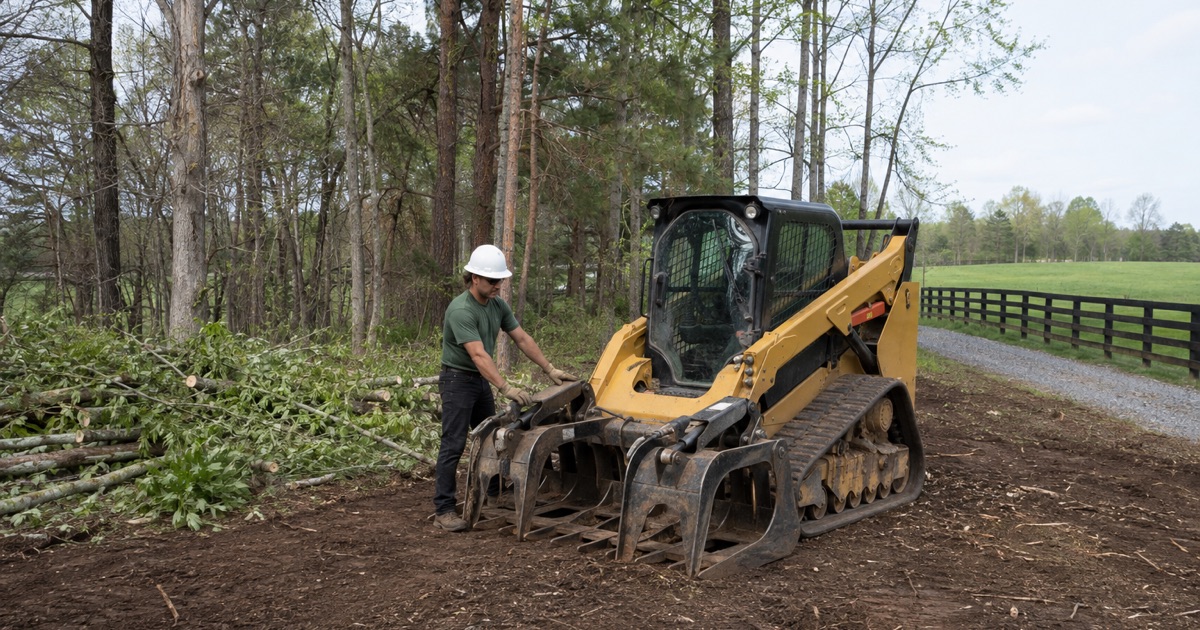
Most jobs we quote are selective: understory and small stems removed, canopy trees of value retained, boundaries and drainage ways left vegetated. A clean sweep is faster and cheaper per acre and appropriate on a site heading straight for cut and fill. Deciding which one you are buying is the first question, because a selective job priced as a sweep produces a lot that cannot be undone.
Forestry Mulching in a Single Pass
A forestry mulcher carries a rotary drum that reduces standing brush and small stems to chips where they stand. One machine, one pass, no burn pile, no hauling, no bare soil left exposed, and no truck traffic in and out of the site. On overgrown ground with a lot of stem count and modest diameter, it is usually both the fastest and the least disruptive way to get the parcel back.
Conventional Cut, Haul and Grub
Larger timber, anything that has to leave the property, and any site that will be graded still calls for the conventional sequence: fell, buck, load out, then grub the stumps and root plates with an excavator. It leaves the site truly clean rather than covered, and it produces material and cost — gate fees at the landfill, truck movements — that we quote as their own lines rather than hiding in a per-acre rate.
Site Types We Clear Around Madison
Wooded Residential Build Sites
A wooded lot bought for a house is the most common clearing job in this ring, and the one where retained trees matter most to the finished value. The building envelope, the drive, the septic or sewer run and the equipment laydown area all get cleared; everything else is a decision. Trees along the rear boundary are usually worth keeping and are usually the ones nobody protected.
Pasture Reclamation and Fence Line Recovery
Pasture that has gone three or four seasons without a bush hog comes back as sweetgum, privet, blackberry and cedar, and fence lines are always worse than the field. Mulching takes both back in a pass and leaves a layer that slows the regrowth. It also lets you see the fence, which is generally the point, and it does not leave a pile you then have to deal with.
Commercial Pads, Laydown Yards and Access Roads
Commercial work runs to a different clock and a different set of rules. On a site subject to Madison’s landscaping and buffer requirements, the natural vegetation along property lines and rights of way is part of an approved plan rather than an obstacle, and clearing it because it was in the way is a plan revision nobody wanted. We clear to the plan and document what was left standing.
Trees Worth Keeping, and How the Ordinance Sees Them
Preservation Credit and the Tree Protection Zone
Madison’s ordinance will credit an existing tree toward required planting, but only on conditions: adequate caliper, a live crown that is a real proportion of tree height, freedom from serious root, trunk and crown injury, marking on the plan as a tree to be saved, a durable physical barrier during construction, and grade cut or fill kept under eighteen inches. We set that barrier at the drip line before the first machine arrives, not after.
Edge Trees After the Stand Opens Up
A tree that grew inside a closed stand put its wood where the load was, which was mostly nowhere, because its neighbors carried the wind. Take those neighbors away and the retained tree is suddenly exposed on three sides with a high crown and a slender stem. That is why so many preserved trees fail two or three winters after the clearing, and why we assess retention candidates on taper and crown position rather than on how green they look.
Buffers, Frontage and Natural Vegetation Rules
The ordinance requires natural vegetation, especially trees and shrubs, to be preserved along property lines including fence rows and drainage ways and worked into the landscape plan, with unhealthy or nuisance material removable where the plan identifies it. Buffers along public street frontage carry their own planting rate. Reading those requirements before clearing rather than after is the difference between a credit and a replanting bill.
Debris, Burning and What Leaves the Site
Mulch Left in Place as Erosion Cover
The residue from mulching is not waste to be dealt with, it is the cheapest erosion control available and it is already exactly where you need it. A mulch layer takes the impact out of heavy rain on freshly disturbed ground and slows the regrowth of everything that was just cut. On sloped ground above a drainage way, that layer is doing more work than anything you could seed.
Grinding, Chipping and Hauling Off
Where material has to leave, it leaves as chips, as logs, or as grindings, and each prices differently at the gate. Merchantable timber occasionally offsets part of a job; more often it does not, and we will say which rather than implying a credit that never appears. Whatever leaves is a stated line on the estimate, so the disposal cost is visible instead of buried in an acreage number.
Ash Disposal and Emerald Ash Borer
The Alabama Forestry Commission confirmed emerald ash borer in Madison County on June 6, 2025, and its guidance is that infested ash which has been cut down should preferably be burned or destroyed on site to slow the insect’s dispersal. That makes ash a special case in any clearing plan around here: moving the wood is how the pest travels, so the disposal method gets decided on site rather than by default.
- 20+ Years in the Tennessee Valley
- Free Written Estimates
- Crane and Narrow-Access Equipment