
Madison Tree Removal Pros has been doing stump grinding in Madison, AL for more than twenty years, serving surrounding cities including Huntsville, Redstone Arsenal, Triana, Harvest and Athens. It is quoted as its own line on every estimate rather than folded into the takedown, because the stump is one of exactly three things tree quotes in this market disagree about, and a bundled number hides which one you are actually paying for.
The depth question is where most stump quotes get vague, and here it does not have to be. The dominant upland soils around Madison are deep residual soils over limestone with bedrock more than six feet down, so nothing stops the machine before its own rated cut does. That means we can put a depth below grade on the estimate and stand behind it, which is not true on a shallow glade soil where rock ends the job wherever it happens to sit.
What we need from you before quoting is not the trunk diameter but the access and the intention. Gate width, the carry from the truck, any slope on the approach, and what is going back over the top — turf, a bed, a patio, a replanted tree — between them choose the machine, the depth and the price. Access is measured first here, on stumps as on everything else.
What Grinding Actually Removes
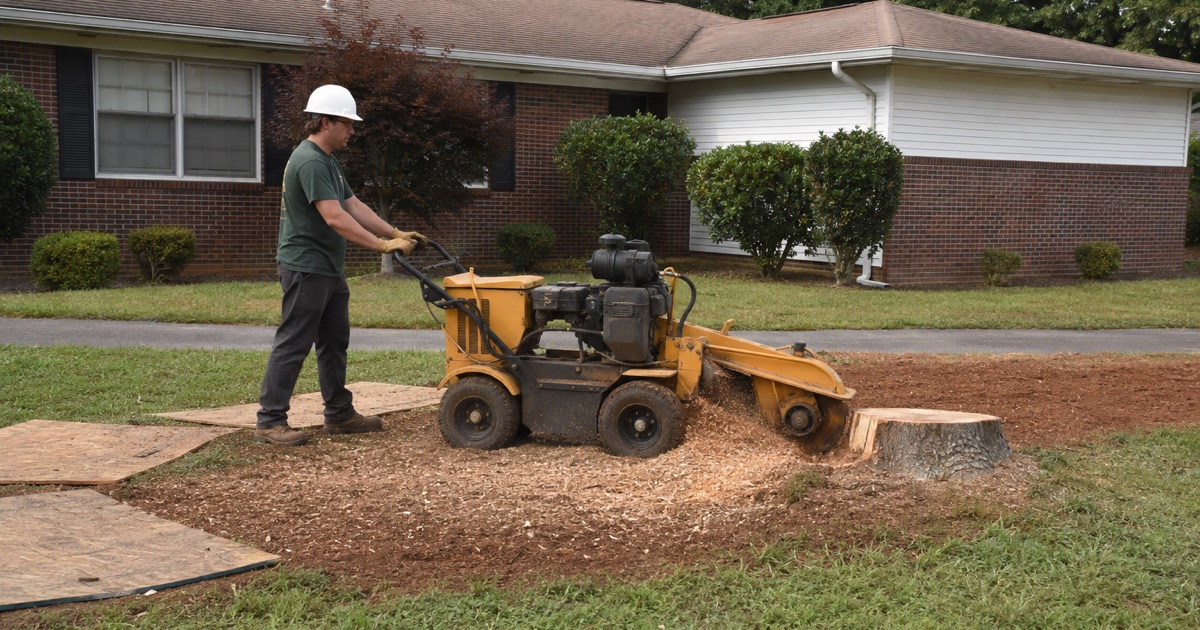
The Stump, the Flare and the Chips It Makes
A stump grinder works a wheel of carbide teeth across the stump in passes, reducing wood to chips in place rather than pulling anything out of the ground. What disappears is the visible stump and the main flare below it, down to the agreed depth. What is left behind is a shallow depression and a surprising quantity of grindings, which is the part of the job worth planning rather than discovering.
Surface Roots the Grinder Does Not Chase
The roots radiating away from a stump were there long before it was cut, and grinding the center does nothing to the ones crossing the lawn. They keep catching a mower and keep lifting pavers until they are dealt with as their own scope. We will point them out at the estimate and price chasing them separately, rather than letting you assume the grind covered it.
Grinding Against Full Stump Excavation
Excavation lifts the root plate whole and leaves a real hole, plus a root ball nobody wants to dispose of. Grinding leaves the root system in place to decay quietly and leaves the surrounding lawn intact. On a finished property that trade is nearly always worth making; on a lot about to be cut and filled by a grading contractor, taking the plate out while the machine is already there can be the better order.
Depth, Machine Class and Madison Soils
Rated Cut and What Sets It Here
Machine class sets the practical range, generally around 12 to 25 inches below grade, and the larger the wheel and the longer the swing arm the deeper it reaches. On these soils the machine is the only limit in play, so the conversation is about what you need rather than about what the ground will allow — an unusual position, and one worth using.
Why Bedrock Depth Changes the Promise
The Decatur and Dewey soil series that dominate these limestone uplands run more than five to six feet to bedrock and are well drained. A grinding quote written on that ground can commit to a number. The same quote on a thin soil over rock has to hedge, because the operator finds out where the rock is at the same moment you do. Knowing which you are standing on is local knowledge with a dollar value.
Depth for Turf, for Replanting and for a Slab
How deep is enough depends entirely on what happens next. Turf over the top needs enough clean soil to hold moisture and take a mower. A replanting hole needs the chips out and the depth greater. Anything structural — a shed pad, a patio, a footing — needs the wood gone below the bearing surface, and that is a conversation with whoever is pouring, not a guess by us.
Access Decides the Machine
Narrow-Access Grinders for Fenced Back Yards
Most of the stumps we grind sit behind a gate. A narrow-access, self-propelled machine walks through a standard side gate and works in a space a towable unit cannot enter, which is the difference between grinding a back-yard stump and removing a fence panel to reach it. We measure the gate at the estimate, so the machine on the truck is the one that fits.
Tracked Machines, Slopes and Soft Ground
A sloped or soft approach changes the answer again. Tracked machines spread their weight and hold a grade that would have a wheeled unit sliding, and they mark a lawn far less in wet conditions. Where the ground genuinely will not take a machine that week, we will say so and reschedule rather than leave ruts you then have to repair.
Stone, Metal and Fence Lines in the Cut
Carbide teeth are hard, and everything they meet that is not wood costs money: landscape stone, buried concrete, an old clothesline post, wire grown into a trunk beside a fence line. We clear and probe the cut zone first and flag what we find, because a tooth destroyed on hidden stone is a delay and a bill, and both are avoidable with ten minutes of looking.
Grindings, Backfill and What Leaves the Property
The Volume Nobody Expects
Ground wood occupies far more space than the stump it came from, so the pile is always bigger than the hole. That single fact drives most of the disappointment in this trade. Our estimate states plainly whether the grindings are staying, being spread, or leaving, and prices the third option honestly instead of quietly assuming the first.
Spread, Hauled Off, or Left as a Mound
Grindings crowned over the hole will settle for a season and then need topping up with soil. Spread thinly through beds they behave like a coarse mulch, though they are not a substitute for finished compost. Hauled away, they become a disposal line on the invoice. All three are legitimate and we will tell you which one your yard actually wants.
Why the City Will Not Collect Them
Madison’s own trash brochure states that waste generated by commercial workers and professional lawn services cannot be put out for collection, and separately refuses contractor material outright. So a mound of grindings raked to the curb after a hired job is not going anywhere. Haul-away is the lawful route, and pricing it up front is the only version of this that does not end in a phone call.
Our Step-by-Step Stump Grinding Process
Step 1: Utility Locate and Site Check
Public utilities are located through the state one-call service before the date, and private lines — irrigation, low-voltage lighting, invisible fence, anything run by a previous owner — get walked with you on site. The grinder works in the exact band of soil where all of that lives, so this step is the difference between a routine morning and an irrigation repair.
Step 2: Clearing and Protecting the Cut Zone
We pull loose stone, edging and mulch back from the stump, and set plywood or matting where chips would otherwise fly into a pool, a window or a neighbor’s drive. Chips travel further than people expect. Ten minutes of shielding at this stage saves an hour of raking and a conversation over the fence at the end of it.
Step 3: Grinding to the Agreed Depth
The operator works the wheel across the stump in passes, taking the flare and the reachable laterals as well as the trunk, and checks depth against the agreed figure rather than against how the surface looks. Where a second, larger machine is needed to reach the depth on the estimate, that was priced at the quote and not raised on the day.
Step 4: Backfill, Cleanup and Handover
Grindings are then spread, crowned over the hole or loaded out according to what the estimate says, the surrounding turf is raked and blown clean, and anything we moved goes back where it was. You get told what will settle and roughly when, so the low spot that appears in a few months reads as expected behavior rather than as a job left unfinished.
- 20+ Years in the Tennessee Valley
- Free Written Estimates
- Crane and Narrow-Access Equipment