Madison Tree Removal Pros prices tree removal in Athens around a fact most quotes leave out until the wood is already on the ground: the City will not haul it away. That is not a complaint about Athens Sanitation. It is written into the ordinance, and it decides where a job here actually ends.
So our estimate arrives as three separate figures — the takedown, the stump, and the debris. Each one is written down before anything is cut, free of charge, and each says outright whether haul-away is included, because a bid that buries that cost and a bid that states it are not comparable numbers. Leave the rounds cut and stacked and the firewood credit shows on the same sheet; have us take them and that shows too.
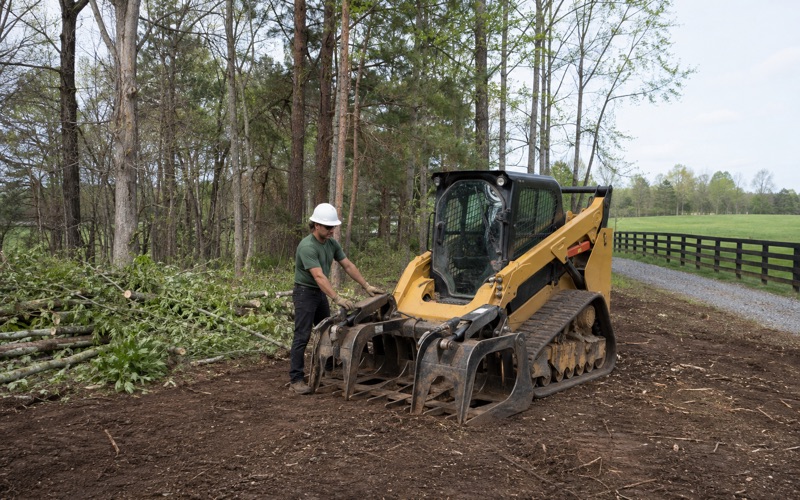
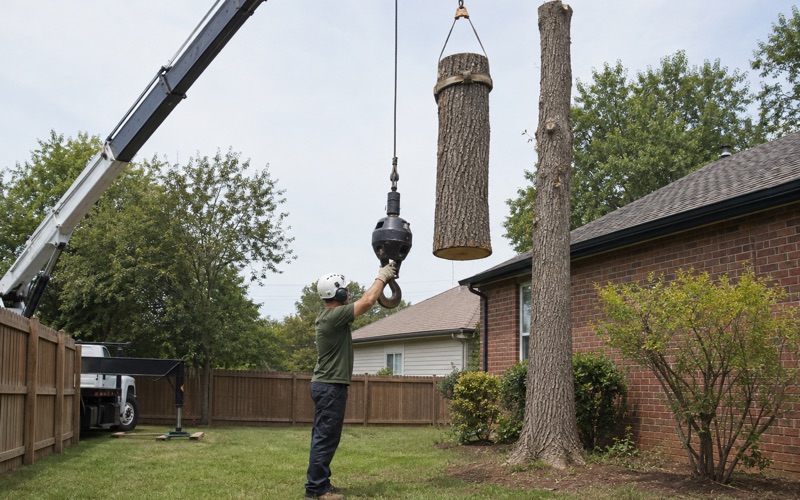
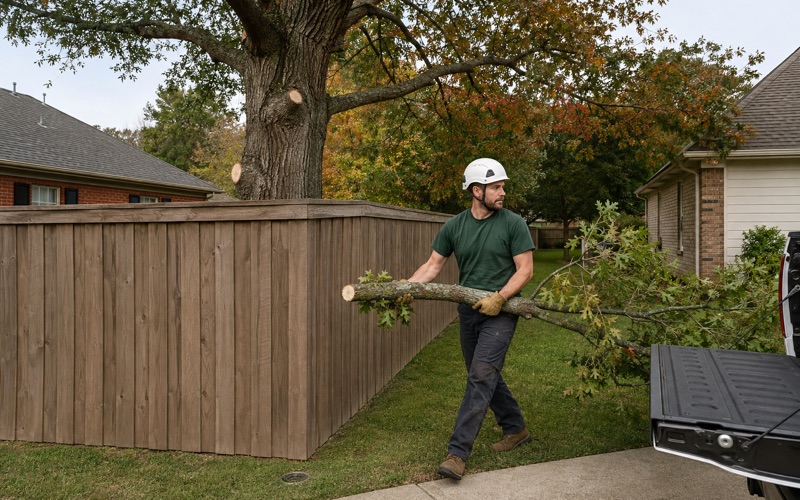
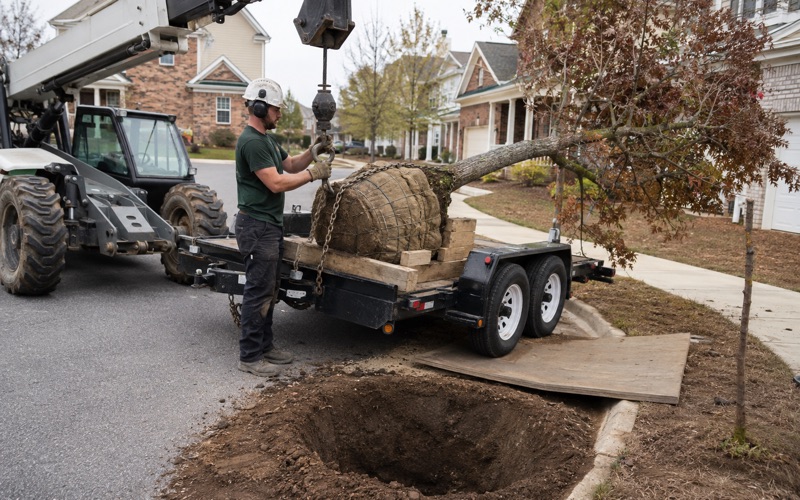
Access gets measured before the tree gets priced, which after more than twenty years of tree work in the Tennessee Valley is the habit that keeps a number honest. Gate width, the drop zone, the carry distance back to the truck and whether a chipper can get within reach of the work move a price further than trunk diameter does. Crane and tracked-lift capacity cover trees standing over a roof; narrow-access machines cover the fenced back yards a bucket truck cannot enter.
Nobody in Athens has to ask permission to cut a tree in their own yard
There is no removal permit for a finished residential lot inside the city limits, and no diameter threshold that turns one on. The trigger in the zoning ordinance is development-side. Paragraph 2.5.2.D(1) provides that prior to removal of natural vegetation, restructuring of the land, or construction of any improvements, an approved final site development plan is required for the developments stipulated in subsection 2.5.2.B.2 — and site plan review is required for all multi-family and non-residential projects requiring a Certificate of Occupancy. A single-family lot is not in that set.
The subdivision regulations read the same way. Their articles run from statement of policy through authority and jurisdiction, definitions, procedure, design standards, improvements required, construction acceptance and administration, and there is no tree article, no preservation article and no permit section anywhere in the document that governs how land is divided in Athens.
Where the rule does bite
On a commercial parcel, an apartment property or a church lot the sequence reverses: the plan is approved first and the vegetation comes out second. Site Development Plan Review carries a review fee of 250 dollars for 0 to 1 acres, 500 dollars for 1 to 5 acres, and 1,000 dollars for 5 acres or more. Landscaping on that plan is designed to Zoning Ordinance section 6.2, and the city’s guidance requires that the plants specified not be invasive according to the ordinance or a reputable source, naming the Alabama Invasive Plant Council as one such source. Along the major arterials, US Highway 72 and US Highway 31, the ordinance sets a 50-foot setback with the first 20 feet reserved for landscaping.
That calendar is worth planning against rather than around. The Planning Commission meets the third Tuesday of every month at 5:45 p.m. in the Council Chambers at City Hall, 200 West Hobbs Street, and clearing scheduled ahead of an approval is clearing done twice.
The notice that is never optional
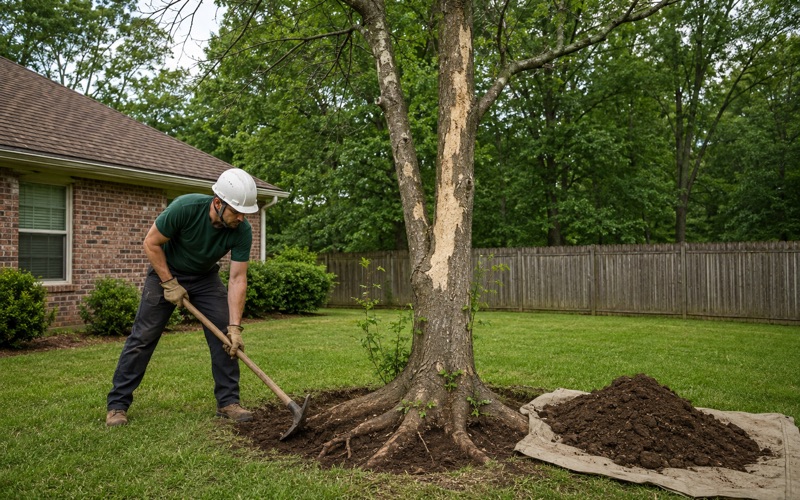
Alabama 811 has to receive notice before excavation, and stump grinding and root excavation both count as excavation. That call goes in ahead of the machine on a homeowner’s back lot exactly as it does on a graded commercial pad.
Looking for tree-removal closer to Meridianville? See Meridianville Tree-Removal.
The City collects brush. It will not collect ours.
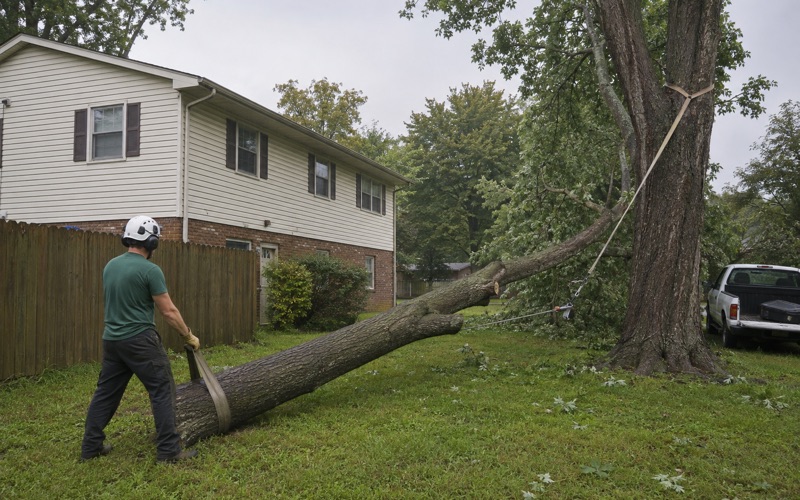
Athens Sanitation does pick up limbs and brush — generated at the residence, by the resident, limited to 4 cubic yards per week, which the city puts at approximately 12 feet long by 3 feet wide by 3 feet high under section 46-97(c) of the 2009 Code of Ordinances. The sentence attached to it is the one that shapes every tree bid in town: any work performed by a contractor, or by anyone paid or given material for work performed, will not be collected by the City.
Read the second half of that clause slowly, because it is wider than it looks. Being paid is one way to land inside it. Being given the material for the work is the other, so a crew that takes your oak in trade for the wood has still generated contractor debris, and the pile stays with the property.
Where the wood goes instead
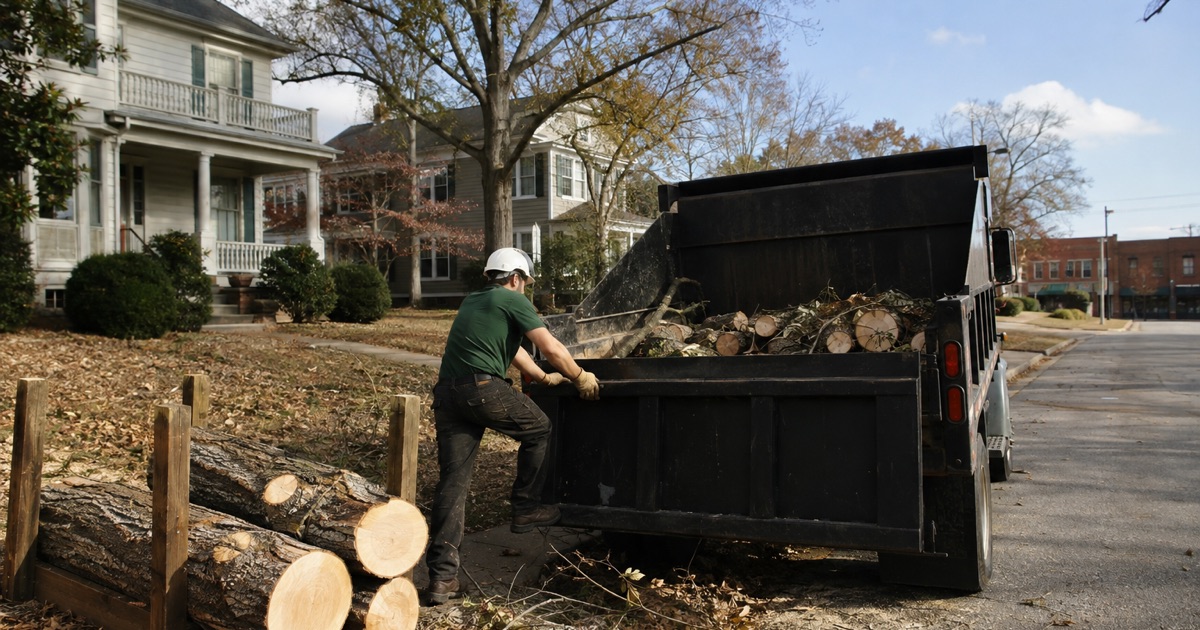
The published destination is the waste transfer station operated jointly by Limestone County, the City of Athens and BFI, at Seven Mile Post Road and US Highway 72 west of town — 16100 BFI Lane, Athens, AL 35611, 256-729-8505. The city’s own instruction is to call ahead and confirm the material will be accepted, and the county describes the facility as open to residents for a nominal fee. Loading, weighing and tipping are real hours and a real gate fee, which is exactly why that figure sits on its own line instead of hiding inside the takedown.
Outside the city limits the answer does not improve
Limestone County’s automated residential collection serves the unincorporated county only, is established when you apply for utility service through Athens Utilities, and is billed at 18 dollars per billing cycle. It does not collect leaves, limbs, yard waste, bulk items, or landscaping and construction debris, and county residents are routed to the same transfer station.
So the choice we put in front of you is a real one with an address behind it. Grindings, chips and rounds go on the truck or stay where you want them on the property, marked on the estimate either way, and no load leaves for the curb hoping somebody will take it.
Square lots, the Beaty streets, and ground the City maintains
Downtown is built around the Limestone County Courthouse and its square, and the surrounding blocks are on the National Register as the Athens Courthouse Square Commercial Historic District — roughly 14 acres bounded by Clinton, Hobbs, Madison and Green Streets. A tree there stands over sidewalk, parked cars and storefront glass with no drop zone in any direction.
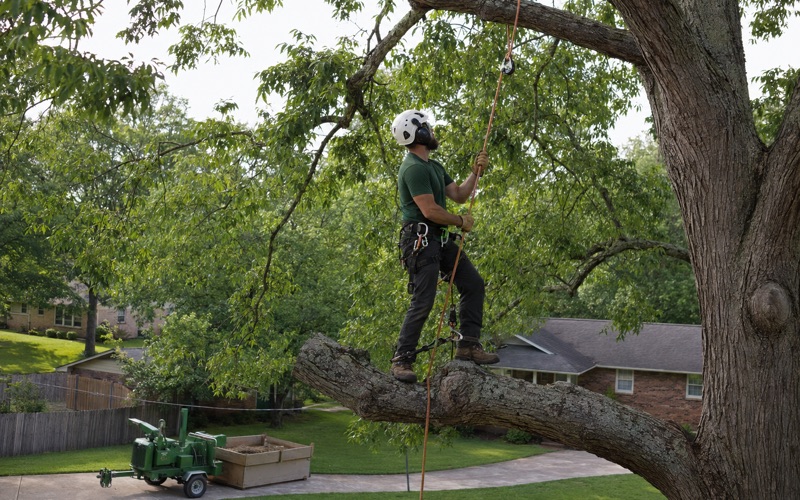
That is sectional dismantling work from the first cut. Pieces come off on a bull rope through a rigging block and are checked on a Port-a-Wrap friction device rather than dropped, with rigging sized to a stated working load limit instead of to what looks strong enough. Directional felling with a notch and back cut belongs to open ground, and inside the square there is none.
Telling the Street Department before we occupy the right of way
Work in the City right of way requires notification of the Athens Street Department before it begins. The department operates out of Public Works at 1600 West Elm Street and maintains the street signs, rights of way, sidewalks and public drainage that a chip truck and a set of crane outriggers would be sitting on. We make that notification part of scheduling rather than part of the morning.
Older residential canopy, and institutional ground
The Robert Beaty Historic District covers 43.4 acres roughly bounded by the Louisville and Nashville Railroad and Forrest, East and Washington Streets, listed in August 1984, and the George S. Houston district takes in parts of Jefferson, McClellan, Marion, Hobbs, Madison, Washington and Houston Streets. Citywide, 38.4 percent of the 12,415 housing units predate 1980, and 6,727 of them are owner-occupied one-unit detached homes on the ACS 2024 five-year estimates. Old streets and mature shade trees track each other closely, and the removals on them are almost always tight-quarters jobs.
Institutional property has the same geometry under different ownership. Athens State University traces back to the Athens Female Academy founded in 1822, Athens City Schools runs the in-town campuses separately from the county system, and the City owns and maintains the Swan Creek Greenway Trail, roughly 2.3 miles of level paved and gravel path running beside Swan Creek from the Athens SportsPlex to US Highway 72 as a designated National Recreation Trail. A limb hanging over a public path or a campus walk is a closure question before it is a cutting question, and we scope it in that order.
What the ground allows, and who owns the wire
The valley soils under most of Athens are the Decatur and Dewey series, both extensive through Limestone County. Decatur is type-located in this county, near Greenbrier: a fine, kaolinitic, thermic Rhodic Paleudult, very deep and well drained, formed in residuum derived from limestone and in old valley fill, with cherty limestone bedrock at depths of greater than 6 feet. Dewey exceeds 60 inches on both solum thickness and depth to bedrock.
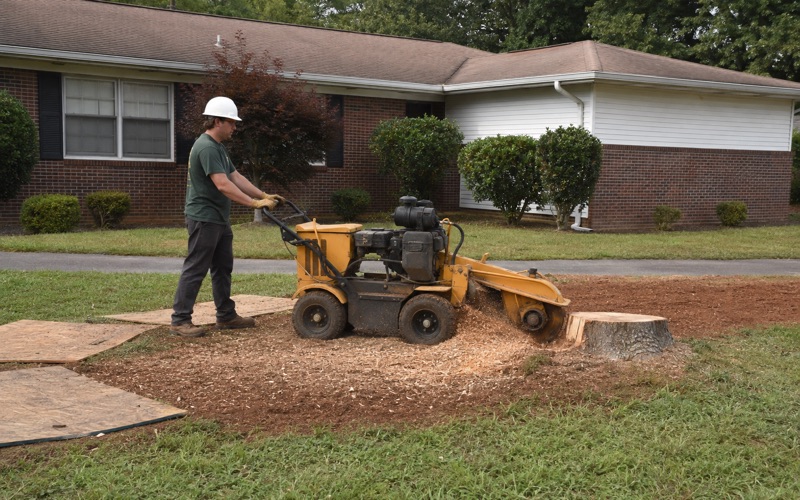
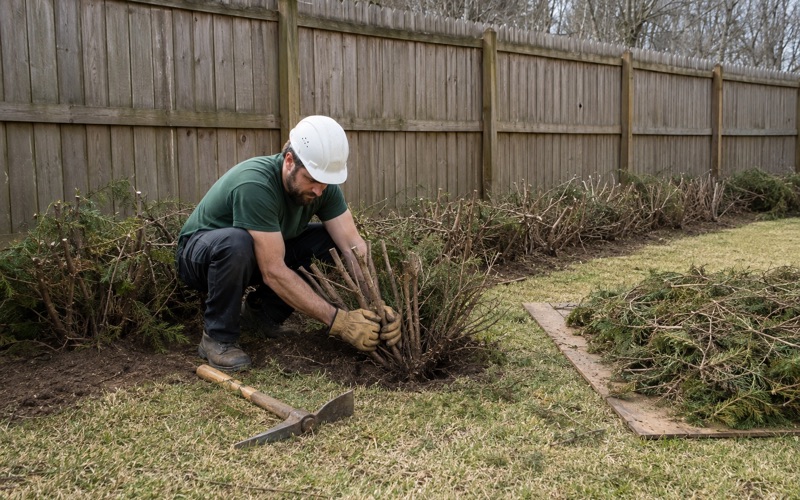
That inverts what people expect of limestone country. Rock sits deeper than any grinder reaches, so the binding constraint on a stump here is the machine’s own rated cut below grade — roughly 12 to 25 inches depending on machine class — rather than refusal on stone. We still decline to promise a depth sight-unseen, because this is the Eastern Highland Rim and the ecoregion carries cedar glades on thin soils over shallow limestone where the answer flips and the wheel finds rock first.
Trunks fail here more often than root plates do
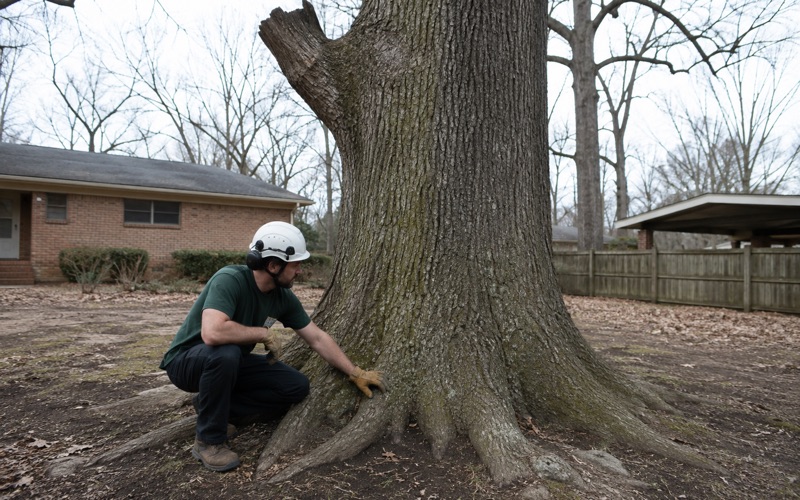
Deep, well-drained residual clay lets a mature oak or hickory build a deep root plate, so the wide, thin, whole-plate windthrow of a shallow glade soil is not the usual failure mode on these lots. Trunk and union failure is: included bark between co-dominant stems, a decay column behind an old wound, bracket fungus or a conk at the root flare, epicormic sprouts filling in for a crown that is quietly thinning. Where the live question is how much sound wood remains, resistance drilling measures it, and the written condition and risk documentation is priced as its own deliverable rather than folded into a sales visit.
A tree on the line is Athens Utilities’ decision first
Athens Utilities is a department of the City of Athens, carrying electric, gas and water and wastewater service across a 607-square-mile footprint covering Athens and Limestone County. It buys power from TVA as one of TVA’s local power companies and maintains 15 substations, five of them TVA delivery points. A downed or arcing conductor, or a tree lying across a primary line, goes to 256-232-1440 before any crew approaches, because the utility owns both the conductor and the clearance decision.
The rest of the order is short: life safety and fire to 911, a blocked street or a limb in the public right of way to the Street Department, and the service drop into the house disconnected by arrangement before anyone works that span. Athens sits in National Weather Service public forecast zone ALZ005, Limestone, which doubles as its fire weather zone under the Huntsville office, so a wind or ice headline can be issued here without covering the counties to the south. We answer storm and hazard calls the same day, and we state plainly what the ANSI Z133 safety requirements permit and forbid near energized conductors in wind and ice.
- 20+ Years in the Tennessee Valley
- Free Written Estimates
- Crane and Narrow-Access Equipment