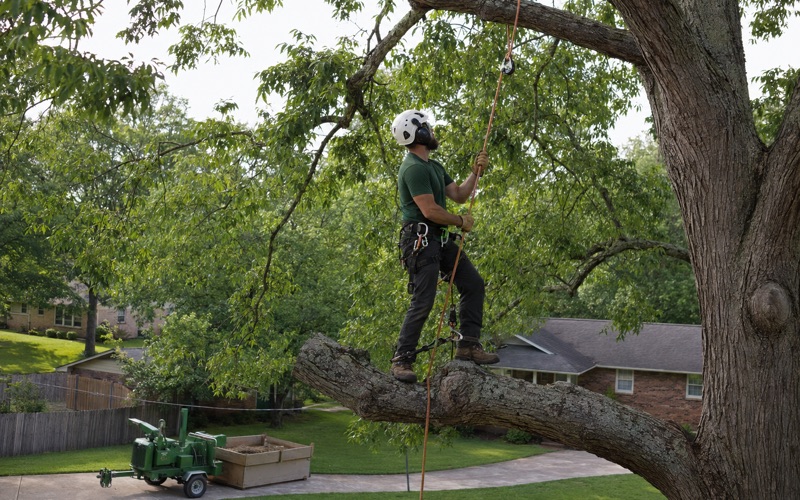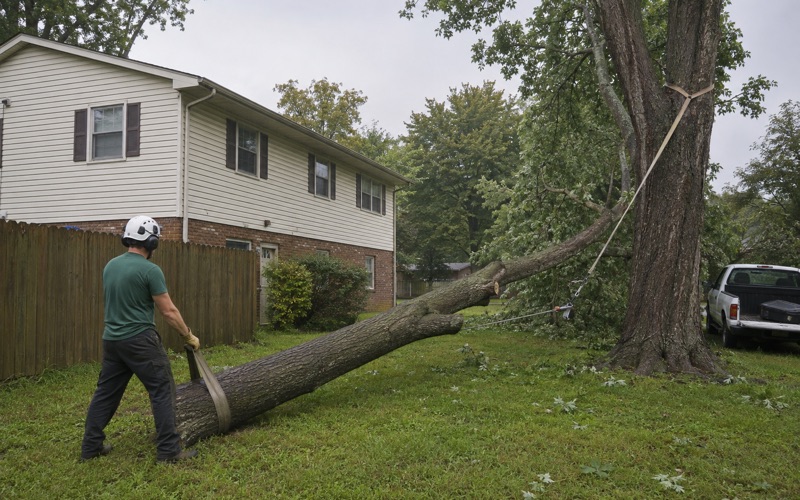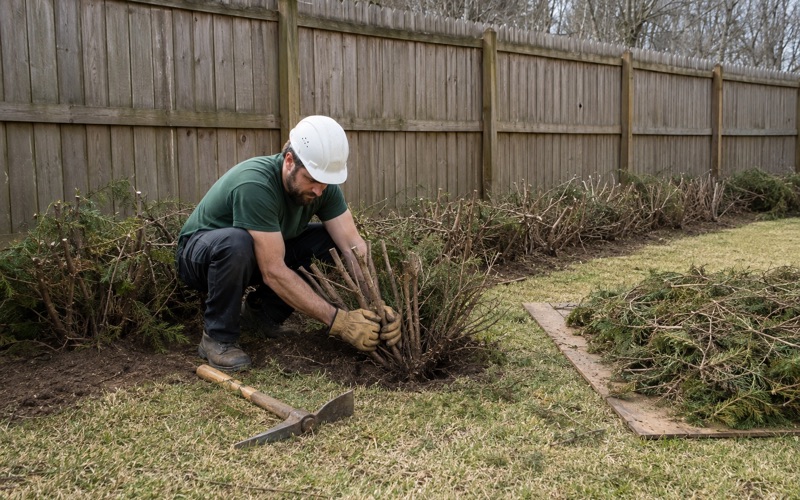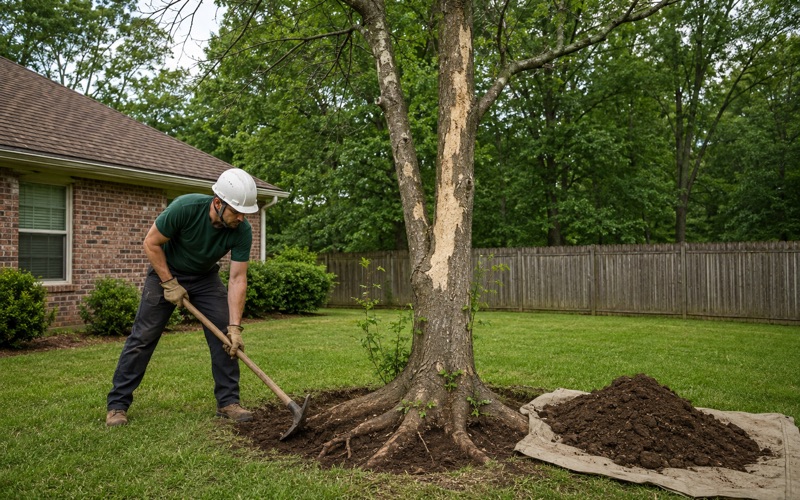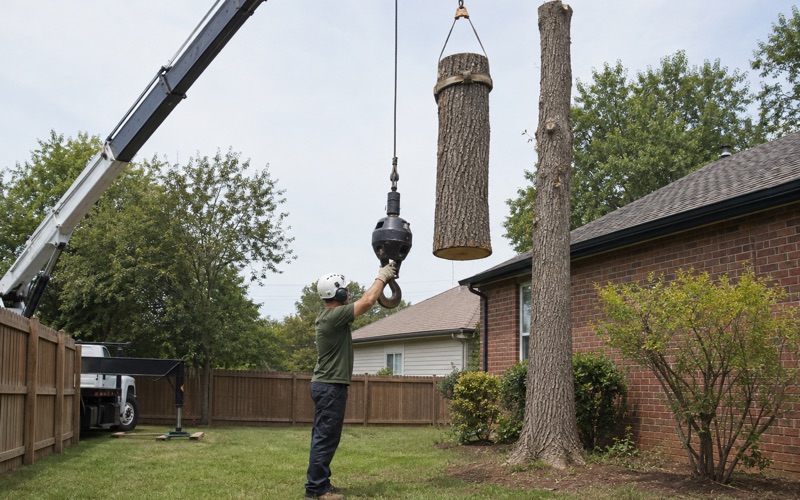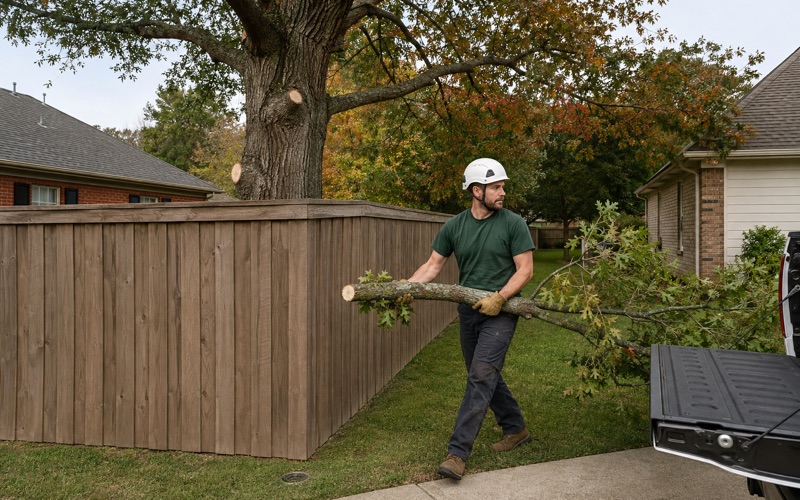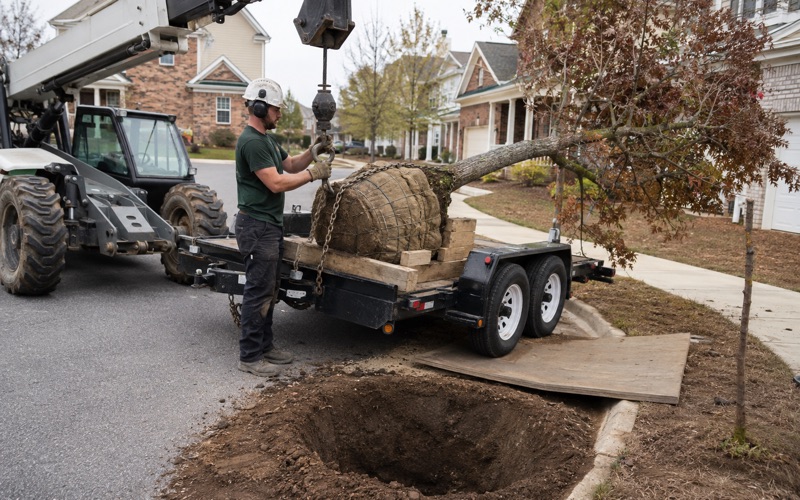
Madison Tree Removal Pros has been doing tree removal in Decatur for more than twenty years, and on most of these lots the tree itself is the easy part. What decides the day is everything packed in around the trunk: a porch roof on one side, a driveway on the other, and a fence line that leaves nowhere for a stem to land. When there is no drop zone, the tree leaves in pieces on rope, lowered past a roof edge instead of felled into a yard.
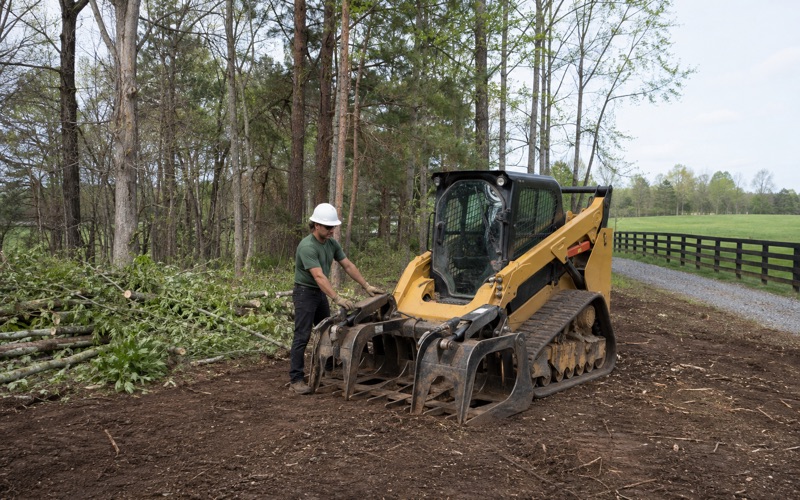
So we measure the access before we price the tree. Gate width, the carry distance from the trunk to the truck, whether a chipper can get within reach of the brush, and whether anything on tracks can reach the back of the property at all — those answers move a quote further than trunk diameter does. A crew that skips that walk prices a felling job and then discovers a rigging job.
Our written estimates split the work into three lines: the takedown, the stump, and the debris haul. Each line states plainly whether it is included, which is the only way two numbers from two companies can honestly be compared. Rounds can stay cut and stacked for firewood, and the estimate shows what that credit is worth either way.
Taking a tree off a town lot in Old Decatur and Albany
The two oldest neighborhoods here were platted as walking towns, with narrow street frontage, deep lots, and service alleys running behind the houses. New Decatur was laid out in 1887 as a planned suburb, renamed Albany in 1916, and merged back into Decatur in 1927. Between the Bank Street blocks of Old Decatur and the Albany district sits what the city describes as the largest concentration of Victorian-era craftsman and bungalow homes in Alabama, the houses known locally as the Painted Ladies. The trees that grew up with them now stand over porch roofs, turned columns, and original wood siding.
That changes the arithmetic on every cut. A limb that would bounce off a modern asphalt roof can crack a rafter tail or split a porch bracket nobody can order a replacement for. We rig those pieces small and slow, taking the weight on a bull rope through a rigging block and metering it down on a Port-a-Wrap friction device, rather than trusting a piece to land where it was aimed.
Design review, and who to ask first
Portions of both districts are locally zoned historic districts, where exterior work goes through design review by the city’s Architectural Review Board and a Certificate of Appropriateness. Whether that review reaches trees, landscaping, or other site features is not something we will assume in either direction on a customer’s behalf. Before work is scheduled inside those blocks, the question goes to the city’s Historic Preservation program coordinator and the answer goes on the file in writing. The commission behind that review was established by municipal ordinance in 1990.
Outside the historic blocks the picture is simpler. Decatur’s zoning ordinance, rewritten as Chapter 25, imposes no tree removal permit on a finished lot. Its landscaping and buffer rules live in the development standards and govern development sites working from a landscape plan, not a homeowner taking down a declining oak beside a garage.
Looking for tree-removal closer to Moores Mill? See Tree-Removal Services in Moores Mill.
Working from the alley when the front has no room
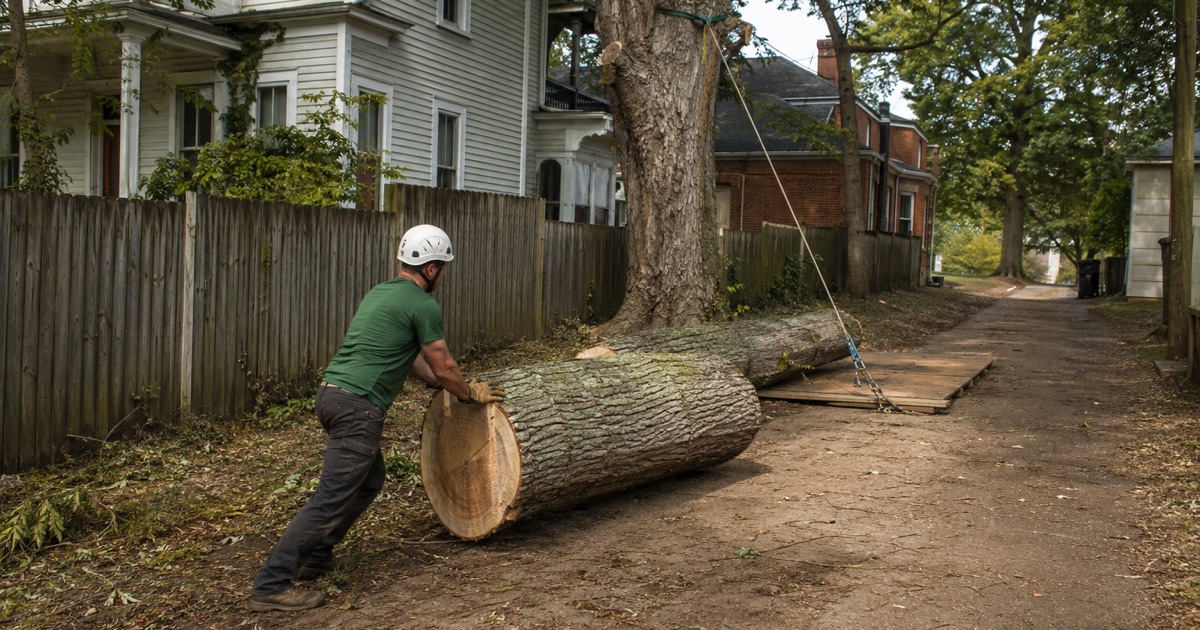
Alley access is the quiet advantage of an old plat, and we use it deliberately. A chip truck and a knuckleboom grapple truck staged behind the house keep the whole operation off the street frontage, which means no outrigger pad on a brick sidewalk and no brush dragged past the front porch.
The catch is width. These alleys were sized for a delivery wagon, and garages, poles, and fences have narrowed them since. We walk the alley before the day of the work and settle on the machine that fits: a tracked spider lift that will pass through a gate and set up in the back yard, or a crane on the street when a stem has to come out over the roof in one lift rather than travel down through it.
Every piece that comes off over a roof has a number attached to it. We size the bull rope and the block to the working load limit demanded by the heaviest piece in the plan, not the average one, and where the alley offers a straight run we set a speed line to fly brush clear of the house rather than lower it into the gap between a garage and a fence. Sectional dismantling costs more hours than felling, and on a lot this tight it is the only honest way to get a large stem down.
Service drops and the calls that come first
Almost every one of these lots has a service drop crossing it somewhere, and Decatur Utilities is the municipal electric, natural gas, water, and wastewater provider inside the city. We arrange the service-drop disconnect before anyone works near that line, because the approach distances in ANSI Z133 do not bend for a schedule. On a storm call the order never varies: a downed or arcing conductor, or a tree lying on a primary line, goes to Decatur Utilities at 256-552-1400, option 1, and no one goes near it. The utility’s own instruction is to stay away from all downed power lines.
A gas leak is option 2 on that same number, and 911 if there is fire. Debris blocking a public street or sitting in the right of way is a call to Environmental Services at 256-341-4740. We place those calls ourselves instead of leaving a homeowner to work out which department owns which hazard, and storm and hazard work gets a same-day response within the limits weather and energized lines actually allow.
Why more than half of Decatur’s houses stand under older canopy
Of 25,467 housing units in the city, 55.5 percent were built before 1980, and 69.9 percent are one-unit detached, with 13,629 of those owner-occupied, on the American Community Survey 2024 five-year estimates. Housing that old carries planting that old. The canopy shading these blocks was set decades ago, and it has reached the age where structure rather than size is what gives way.
The soils explain the failure mode. The Decatur series, which takes its name from this area, is deep, well-drained clay formed in residuum over limestone with bedrock greater than 6 feet down, and the neighboring Dewey series runs more than 60 inches to rock. Trees rooted that deep seldom lift a whole plate in wind. They decay from the inside instead and split at co-dominant unions, a slower failure and a far less obvious one from the sidewalk.
What gets looked at before a tree is called hazardous
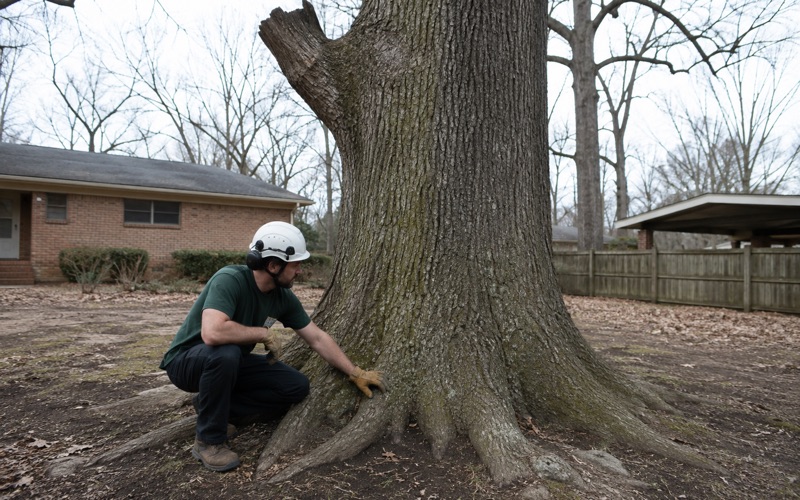
We read the root flare for conks and bracket fungus, the unions for included bark, and the trunk for a decay column, bringing in resistance drilling where the outside of the stem gives nothing away. Hazard assessment guidance from the Alabama Cooperative Extension System is the framework this trade works from, and the ISA Tree Risk Assessment Qualification is the industry’s formal version of the same judgment. Written condition and risk documentation is priced as its own deliverable here — for an insurance claim or a boundary question — rather than folded into a sales visit.
Not every one of those trees is a removal. A weak union caught early can often be managed with crown cleaning and a reduction that takes leverage off the limbs feeding it, or with a static or dynamic cabling system that shares load between the stems. We say so when that is the honest answer, and we say it just as plainly when a decay column has gone too far for hardware to help.
Pines get a separate look. The Alabama Forestry Commission calls southern pine beetle the number one killer of pines in Alabama, and under drought the usual pitch tubes may be very small or absent, leaving only reddish-brown boring dust as evidence. S-shaped galleries under the bark indicate southern pine beetle, while Y- or H-shaped galleries indicate Ips engravers.
Delano Park, about 28 acres established in 1887, and the open ground at Point Mallard are where a shade tree in this city has had room to reach full size. Very little that went into a residential lot in the older blocks ever had that room.
What the debris rule and the grind depth do to a quote
Decatur’s solid waste ordinance is written straight at this trade. All contractors are required by city ordinance to haul away their debris from work sites, the Solid Waste Department will not haul it, and homeowners are told not to negotiate with a contractor on the assumption that the city will collect it. A quote that comes in low because the brush is headed for the curb is not a cheaper job, only an unfinished one.
What the city does collect from a homeowner is limbs cut to less than 12 feet in length and less than 12 inches in diameter, stacked neatly away from fences, mailboxes, buildings, and utility poles. Bulk pickup is unscheduled and may take approximately two weeks. That is a workable arrangement for pruning a crape myrtle over a weekend, and no arrangement at all for a whole tree.
Our material goes to the Morgan County Regional Landfill on Landfill Drive in Trinity, which the City of Decatur operates. The gate rate there is 30 dollars per ton for wood, construction and demolition debris, and general trash, with a 16 dollar minimum charge, and the scale house runs Monday through Friday, 6:00 a.m. to 4:00 p.m., and Saturday, 7:00 a.m. to 11:00 a.m. Those tons are a real line on an estimate, and we would rather show them than bury them in a total.
Committing to a grind depth
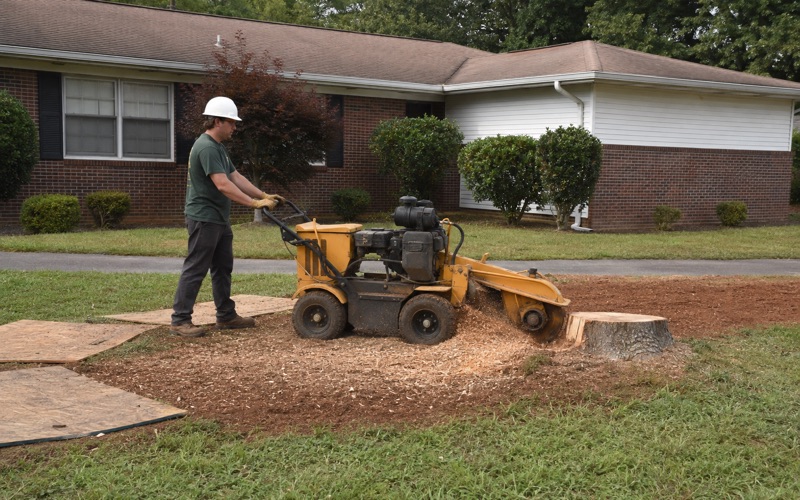
Because rock sits below 60 inches on the dominant valley soils, the limit on stump grinding here is usually the machine rather than the ground: a cutting wheel carrying carbide teeth reaches roughly 12 to 25 inches below grade depending on the class of machine. That is enough for turf, a replacement planting hole, or a slab on most lots in town. Shallow pockets over limestone do exist in this same landscape, so a finished depth is something we confirm standing on the stump rather than promise over the phone.
Grinding is excavation, so an Alabama 811 notice goes in before the wheel turns; that requirement reaches stump grinding and root excavation, not only footings and trenches. Grindings, chips, and rounds leave with us or stay on site exactly as a customer prefers, and the estimate says which before the crew ever arrives.
- 20+ Years in the Tennessee Valley
- Free Written Estimates
- Crane and Narrow-Access Equipment