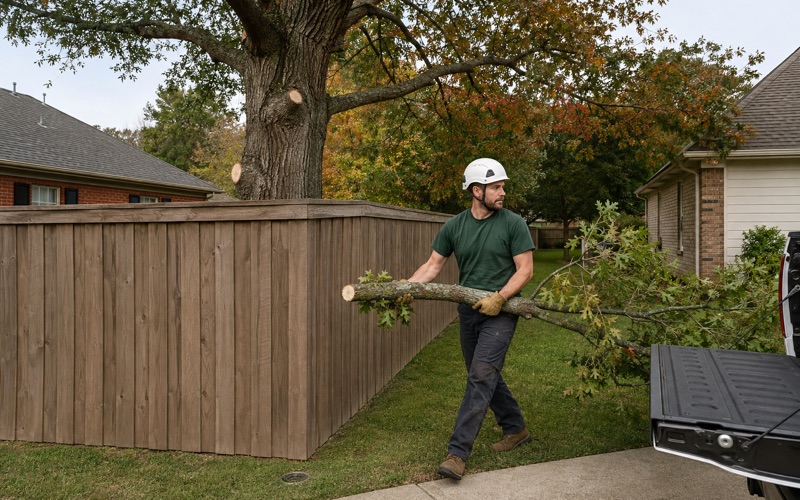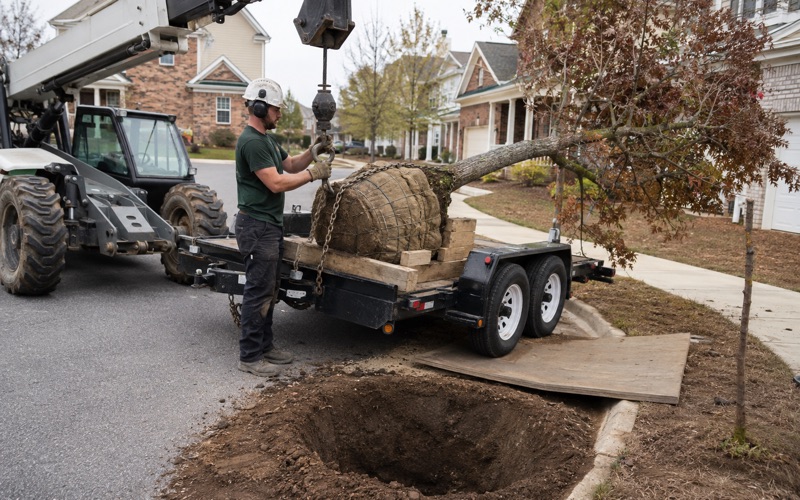
Madison Tree Removal Pros brings more than twenty years of Tennessee Valley tree work to tree removal in Hartselle, and a call from here starts with a question we ask nowhere else in the region: how close is the tree to a power line, and is the address inside the city limits? Both answers can be worth money to you before we quote a thing. Hartselle Utilities publishes an offer that no neighboring provider matches, and the honest local job is working out which trees it does not reach.
Those are the trees we price. The estimate is free, it is written down, and it separates into three figures rather than one — the takedown, the stump, and the debris haul. Each figure states plainly whether hauling is included, because that single unstated item is what makes two bids look hundreds of dollars apart when they are quoting different work entirely.
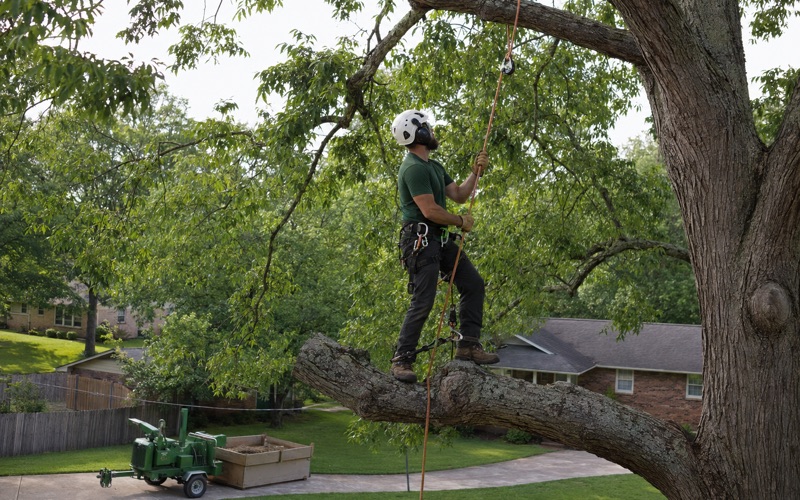
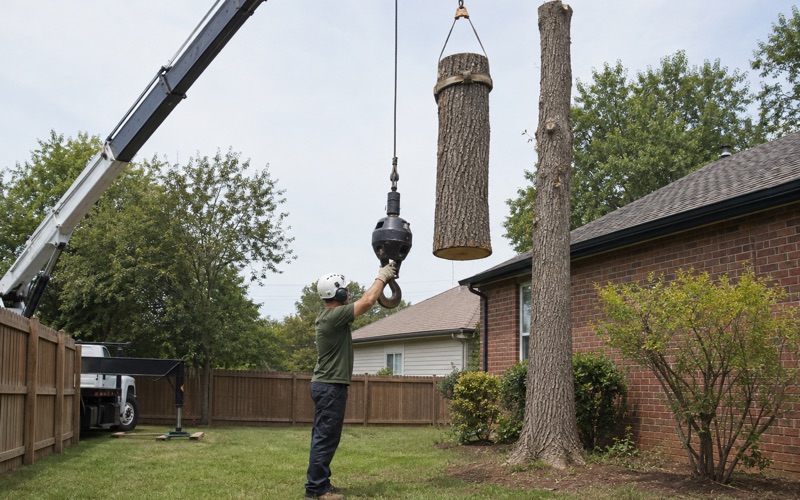
We measure the way in before we price the tree: gate width, the drop zone, the carry distance back to the truck, and whether a chipper can get within reach of the stem. Rounds can stay cut and stacked with the credit shown on the same sheet, or they can leave on our truck, and either choice appears as a number rather than a surprise.
The takedown Hartselle Utilities will do for nothing
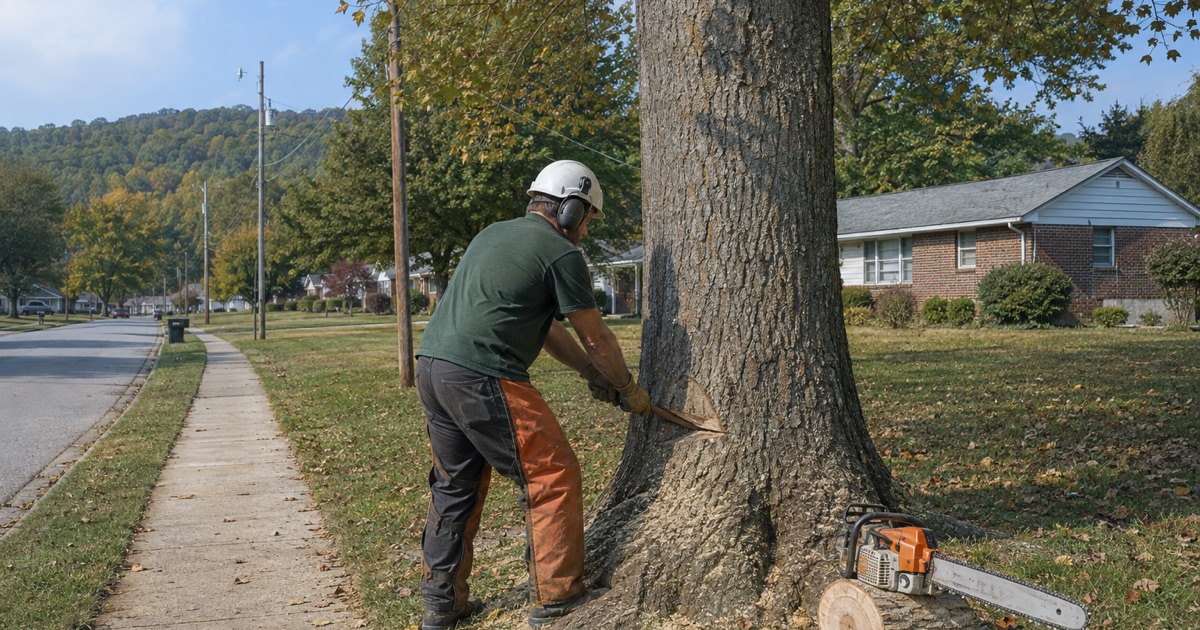
The policy is published in the utility’s own words. If you have a tree in your yard that needs to be pruned repeatedly to keep it away from power lines, Hartselle Utilities will cut the tree down for you at no charge, and the number to request it is 256-773-3340. That is not a storm program or a seasonal offer. It stands alongside a system-wide plan to monitor and trim trees and remove brush within ten feet of the power lines.
So when a homeowner describes a tree that has been cut back three times already and is back in the wire again, our first advice is often to make a different phone call than the one they just made. We would rather lose that job than take payment for work the utility has already agreed to do.
The orange door hanger, and the clearance around the equipment
When trees on a property near electric lines are likely to be trimmed, the utility notifies the customer with a bright orange door hanger. It also asks for a six-foot clearance around its equipment for landscaping, fencing, shrubbery and other obstructions, which is worth knowing before a replacement tree goes in the same hole the old one came out of.
Its planting guidance names the mistake that creates most of these trees in the first place. Within 30 feet of power lines, choose a tree with a mature height of less than 20 feet tall. Trees with a mature height of over 40 feet should be planted at least 60 feet away from power lines.
The trees the offer never touches
The offer is written around conductors, and most of what fails in a Hartselle yard is nowhere near one. A leaning water oak over a detached garage, a hickory shedding limbs across a driveway, a pine carrying a decay column at the root flare with nothing but house downhill of it — none of that is a utility matter. Nearly half the housing stock is old enough for this to be common: of 6,509 total housing units, 47.5 percent were built before 1980, and a good deal of the canopy standing over those roofs was planted before anyone decided where a wire would run.
Which utility your address actually has
Hartselle Utilities is a legally separate entity from the City of Hartselle, and the city’s own Development Guide says so outright. It was incorporated in 1962, is one of TVA’s local power companies, and serves more than 5,400 business and residential customers over more than 70 miles of line inside the city limits.
Rural Morgan County around the city is Joe Wheeler EMC territory instead, run from 25700 AL Highway 24 in Trinity. Each utility’s procedures are its own, and nothing described above transfers across the city line. An address a mile outside the limits gets Joe Wheeler EMC’s answer, not this one.
That boundary decides an emergency call too. Inside the limits, a downed or arcing conductor or a tree lying on a primary line goes to Hartselle Utilities at 256-773-3340, which is also the after-hours number; outside them, the same call goes to Joe Wheeler EMC. Life safety and fire are 911. A blocked public street or debris in the right of way goes to the City of Hartselle at 256-773-2535.
Looking for tree-removal closer to New Market? See Tree-Removal Services in New Market.
Little Mountain sandstone, and where rock stops a grinder
Hartselle sits in EPA Level IV ecoregion 71j, Little Mountain, inside the Interior Plateau — a narrow east-west ridge running parallel to the Tennessee River. What separates it from the Eastern Highland Rim around it is sandstone rather than limestone, plus noticeably more forest cover. The valley floor immediately north of town reads as Eastern Highland Rim, so this is a Hartselle condition and not a regional generality borrowed from a neighbor.
The rock carries the town’s name. The Hartselle Sandstone is a Mississippian formation, light-colored and thick-bedded to massive, quartzose with interbeds of dark-gray shale, laid down roughly 325 million years ago beneath a shallow sea as a tidal strandplain later reworked by a transgressing sea.
Why a grind depth is not promised over the phone here
The soil weathered from that rock is the operative fact. The Hartsells series is moderately deep and well drained, formed in loamy residuum from acid sandstone carrying thin strata of shale or siltstone, on nearly level to moderately steep ridges and upper slopes. Depth to bedrock runs 20 to 40 inches.
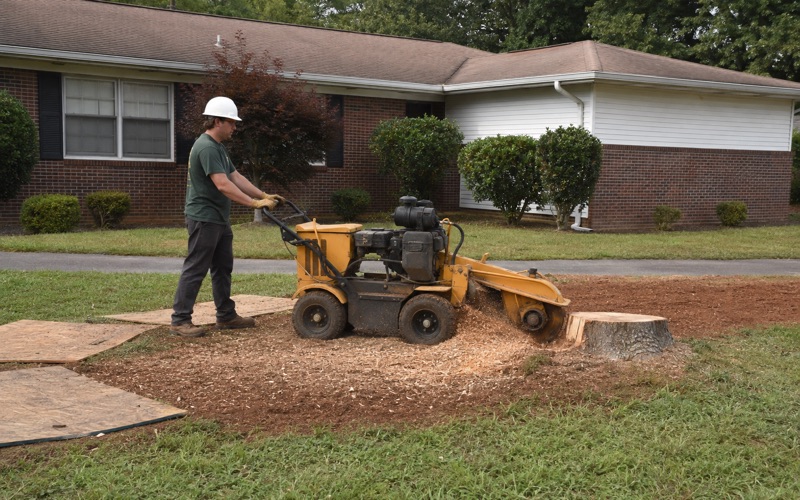
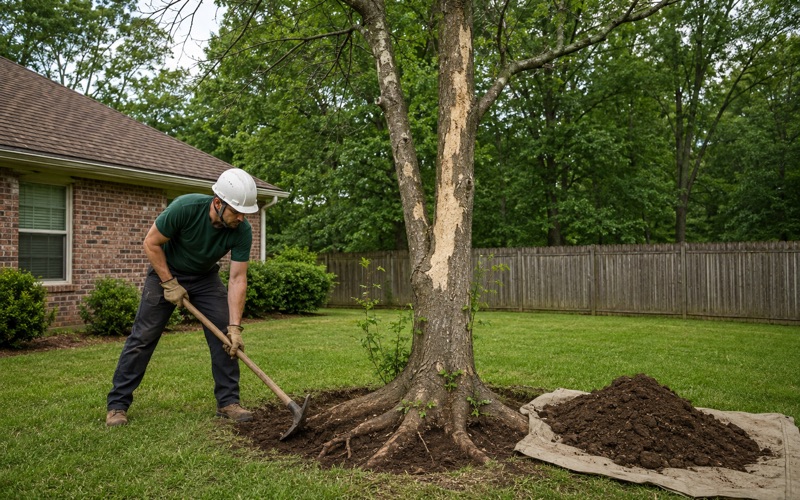
A stump grinder rated to cut roughly 12 to 25 inches below grade sits squarely inside that window. On the shallow end of the range the rock binds the wheel before the machine’s own stop does, which means a below-grade number given sight-unseen on ridge ground is a guess. We look at the ground, say what the wheel can reach there, and write that figure down rather than a catalog specification.
Wide root plates instead of deep ones
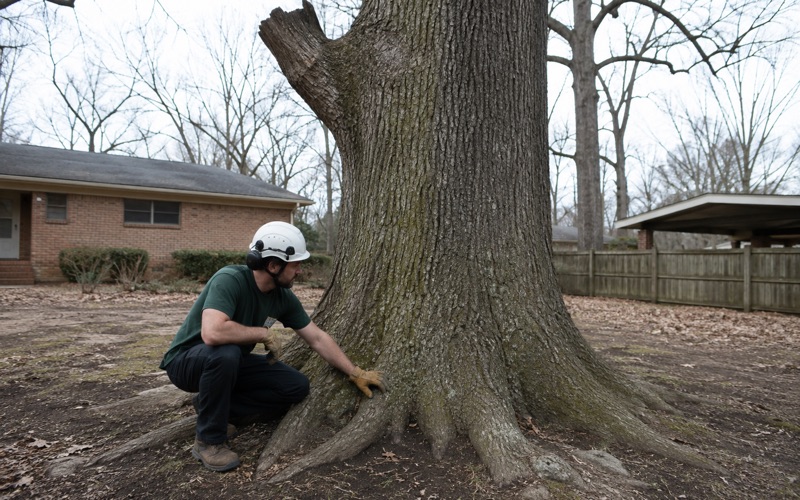
Rock capping the rooting depth changes how a mature tree fails. Roots spread outward rather than down, so the failure mode on this ground is the whole tree coming over in saturated conditions rather than the trunk breaking. It is the reason a tree that looked untroubled for forty years can leave a plate of soil standing on edge after one wet windstorm.
The forest the Hartsells series is named for is oak, tulip poplar, blackgum, hickory and pines, and that last one carries a standing pest question. The Alabama Forestry Commission calls southern pine beetle the number one killer of pines in the state, with unmanaged loblolly and shortleaf stands the susceptible ones. Under drought the pitch tubes may be very small or absent, leaving only reddish-brown boring dust as the sign. S-shaped galleries under the bark indicate southern pine beetle, while Y- or H-shaped galleries indicate Ips.
Whatever the depth turns out to be, the notice comes first. Alabama 811 takes the call before any excavation, and stump grinding and root excavation count as excavation; a locate technician marks underground utilities within 48 hours. Hartselle Utilities gives the same instruction in plainer terms: call before you dig anywhere in the yard.
Free to the homeowner, billed by the ton to us
The Hartselle City Landfill at 99 Lovelady Street NW is where wood from a job in town ends up, and its rate sheet states a split most estimates leave unspoken. Residential dumping is no charge. Business and contractor yard waste runs 30 dollars per ton, business and contractor junk waste 62 dollars per ton, each with a 5 dollar minimum. The same wood, off the same tree, in the same yard, is free to the homeowner who hauls it himself and billed by weight to the company that hauls it for him.
One restriction reaches past price. The landfill is only allowed to accept waste that comes from within the city limits of Hartselle, so a property just outside the line has no city disposal route at all and the wood travels further. Gate hours are Monday through Friday, 7:30 a.m. to 4:00 p.m., and Saturday 8:00 a.m. to noon.
Curbside collection meters a resident and refuses a contractor
The city’s brush rule does not turn a homeowner away, it counts. A resident is limited to 20 cubic yards of limbs at the curb at one time, and more than that incurs a fee of 100 dollars per every 20 cubic yards the city removes. Limbs must be no more than five feet in length.
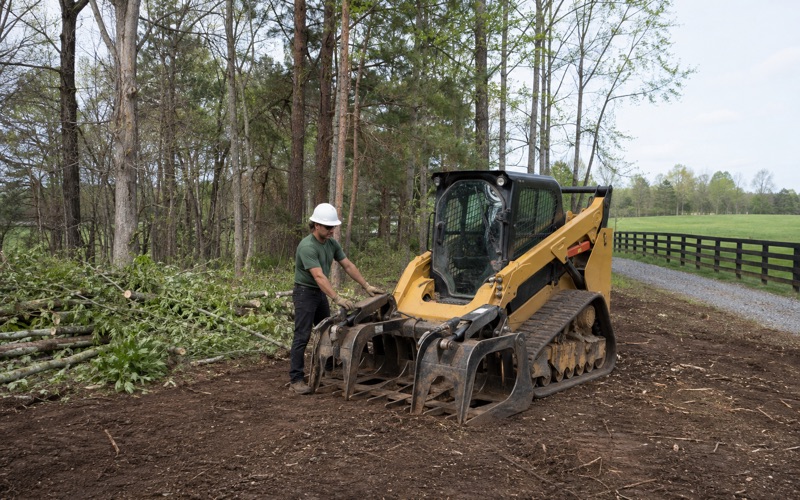
The contractor rule is a flat exclusion, and it names this trade rather than implying it: the city does not pick up or remove any waste produced or generated by a contractor, including contractors who cut down trees for residents and businesses. That is why the debris figure on our estimate is its own line. Grindings, chips and rounds go or stay at your choice, with the disposal rule explained rather than quietly absorbed into a number.
What the fee schedule proves about permits
Hartselle’s Development Guide 2025 publishes the complete Schedule of Fees for development review, and reading it is faster than arguing about ordinances. A Subdivision Certificate is 100 dollars, an Engineering Plan 300 dollars plus 10 dollars per lot plus certified mailing, an Annexation or Rezoning 750 dollars, a Board of Zoning Adjustment case 50 dollars. Nothing on that schedule charges for a tree, vegetation, land-disturbance or clearing permit. A complete published price list with no line for a thing is stronger evidence than the silence of a code index.
The Guide also states that full site plans are not required for single-family residential dwellings, though staff review of a simplified plot plan is required when a building permit is applied for. The Planning Commission meets the first Tuesday of the month, and City Hall is at 611 Chestnut Street NW, 256-773-2535, if a lot has a development question stacked on top of the tree.
Whose tree it is before whose crew it is
Authority ends at the city line. Outside it the Morgan County Commission is the governing body, and the fee schedule above describes nothing about that ground. Inside it, a tree standing in Sparkman Park is the city’s tree rather than the neighboring homeowner’s, which sounds obvious until a limb comes down over a fence and two parties start guessing.
When the answer has to be on paper
Some removals are really documentation problems with a tree attached — a boundary argument, an insurance claim, a lender asking what the risk actually is. We write condition and risk documentation as its own priced deliverable rather than folding it into a sales visit, and it records what is observable on the day: included bark at co-dominant stems, a decay column, a bracket fungus at the root flare, girdling roots, epicormic sprouts on a stripped crown.
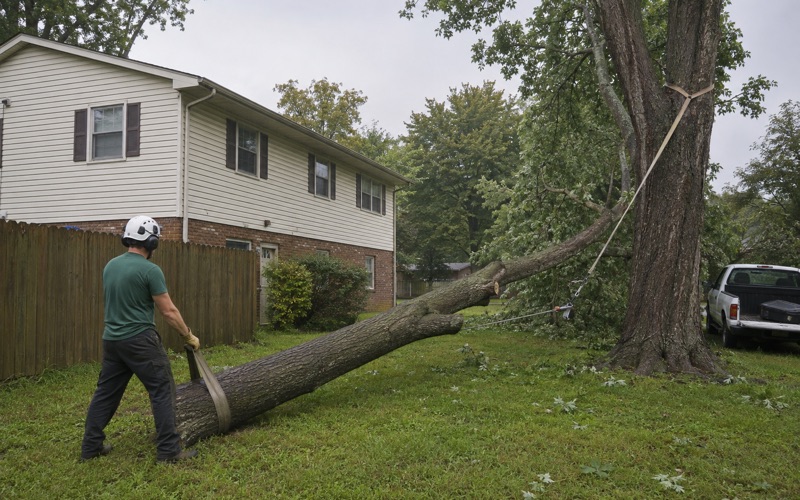
Storm and hazard calls get a same-day response, with the limits stated up front rather than after the truck arrives. ANSI Z133, the safety standard for arboricultural operations, puts hard boundaries on what any crew may do near energized conductors in wind and ice, and a tree resting on a live primary is the utility’s decision before it is a climbing problem. Those two facts decide the order of a storm morning here more often than the size of the tree does.
- 20+ Years in the Tennessee Valley
- Free Written Estimates
- Crane and Narrow-Access Equipment