Madison Tree Removal Pros handles tree removal in Harvest with more than twenty years of tree work behind the crew, and most of what we take down here was never planted by the person paying for it. The tree that fails on a Harvest lot is usually one a builder decided to keep.
That single fact reorders how a removal gets priced and staged. A retained tree stands where the site plan left it rather than where an owner would have chosen it, which is often a few feet off a foundation corner, inside a fenced back yard, or over a driveway poured across its roots. Access, not height, decides the method.
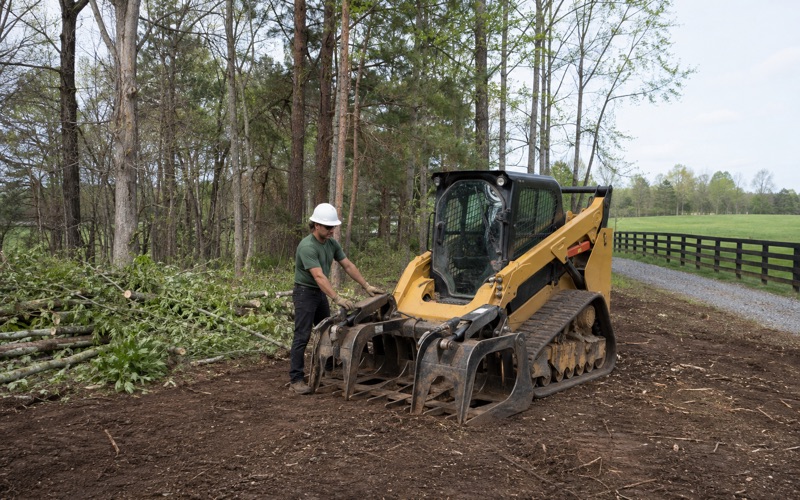
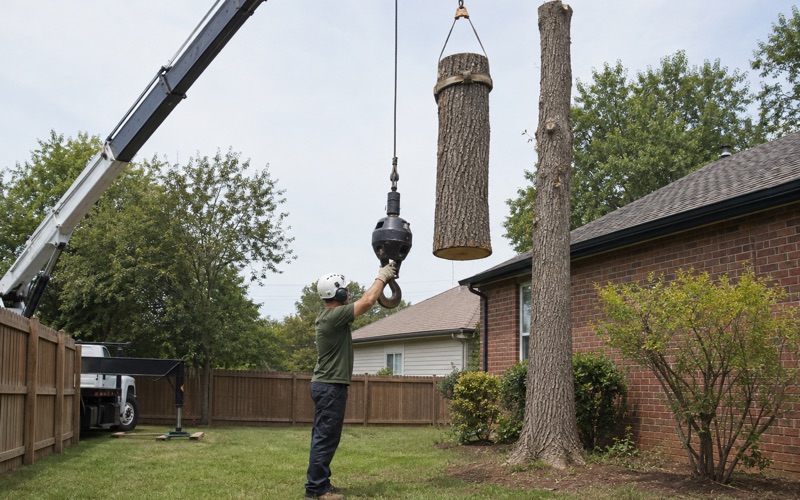
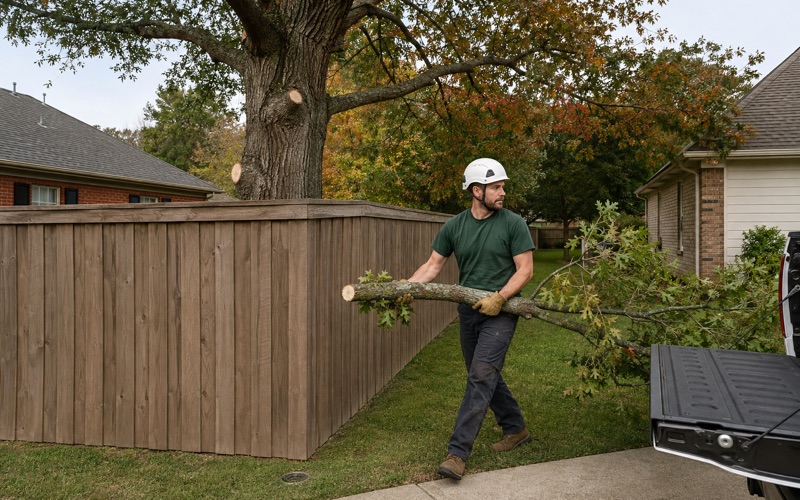
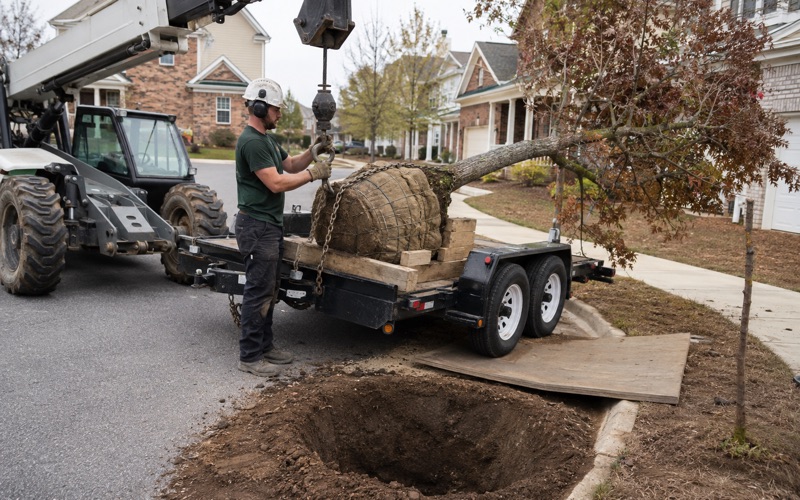
So we measure the approach before we price the tree: gate width, drop zone, carry distance to the truck, and whether a chipper can get anywhere near the work. Fenced back yards get a narrow-access machine; anything hanging over a roof gets crane or tracked-lift capacity. Every written estimate splits the takedown, the stump and the debris haul into three separate lines, because those are the three things quotes around here disagree about.
Advice written for older neighborhoods does not describe these lots
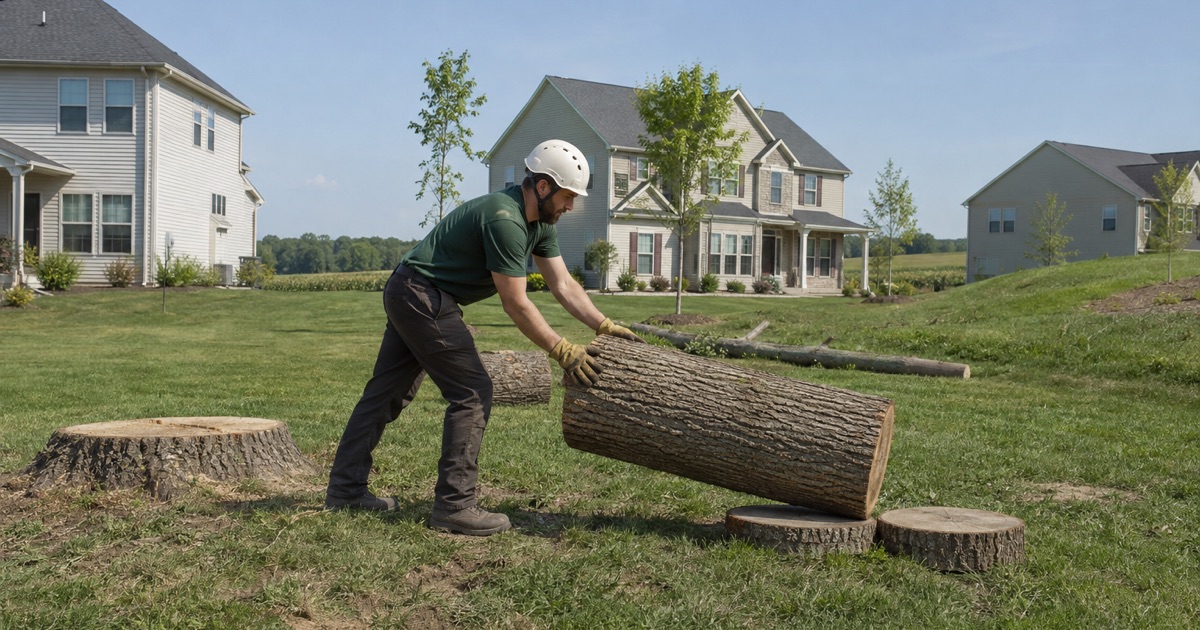
Only 9.5 percent of Harvest’s 2,289 housing units were built before 1980, and 93.2 percent of them are one-unit detached houses, on the ACS 2024 five-year estimates. Owner occupancy runs 82.7 percent, and 1,755 of those owner-occupied homes are detached single-family. That is a young and remarkably uniform residential stock, cut out of farmland and woodlot within living memory.
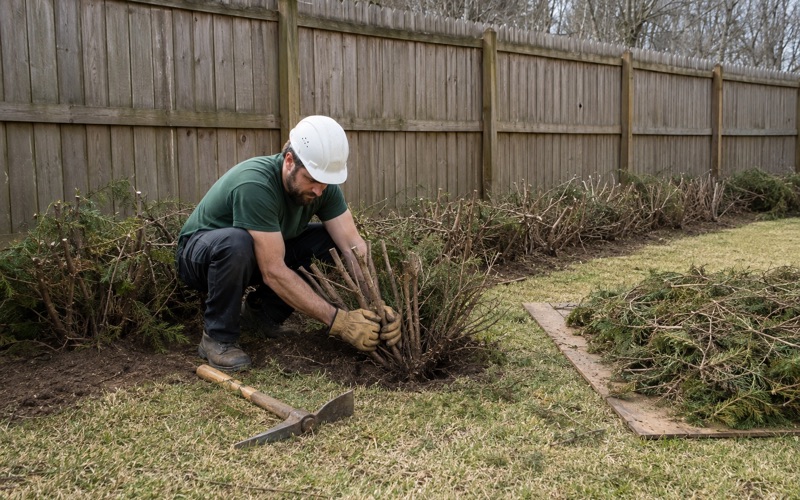
It produces a different mix of work than an older street does. We clear lots ahead of construction, take down edge timber left standing along a new rear property line that now leans over a finished house, remove planted landscape stock that has reached the roof or the driveway, and deal with storm-damaged trees whose root plates were severed during grading years earlier.
The trees you are actually looking at
Harvest sits in EPA Level IV ecoregion 71g, the Eastern Highland Rim, inside the Interior Plateau. The woods behind these subdivisions are oak-hickory, with cedar glades on the shallowest limestone soils. The escarpment forest people picture from the mountains east of here belongs to a different ecoregion and does not grow on this ground, so we quote what is standing rather than what a regional brochure suggests.
Pine left along a subdivision edge
Where a developer kept a strip of loblolly or shortleaf between two phases, what remains is exactly the unmanaged stand the Alabama Forestry Commission describes as susceptible to southern pine beetle, which it names the number one killer of pines in the state. Under drought conditions the pitch tubes may be very small or absent, leaving only reddish-brown boring dust as the sign. S-shaped galleries under the bark indicate southern pine beetle; Y- or H-shaped galleries indicate Ips.
Looking for tree-removal closer to Athens? See Tree-Removal Services in Athens.
The tree the builder kept, and what grading did to its roots
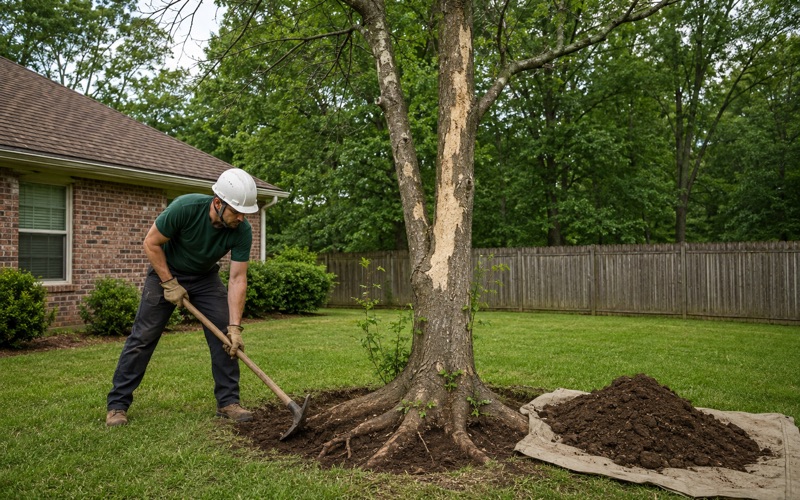
A specimen tree carried through construction has to survive grading, trenching, compaction and material storage stacked inside its critical root zone, which on most species reaches well past the drip line. The protection that works is a fenced tree protection zone set before the first machine arrives, not a ribbon tied around the trunk after the pad is cut.
Almost nobody calls a tree crew during that window. Root damage inflicted during construction expresses itself as crown dieback several seasons later, so the call reaches us three or four summers after the driveway was poured, when a third of the canopy is bare and the owner assumes the tree caught something.
What we look at on a retained tree
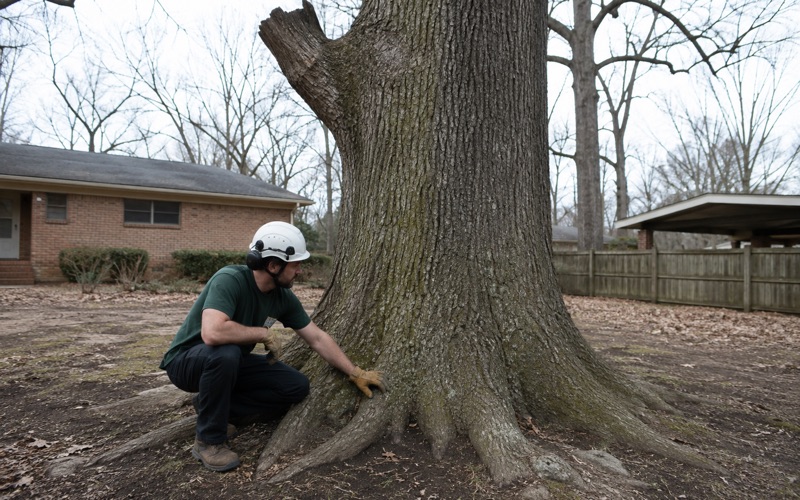
We start at the bottom: a root flare buried under fill, girdling roots circling the trunk, bracket fungus or a conk at the root collar, included bark between co-dominant stems, epicormic sprouts filling in for limbs that lost their crown. Where the real question is how much sound wood is left around a decay column, resistance drilling measures it instead of guessing. The industry frameworks for this are the ANSI A300 tree care standards and the ISA Tree Risk Assessment Qualification, and we deliver written condition and risk documentation as its own priced item rather than folding it into a sales visit.
Storm work on a root plate that was already cut
The National Weather Service Huntsville survey of the April 27, 2011 EF5 tornado tracks it narrowing to about 300 yards near Anderson Hills, where winds of 140 to 160 mph destroyed dozens of well-constructed homes, and records complete wall collapse on several homes near Harvest at those same high end EF-3 wind speeds. That day brought 39 tornadoes to the Huntsville forecast area out of 62 across Alabama. A tree standing on half the root plate it grew is the one that goes over in far less wind than that, which is why we answer storm and hazard calls the same day, with the plain limits the ANSI Z133 safety requirements put on working near energized conductors in wind and ice.
Taking one down over a finished house
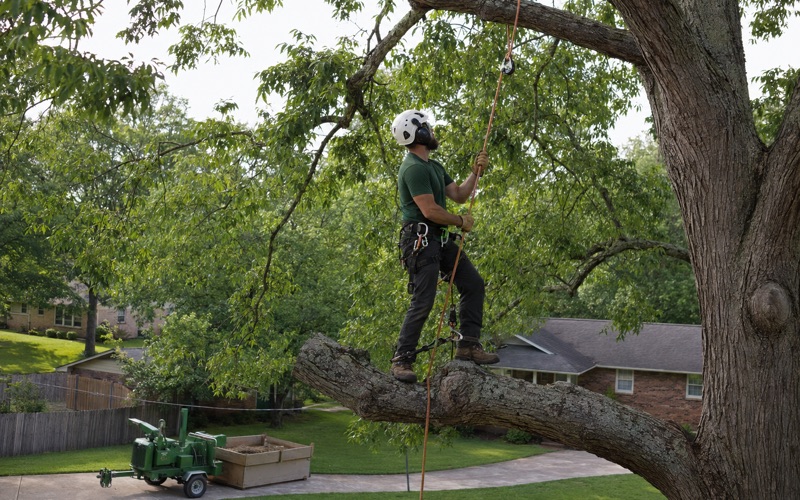
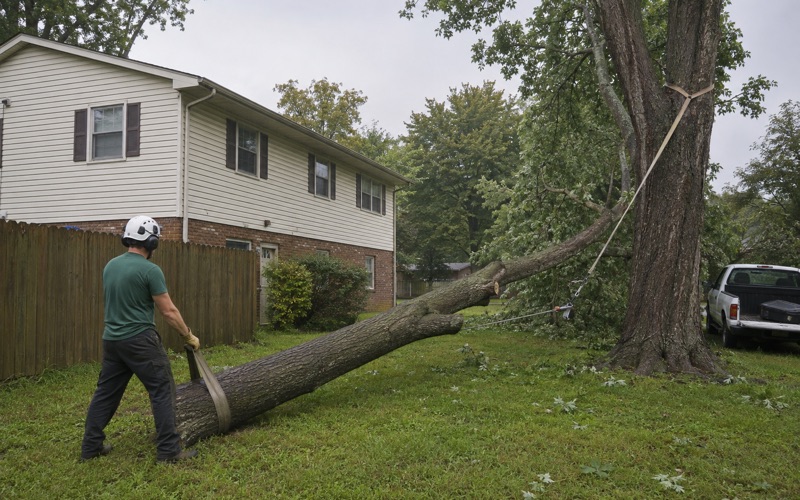
On a lot this size there is usually no drop zone at all. A retained oak between a rear deck and a property-line fence comes down in sections, each piece let out on a bull rope through a rigging block and checked on a Port-a-Wrap friction device rather than dropped, with a tracked spider lift getting through a gate no bucket truck will fit. Directional felling with a notch and back cut is reserved for the few lots that still have open woods behind the rear line.
Where the tree is worth keeping, the alternative is smaller work: crown cleaning to take out the deadwood a stressed tree sheds first, a reduction that shortens the leverage a long limb has over the roof, or a static or dynamic cabling system across co-dominant stems with included bark between them. We price that against removal on the same estimate, so the choice is visible before anything is cut.
Who signs off when there is no city
Harvest is an unincorporated community and census-designated place in northwestern Madison County. There is no mayor, no council and no corporate limit, so no municipal tree permit, removal threshold or landscape requirement applies to a lot here. That is not the same as no rule, and treating it as though it were is how a job goes wrong.
What governs instead is the Madison County Subdivision Regulations, enforced by Madison County Public Works across the unincorporated areas, together with that department’s right-of-way management for anything standing between a front yard and the road and its stormwater and drainage responsibility; the county number is (256) 746-2900. At the state level, ADEM’s NPDES general permit ALR100000 authorizes discharges from construction disturbing one acre or more, and from smaller sites that form part of a common plan of development or sale, with a section requiring natural riparian buffers or equivalent sediment controls. That is the authorization a builder clearing a tract here works under.
The recorded declaration is the tree rule on most streets
Where a subdivision carries covenants, the recorded declaration and its architectural control committee are the operative restriction on removing anything, and those instruments are filed with the Office of the Judge of Probate of Madison County. We read the document recorded against the specific street before anyone quotes a size limit, because the limit belongs to the declaration and no county-wide number exists to substitute for it.
Before the grinder touches ground
An Alabama 811 locate request is required ahead of excavation, and stump grinding and root excavation both count as excavation. Water, sewer and fire protection here come from the Harvest-Monrovia Water, Sewer and Fire Protection Authority, formed on August 2, 1965 to operate a domestic water system for the Harvest and Monrovia area and extended to sewer service in 2002, with a board appointed by the Madison County Commission and offices on Wall Triana Highway. Electric service is Huntsville Utilities, which holds the distribution right of way and puts responsibility for clearing trees off the pole-to-house service wire on the customer; we arrange that service-drop disconnect before anyone works near the span. Institutional grounds answer to the same offices, and the boundary plantings around Sparkman High School on Jeff Road came in with the same building wave as the houses around them.
The stump, the grindings and where the wood goes
Nothing from a tree job here goes to the curb. Madison County Waste Control and Recycling collects household garbage and large items but refuses contractor-generated debris outright, and a resident who hires a contractor for yard work is told the contractor removes it from the property. Tree stumps are named among the items the county does not pick up, and green waste is limited to limbs under 8 feet. The haul is a line on our estimate because it is a real cost, and every quote states plainly whether haul-away is included so a low number and a high number can actually be compared.
Grind depth is a machine question here, not a rock question
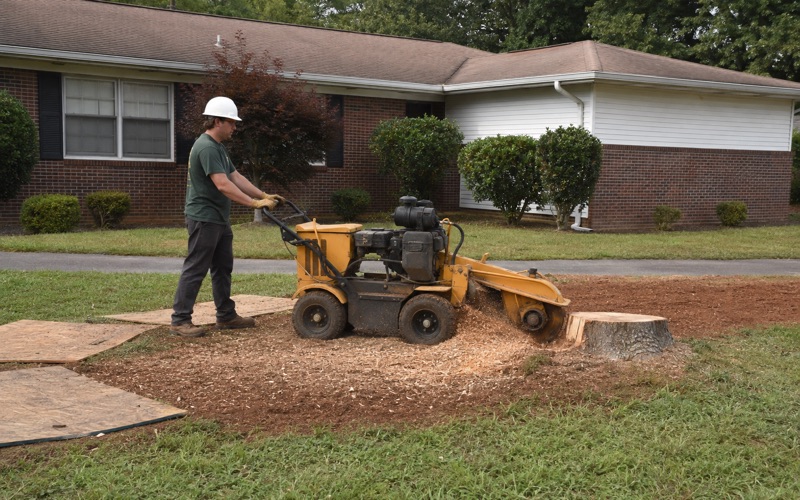
These are the Limestone Valleys and Uplands soils, weathered mainly from limestone residuum. The Decatur series carries a solum more than 72 inches thick with limestone bedrock deeper than 6 feet, and the Dewey series exceeds 60 inches on both counts. A stump grinder’s rated cut of roughly 12 to 25 inches below grade therefore ends the job long before bedrock enters the conversation. On the cherty upland ground toward Capshaw Mountain the Bodine series averages 35 to 80 percent rock fragments, where the cost is carbide tooth wear rather than refusal. A recently graded lot adds a variable no soil survey describes: imported fill and compacted subgrade, which change both the grinding and the shape of the root plate beneath it.
Ash, and what leaves the property
The Alabama Forestry Commission confirmed emerald ash borer in Madison County on June 6, 2025, the first confirmed observation in this county. Its guidance is that infested ash trees cut down should preferably be burned or destroyed on site to slow the insect’s dispersal, which runs directly into the county’s refusal to collect the debris, so an ash removal gets its disposal settled before the saw starts. Otherwise the grindings, chips and rounds go with us or stay, at your choice: leave the rounds cut and stacked and the firewood credit shows on the same estimate, take them away and that shows too.
- 20+ Years in the Tennessee Valley
- Free Written Estimates
- Crane and Narrow-Access Equipment