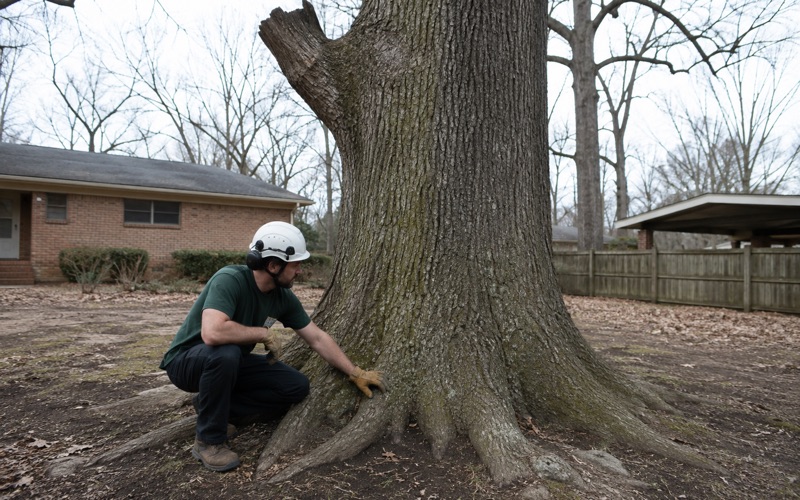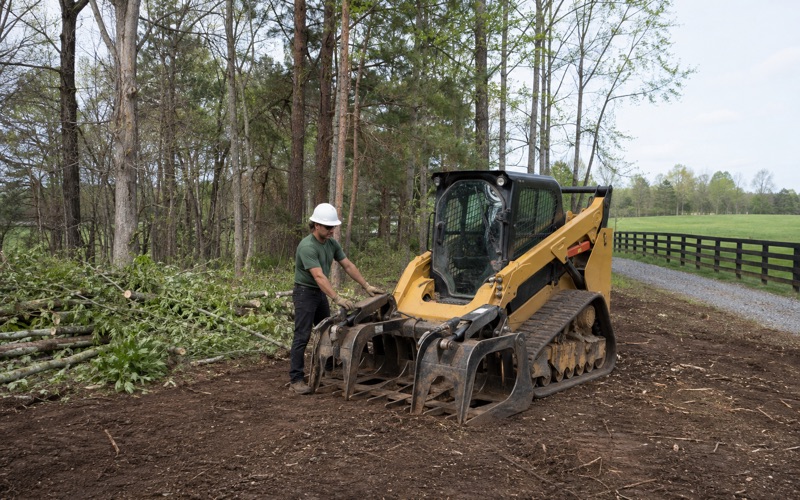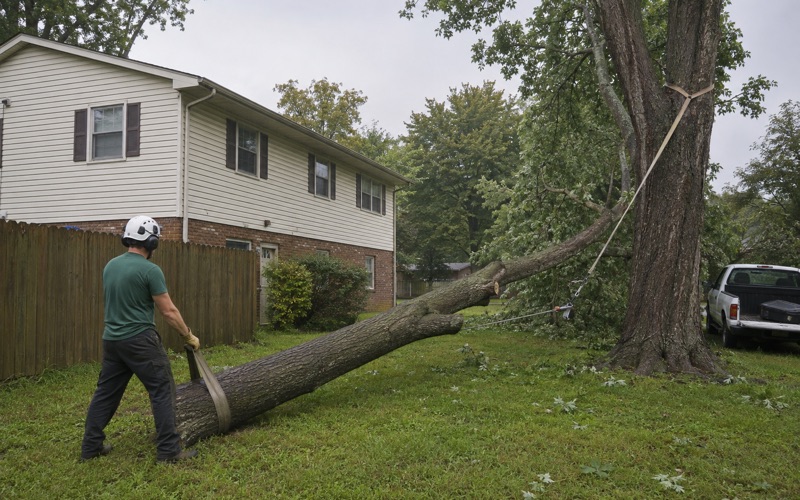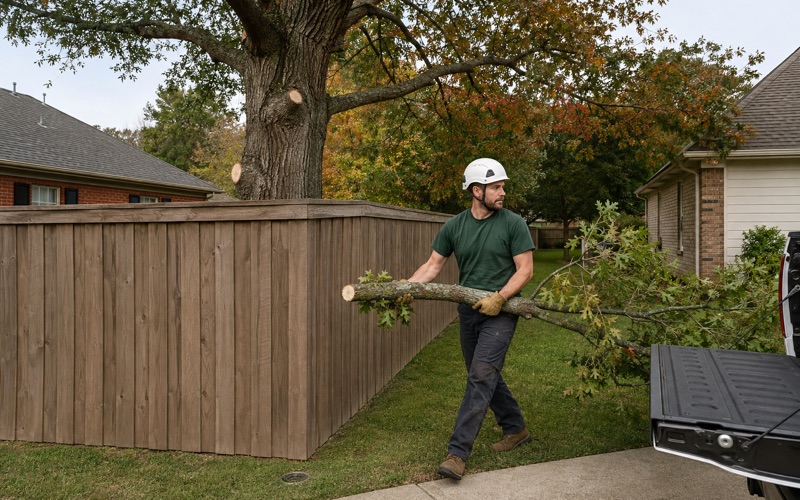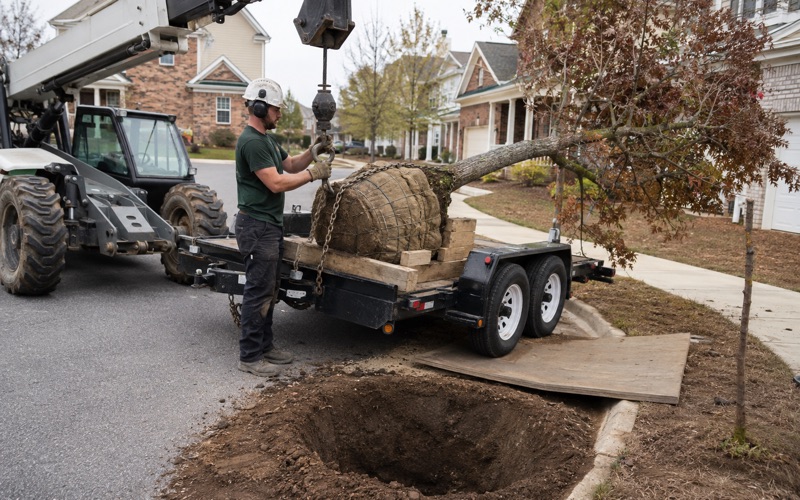
Madison Tree Removal Pros has run tree service in Huntsville for more than twenty years, and on a Huntsville property the first thing we measure is not the trunk. It is the access: gate width, the drop zone, the carry distance back to the truck, and whether a chipper can get anywhere near the work. Those four numbers move a price further than diameter does, and we settle them before the tree is quoted.
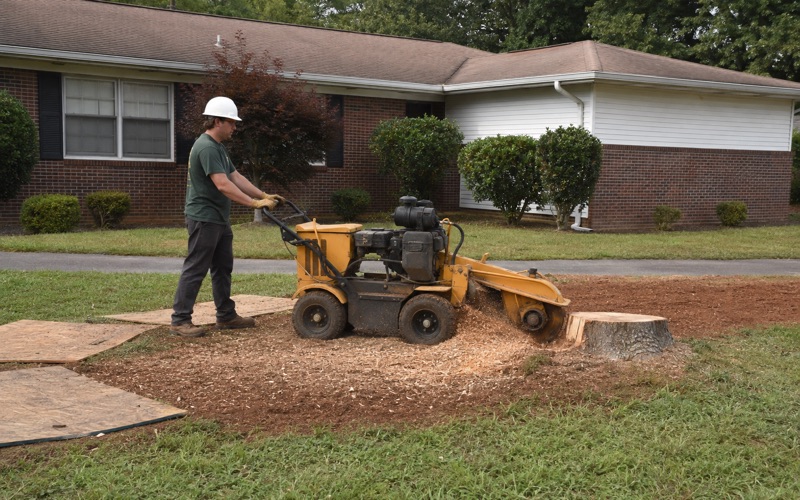
Every written estimate we give here splits into three lines — the takedown, the stump, and the debris haul — because those are the three items Huntsville quotes disagree about. Each one says plainly whether haul-away is included, so a low number and a high number can actually be compared. If you want the rounds left cut and stacked for firewood, the same estimate shows what that credit is worth.
Storm and hazard calls get a same-day response with one limit stated up front. ANSI Z133 governs how close a crew may work to an energized conductor, and in wind or ice that standard sets the order of operations, not the schedule.
Two forests inside one set of city limits
Most cities sit in one forest. Huntsville sits in two, and the seam runs straight through the service area.
Point queries against the EPA’s Level IV ecoregion service put downtown, at 34.7304, -86.5861, in 71g Eastern Highland Rim within Level III 71 Interior Plateau. Monte Sano at 34.7420, -86.5150 and Green Mountain at 34.6300, -86.5300 both come back 68c Plateau Escarpment, inside Level III 68 Southwestern Appalachians. Same city limits, two different Level III regions.
The valley floor, and what it means at the stump
On 71g the community is oak and hickory, with cedar glades where the soil sits thin over limestone. Off the glades the valley ground is deep residual soil: of the two series common on these limestone valley uplands, one carries a solum more than 72 inches thick with limestone bedrock deeper than six feet, and the other runs more than 60 inches to bedrock. Both are well drained.
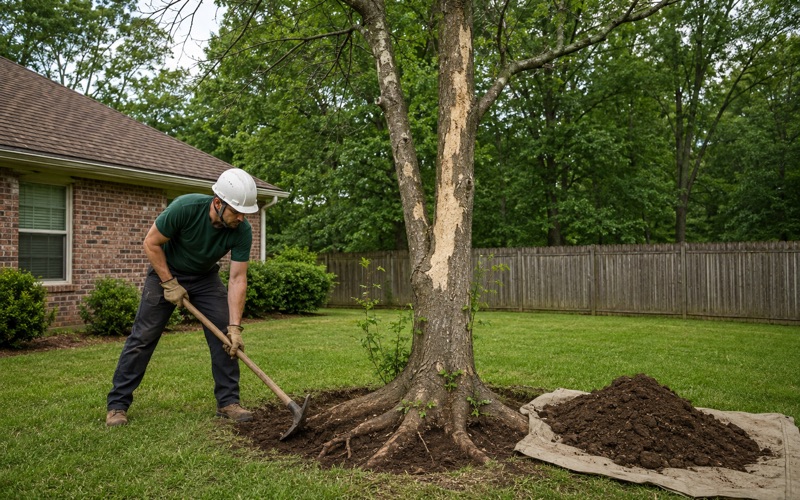
That changes what limits a grind. On this ground the binding constraint is the cutting wheel’s own rated reach, typically 12 to 25 inches below grade, rather than rock the carbide teeth cannot pass. We have not measured the slope soils on Monte Sano or Green Mountain and we do not assume they behave the same way, so a mountain stump gets quoted after we see it.
The escarpment, and the trees that live on it
The EPA’s own description of 68c gives mixed oak and chestnut oak on the upper slopes, then beech and yellow poplar with sugar maple, basswood, ash and buckeye through the middle and lower slopes, with rare hemlock along rocky streamsides. A yellow poplar standing in a cove is not the same removal as a chestnut oak on the ridge above it: different height, different taper, different rigging.
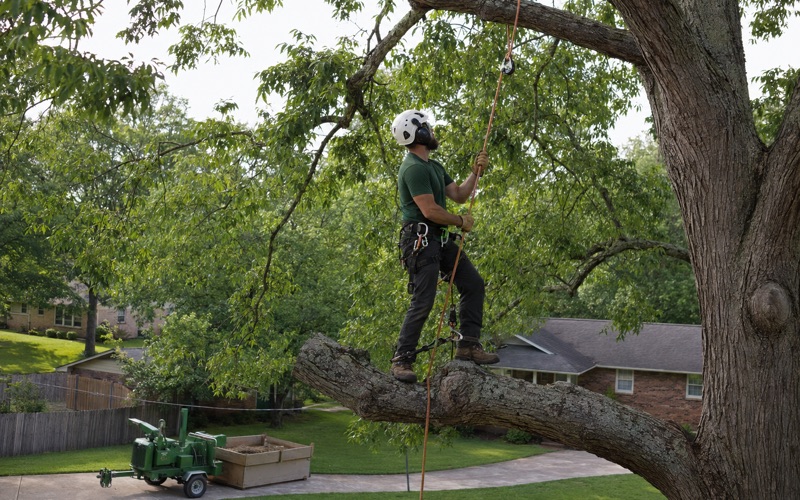
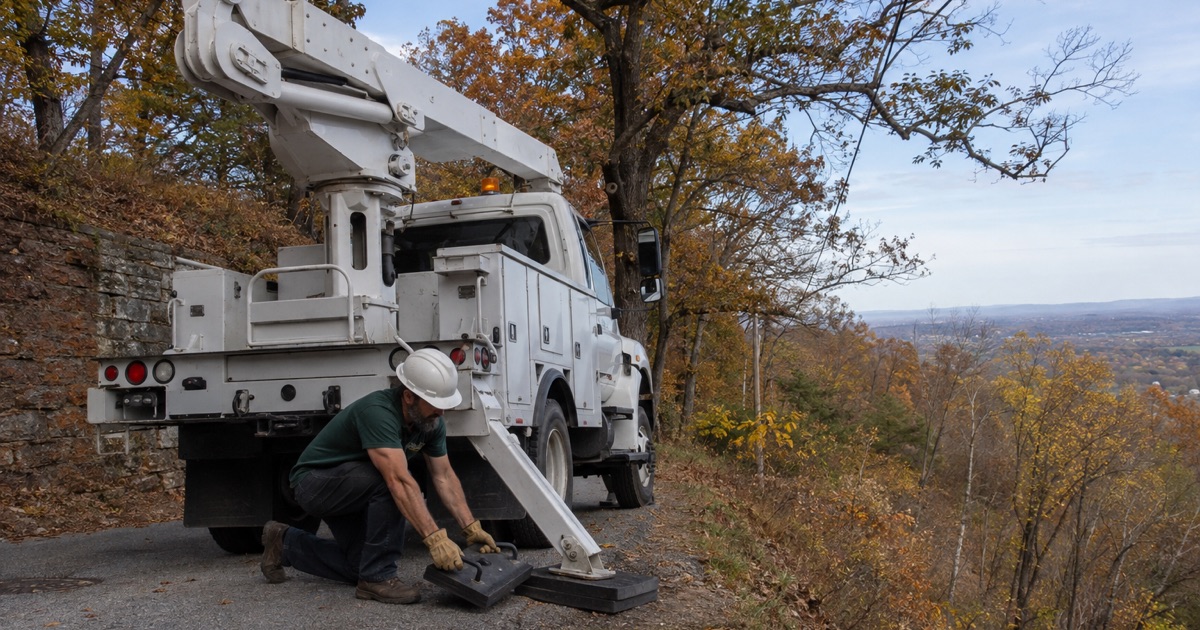
The city names Monte Sano and Dug Hill Road as its concentration point for tree-fall in storms, and the terrain explains why — the escarpment carries the tallest and most exposed stands in Huntsville. Those jobs are usually sectional dismantling with a rigging block and a friction device taking the load, because a slope offers no drop zone for a felling notch and back cut. Where a bucket truck cannot be set level, a tracked spider lift walks in on ground a wheeled machine would tear open.
Looking for tree-removal closer to Redstone Arsenal? See Tree-Removal Services in Redstone Arsenal.
Where the permit question flips
Huntsville regulates trees in detail. Chapter 27 of the Code of Ordinances is titled Vegetation; Article II, Trees, runs from purpose, policy and definitions through offenses, enforcement and penalties into eight substantive maintenance sections, down to a voltage-by-voltage clearance table. With all of that on the books, the chapter creates exactly one removal permit — and it is not for your yard.
Section 27-51(d) provides that any person or agency needing to remove a tree six inches or more in d.b.h. from public land shall first obtain a removal permit from the city forester by telephone, and that such permits shall be issued at no cost under guidelines established by the tree commission. The same subsection requires whoever removes a permitted tree at that size to provide for planting new trees in approximately equal numbers, at locations mutually agreed with the city forester. It is the rule that governs ground the public uses — Big Spring Park at the downtown spring, or the old shade canopy over Maple Hill Cemetery — where the job opens with a phone call rather than a quote.
Your tree, your land
Section 27-52(a) states that trees on private property belong to the landowner, while recognizing their public usefulness and their value in energy conservation, in moderating extremes of temperature and humidity, in reducing noise, glare and air pollution, in reducing soil erosion, and in improving the city’s aesthetic character.
The tree commission’s role on private land is technical guidance to landowners and developers, conservation partnership and cooperative community projects. It issues nothing and it approves nothing. That section took effect February 12, 2004 under Ordinance No. 04-45.
The design was deliberate from the start. The tree ordinance passed the City Council in August 1981 as Ordinance No. 81-228, and the contemporaneous account of the drafting says outright that proposing a system of permits and inspections would have doomed the whole effort. Residents still flag a suspect tree through the SeeClickFix app or Huntsville Connect rather than at a permit counter.
When the line itself is the argument
Under section 27-51(b), where a hazardous tree stands wholly on private property the abatement cost is assessed to the owner; where it stands partly on private and partly on public property, the expense is prorated by the proportion of stump diameter on each side. We write condition and risk documentation as its own priced deliverable for situations shaped like that — boundary questions, insurance claims — instead of burying it inside a sales visit.
Historic designation adds a calendar rather than a tree rule. In Twickenham, designated the city’s first district in 1972, or in Old Town, a project resulting in exterior changes to buildings or their settings needs a Certificate of Appropriateness or Expedited Staff Review from the Huntsville Historic Preservation Commission before a building permit issues. Applications close at end of business on the last Monday of the month and the commission meets the second Monday at 4:30 p.m., so tree work tied to such a project runs on a month-long clock.
The line-clearance ordinance, and the species written into it
Huntsville did not leave line clearance to the utility’s own policy. Section 27-55(a) requires that pruning to maintain clearance between an existing tree and an electric power line be conducted in accordance with ANSI Standard A300. Subsection (b) then sets maximum clearances by voltage class: no minimum for telephone and television cable; two feet on existing construction and four feet on new construction for insulated secondary lines of 21 to 750 volts; ten feet for uninsulated distribution and transmission lines of 750 to 35,000 volts; and fifteen feet above 35,000 volts.
Subsection (c) is the one worth reading as a homeowner. It permits Huntsville Utilities to raise those clearances to fifteen and twenty feet respectively for a named list of species that includes hackberry, boxelder, silver maple, cottonwood and loblolly pine. That is the city writing down, in its own code, which trees climb back into a conductor fastest — and it is close to the same short list of brittle, fast, short-lived trees behind most of the removal calls we take in town. Subsection (d) adds that where a tree interferes with system operation and cannot be properly pruned, Huntsville Utilities may offer to remove it and request replacement planting by the city.
The wire from the pole to the house is yours
Huntsville Utilities states that responsibility for clearing trees away from the customer’s own service wire, pole to house, rests entirely with the customer. That single sentence causes more confusion on a Huntsville quote than anything else in the code. We arrange the service-drop disconnect with the utility before anyone works near that wire, and we say so on the estimate.
For street-side trees the utility itself removes, it grinds all resulting stumps and offers a one-for-one replacement voucher for up to three trees at participating local nurseries. Neither applies to a back-yard tree or to a tree taken down at a specific customer request, and in those cases the customer handles the planting and the grinding debris.
The curbside math, and a pile the city refuses twice
The City of Huntsville collects tree limbs up to 10 cubic yards at no charge. A pile past that is chargeable at $55 for collection, and each additional five cubic yards adds a further $55. Yard waste that meets specifications but is not placed in a container may be picked up for a minimum fee of $45 per cubic yard, and tree limbs cannot exceed 5 feet in length. All collection fees are billed onto the resident’s monthly Huntsville Utilities bill, so a debris decision made on a Saturday morning surfaces weeks later on a statement.
A takedown is measured in cubic yards, not in weight, and one mature yellow poplar off a slope fills 10 cubic yards without trying. Estimating the volume before the crew arrives is what separates a free collection from a charge nobody priced.
Refused twice, in the city’s own words
Huntsville excludes contractor debris in two separate places. The city states that it will not pick up construction debris or any debris resulting from a contractor’s work or commercial project. Separately, in its list of common items not collected — alongside dirt, rocks, bricks, cinder blocks, shingles and concrete — it names tree limbs or trimmings resulting from land clearing. And it says plainly that contractors are responsible for removing any debris generated from their work at your home.
So a quote that leaves haul-away vague is not a cheaper quote. It is a pile the city has already refused in two places, sitting at your curb. Ours states whether the haul is included, and the grindings, chips and rounds leave or stay at your choice, with the disposal rule explained rather than absorbed into a surprise line.
Ash is now its own decision
The Alabama Forestry Commission confirmed emerald ash borer in Madison County on June 6, 2025, its first confirmed observation in the county. Damage usually begins at the top of the crowns of ash trees and proceeds downward, which is why a thinning upper crown on an ash is worth a look before it becomes a hazard rather than a pruning question. The commission advises that infested ash trees which are cut down should preferably be burned or destroyed on-site to slow the insect’s dispersal — one more reason the debris line on a Huntsville estimate deserves to be settled in writing before the saws start.
- 20+ Years in the Tennessee Valley
- Free Written Estimates
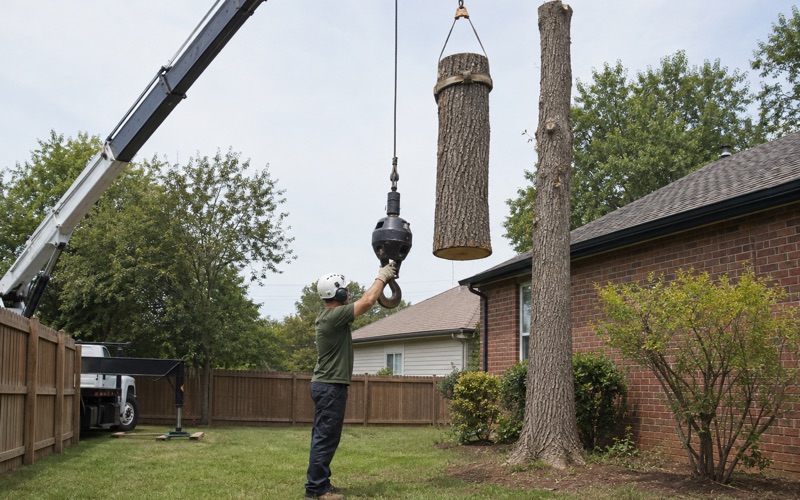
- Crane and Narrow-Access Equipment