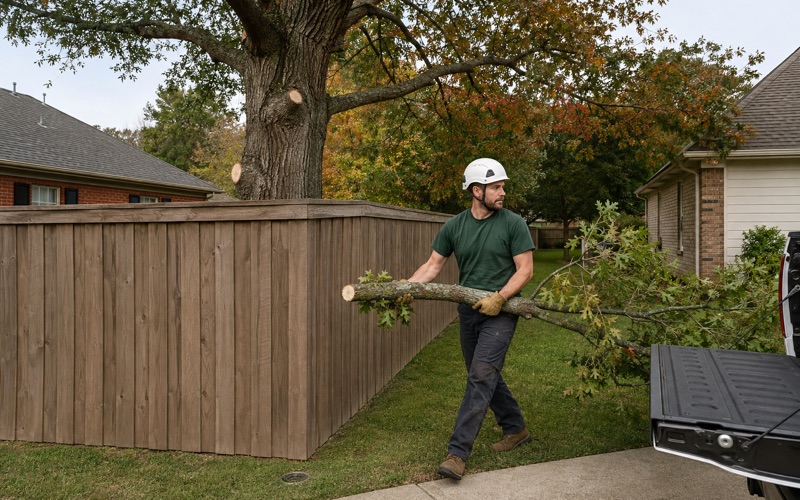
Madison Tree Removal Pros handles tree removal in Meridianville, and after more than twenty years of tree work across the Tennessee Valley we quote a job the way a homeowner has to compare it. The takedown gets one line, the stump gets a second, and the debris haul gets a third. Whether haul-away is included is stated in plain words on the same page, so a low number and a high number can be set side by side.
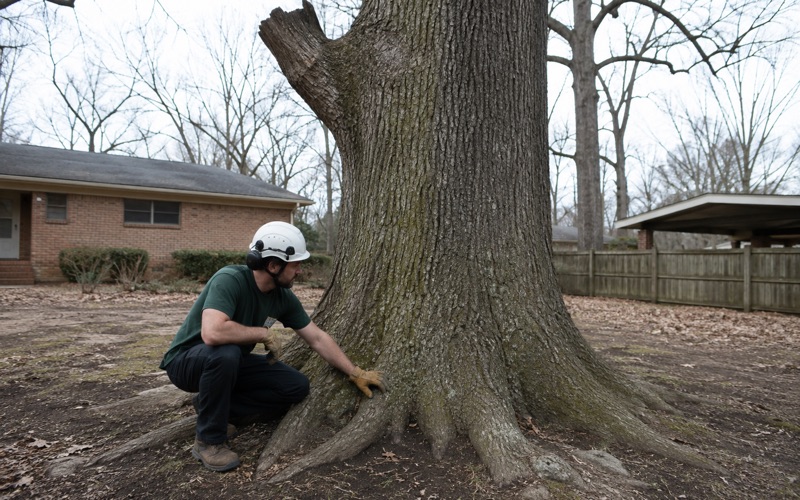
Before any of those numbers exist, somebody walks the approach to the tree. Gate width, the drop zone if there is one, how far the wood has to travel to the truck, and whether a chipper can get within reach of the work all get measured first. They decide the method, and the method decides the price. Where the rounds are worth keeping, the firewood credit is shown both ways on the same estimate: cut and stacked where they fell, or gone with us.
One question comes up on this side of Madison County that comes up almost nowhere else, and it is about how tall a tree is allowed to get. The answer is more interesting than the rumor version, and it starts with a runway.
The airport inside the community, and the trees the federal record names
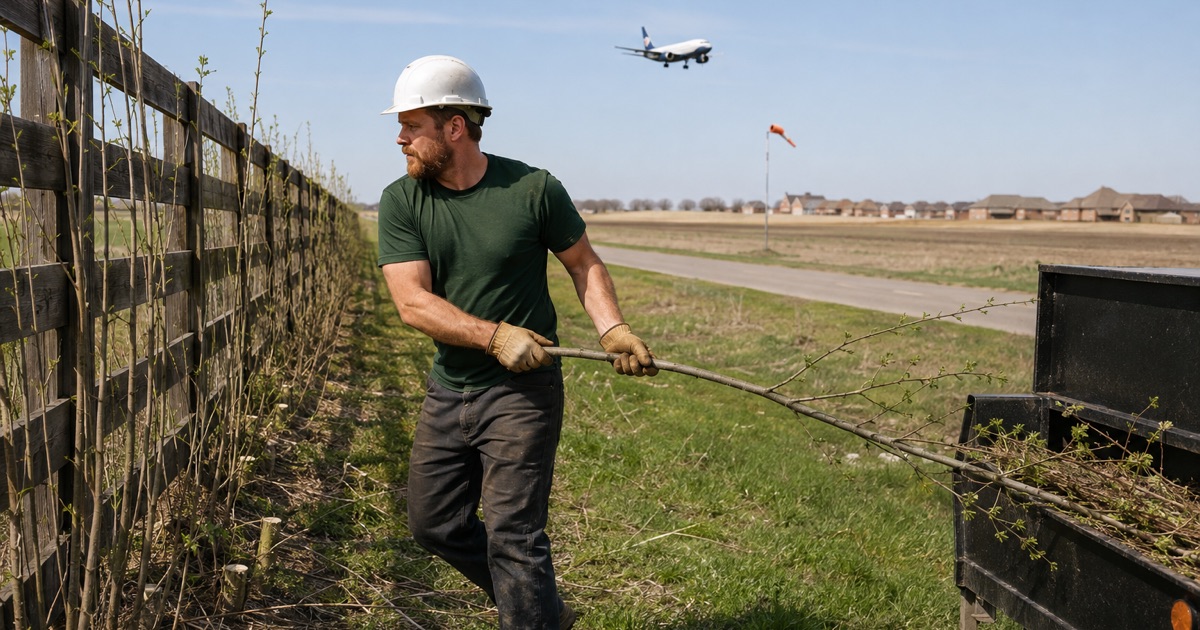
Huntsville Executive Airport, also called Tom Sharp Jr. Field, sits inside Meridianville and is owned and operated by the Madison County Executive Airport Authority. It is a publicly owned, public-use general aviation field with a single asphalt runway, 18/36, measuring 6,500 by 100 feet at a surveyed field elevation of 763.2 feet. Runway 18 carries precision markings and an ILS/DME approach, and each end has a four-light PAPI set to a 3.00 degree glide path.
The part of that record which reaches the ground under it is the runway end obstruction data. For Runway 18 the FAA airport master record publishes 39-foot trees, 1,074 feet from the runway, 204 feet left of centerline, on a 22:1 slope to clear. Runway 36 lists no obstruction at all. That is a federal document naming a stand of trees at a stated height, distance and offset, and it is the most concrete tree-and-airspace fact anyone can point to in this community.
What Part 77 attaches to, and what it does not
14 CFR 77.9 requires notice to the FAA, filed on Form 7460-1, for construction or alteration that stands more than 200 feet above ground at its site, or that exceeds a slope of 100 to 1 for a horizontal distance of 20,000 feet from the nearest point of the nearest runway, where the airport has at least one runway longer than 3,200 feet. Runway 18/36 is 6,500 feet, so the 100 to 1 surface is the one that governs the ground around it. Objects shielded by an existing permanent structure or by natural terrain are exempted from the notice requirement.
Read the section closely and it attaches to construction and alteration. It does not by its terms regulate the growth of a tree, which is how an owner can find trees listed as the obstruction on the published approach and still find no federal filing that applies to the oak in the back yard.
The state chapter that could reach a tree, and the adoption that never happened
Title 4 Chapter 6 of the Alabama code is the state’s airport zoning chapter, and it is the place where tree height becomes reachable in law. It defines an airport hazard to include any structure or tree or use of land which obstructs the airspace. Section 4-6-8 lets a person who wants to permit the growth of any tree in violation of adopted airport zoning regulations apply to the administrative agency for a variance, bars any permit that would let a nonconforming tree become a greater hazard to air navigation than it was when the regulation was adopted, and allows a permit or variance to be conditioned on the owner letting the political subdivision install and maintain markers and lights at its own expense. Section 4-6-15 regulates the height of structures of trees.
All of it operates only through regulations that a political subdivision adopts, and no adoption covering this airport was located. The honest statement to a Meridianville property owner is therefore precise rather than alarming. Nothing here requires a permit to remove a tree, and nothing we could find requires a permit to let one grow; what is real is the published obstruction and the approach surfaces passing over these parcels either way. Where a buyer, an insurer or a neighbor wants the height and condition of a specific tree on paper, we price that documentation as its own deliverable rather than folding it into a sales visit.
Looking for tree-removal closer to Decatur? See Tree-Removal in Decatur.
Who governs a tree on an unincorporated Meridianville lot
Meridianville is a census-designated place, not a municipality. There is no mayor, no council, no corporate limit and no municipal code, so no city tree permit, landscape requirement, removal threshold or zoning overlay of any kind applies to a lot here. The governing body is the Madison County Commission, and the working authority is Madison County Public Works, which enforces the Madison County Subdivision Regulations across the unincorporated county along with plat review, public improvements and drainage, at (256) 746-2900.
Anything standing between the yard and the pavement
A tree between a front yard and the road is a right-of-way question, and right-of-way management in the unincorporated county belongs to the same department. That reaches the US-231 and US-431 corridor, the Memorial Parkway route running north out of Huntsville that carries most of the traffic through here. Whose ground the trunk is standing on gets settled before a saw comes off the truck, because the answer changes who authorizes the work and who pays for it.
The recorded declaration is the rule that actually bites
With no municipal ordinance anywhere in the picture, a subdivision’s recorded declaration of covenants and its architectural control committee are the operative tree restriction on any lot that carries one. Those instruments are filed with the Office of the Judge of Probate of Madison County, and the size limits, replacement requirements and approval steps inside them vary from one subdivision to the next. We read the document recorded against the specific street rather than quoting a general figure, because no county-wide number exists to fall back on.
New houses, owned by the people in them, and older trees overhead
The ACS 2024 five-year estimates count 4,187 housing units in the Meridianville CDP, of which 6.6 percent were built before 1980 and 93.8 percent are one-unit detached houses. Owner occupancy runs 92.5 percent, and 3,511 of those owner-occupied homes are detached single-family. The person who calls us therefore owns the tree, pays for the work and decides at the kitchen table, which is the whole argument for an itemized written estimate over a single spoken number.
It also means the houses are frequently younger than what is standing over them. Lynn Fanning Elementary takes the community’s kindergarten through third grade, and roadside work on the streets feeding it gets staged outside the morning and afternoon school runs.
Getting a large tree out of a yard with no room to drop it
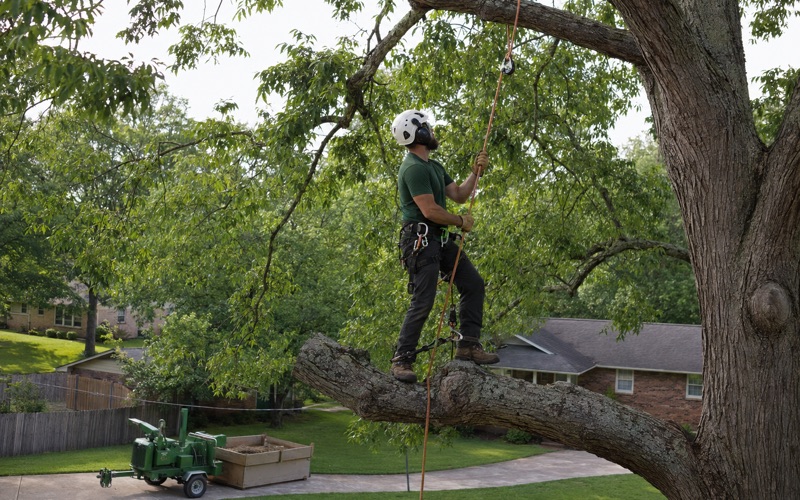
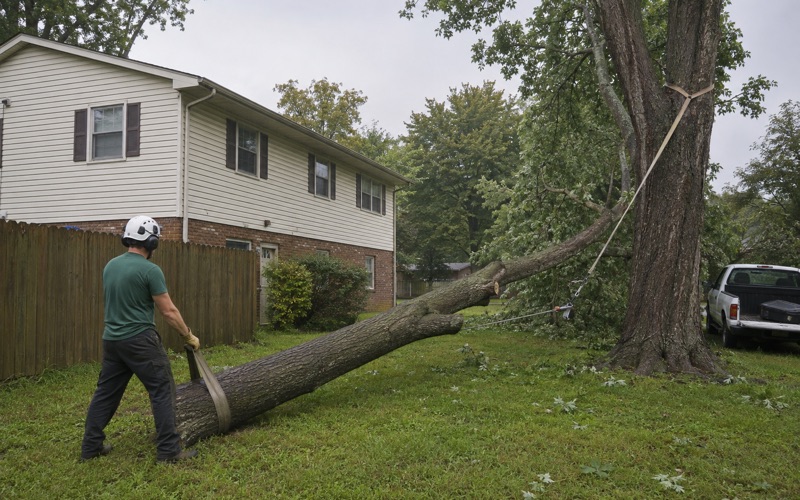
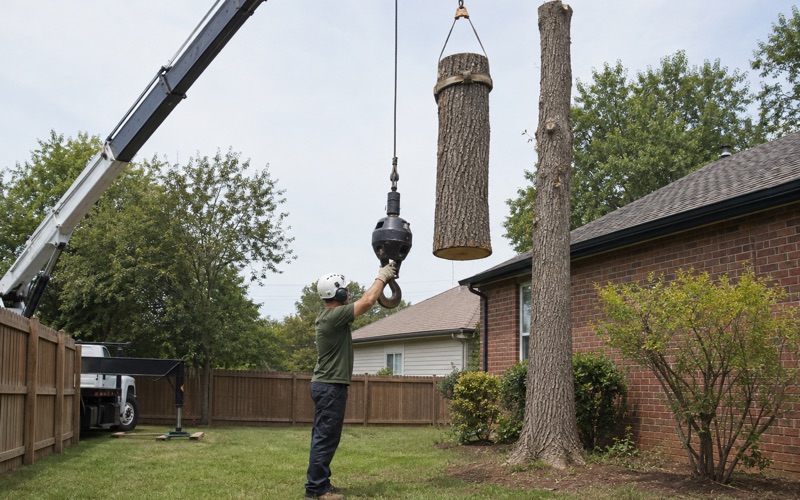
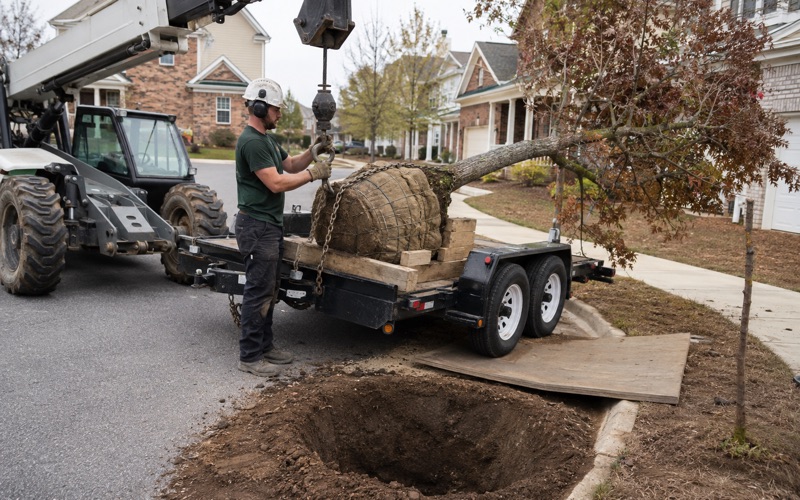
On these lots the wood comes down in controlled pieces rather than in one fall, on a speed line where the geometry allows one and lowered on rigging gear where it does not. Anything leaning over a structure gets crane or tracked-lift capacity, since the load never has to swing over the roof it is being taken off. A fenced back yard gets a narrow-access machine sized to the gate, because a bucket truck parked at the curb reaches nothing behind the house.
The service drop, and what happens on a storm call
Huntsville Utilities distributes electricity across all of Madison County, holds the distribution right of way here, and earned Tree Line USA utility certification from the Arbor Day Foundation in 2022. Its published position puts clearing trees off the customer service wire, the pole-to-house span, entirely on the customer. The stump grinding it performs is limited to the street-side removals it carries out itself, excluding back-yard trees and trees taken at a specific customer’s request, with the grinding debris left to the property owner. We arrange the service-drop disconnect before anyone works that span; its line clearance number is 256-535-1224.
Storm and hazard calls get a same-day response, and Meridianville sits in National Weather Service public forecast zone ALZ006, Madison, out of the Huntsville forecast office. What we will not do is pretend the weather makes no difference to what a crew can legally reach. When wind or ice puts an energized conductor in play, ANSI Z133 is what holds the job until the line is handled, and we say so before arriving rather than after.
Brier Fork ground, the buffer that comes with it, and where the wood goes
The Flint River rises in Lincoln County, Tennessee and runs south into Madison County, where most of its 342 square mile watershed lies before it reaches the Tennessee River. Brier Fork is one of its two major tributaries, entering from the northwest and touching Lincoln County at the top of its own run. That watershed is predominantly agricultural land absorbing heavy recent residential growth out of Huntsville, which is precisely the ground these subdivisions were platted on.
Vegetation on a bank along either stream is the one place a state permit reaches a tree job here. ADEM’s NPDES construction stormwater general permit, ALR100000, authorizes discharges from land disturbance of one acre or greater, and from smaller sites that form part of a common plan of development or sale; its Part III.B requires natural riparian buffers or equivalent sediment controls. We confirm the version currently in force before quoting it, because the permit runs on a fixed term and is reissued.
Before the grinder turns
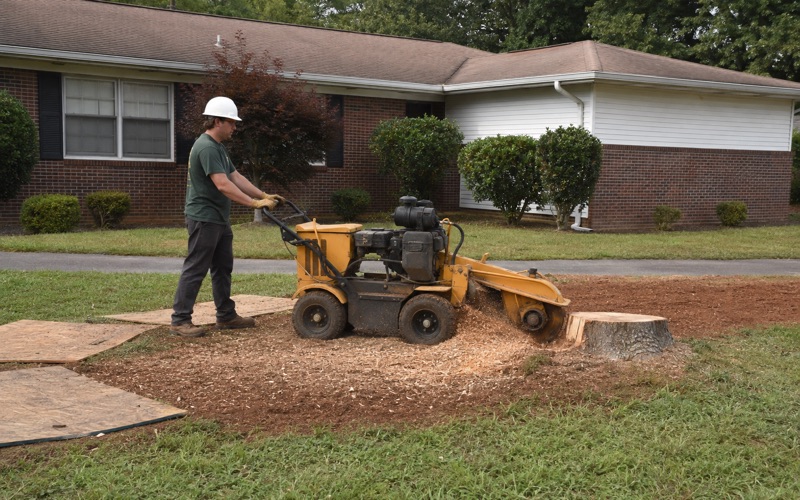
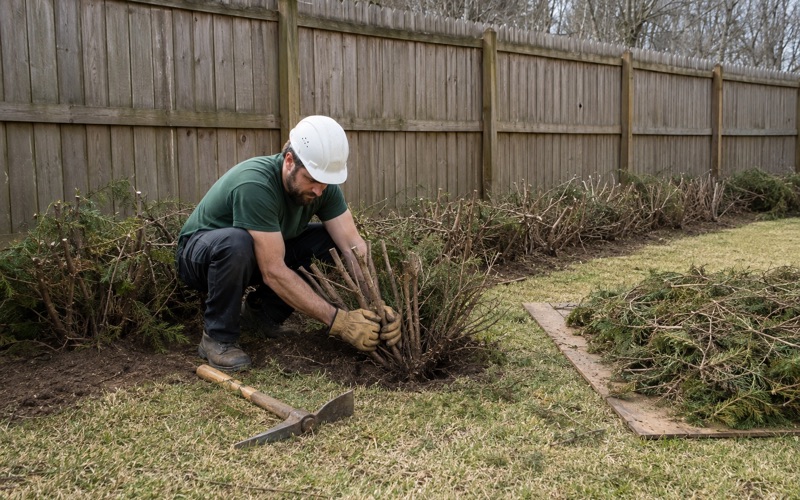
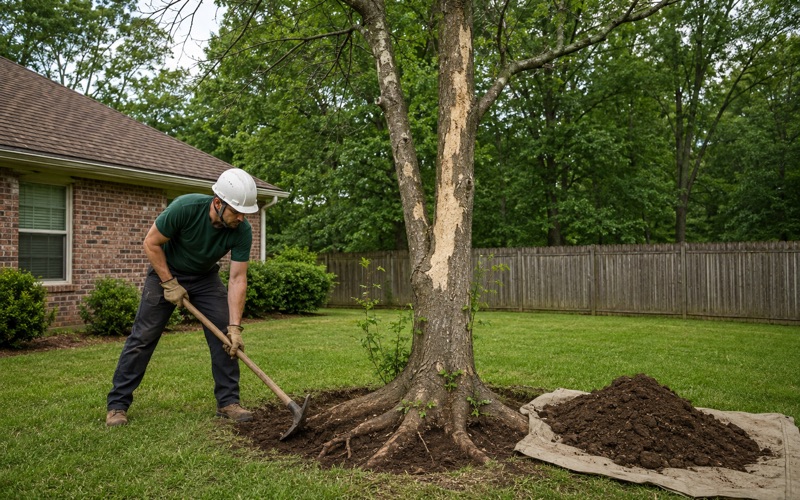
An Alabama 811 locate request is required ahead of excavation, and stump grinding and root excavation both count as excavation. What sets the finished depth after that is the machine rather than the ground: a grinder’s rated cut of roughly 12 to 25 inches below grade ends the job well above the limestone that underlies these valley soils. On a recently graded lot the variable is imported fill and compacted subgrade, which no soil survey describes and which changes both the grinding and the shape of the roots beneath it.
The debris rule this community actually lives under
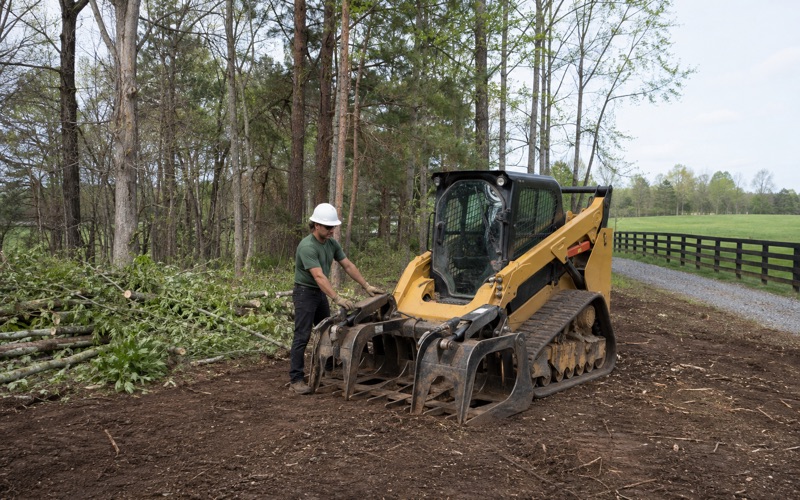
Madison County Waste Control and Recycling collects household garbage and large items, and refuses debris generated by contractors outright; a resident who hires out yard work is told the contractor removes it from the property. Tree stumps are named among the items it does not pick up, and its green waste category caps limbs under 8 feet in length. That is why the haul carries its own line on our estimate. It is a real cost with a real rule behind it, and burying it inside a takedown number is how two quotes stop being comparable.
- 20+ Years in the Tennessee Valley
- Free Written Estimates
- Crane and Narrow-Access Equipment