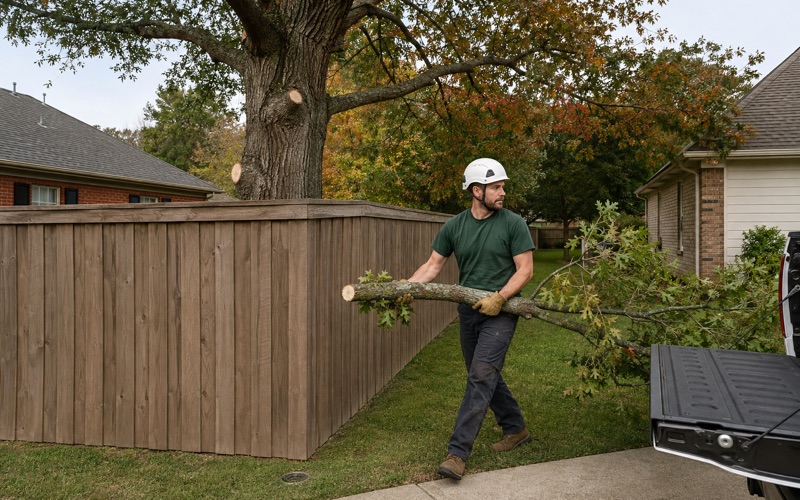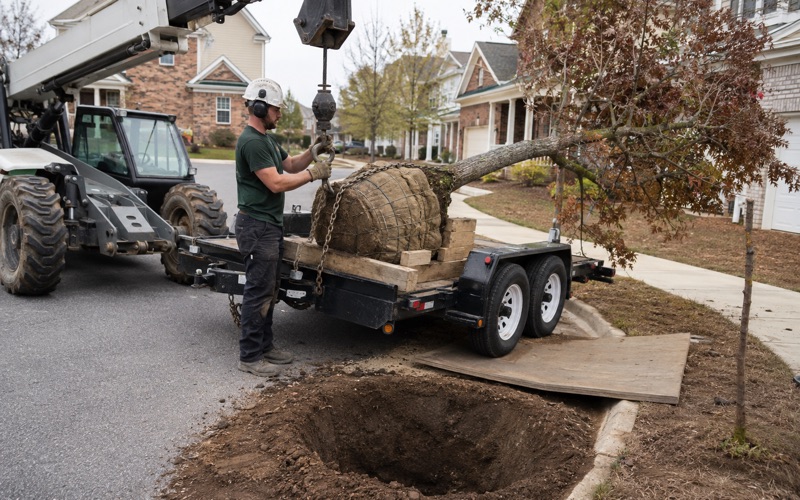
Madison Tree Removal Pros has been doing tree removal in Moores Mill for more than twenty years, and the first thing we tell a homeowner here is that the number on a neighbor’s estimate almost never transfers to their own tree. Two properties on the same road can carry trees three decades apart in age, and age drives everything downstream: the rigging, the machine, the stump and the pile of wood left over.
So we quote in three separate lines, the takedown, the stump and the debris haul. Those are the three items estimates in this area disagree about, and folding them into one figure is how two quotes stop being comparable. Every estimate we write says plainly whether haul-away is included, and it shows the firewood credit both ways: rounds cut and stacked in your yard, or gone with the truck.
We also measure access before we price the tree. Gate width, the carry distance to the truck, the drop zone and whether a chipper can get within reach of the work change what a job costs more than trunk diameter does.
Two tree ages on one street, and why the estimate changes next door
Moores Mill holds 2,678 housing units, and 18.9 percent of them were built before 1980. That one figure explains most of what we run into here, because it sits well above a subdivision built out in a single push and well below a settled rural community. The housing did not arrive all at once. It arrived in waves, lot by lot, and the trees came with each wave.
The result is a road where a brick ranch from the 1970s stands under a closed canopy and the parcel beside it carries a house finished last year with saplings still staked. Of the stock, 85.8 percent is one-unit detached and 12.4 percent is manufactured, so these are individual houses on individual lots rather than one plan repeated forty times. Two neighbors can call us in the same week and get estimates that look nothing alike.
The forty-year canopy
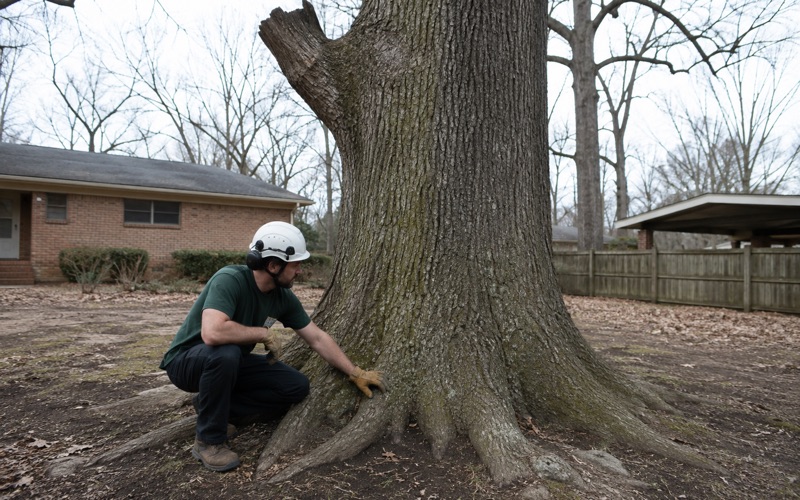
The older properties carry the trees that were here first. This is Eastern Highland Rim ground, ecoregion 71g, and the canopy vocabulary is oak-hickory with eastern redcedar holding the thinner soils over limestone. On a lot left wooded or planted in the 1970s, those trees now stand at a diameter at breast height well past what a homeowner takes down with a chainsaw and a rope.
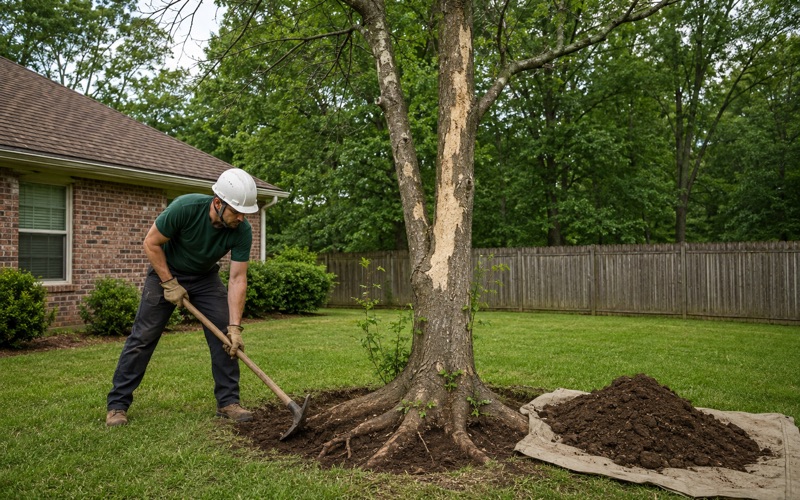
What we look at on that stock is structure rather than size: co-dominant stems with included bark at the union, a root flare buried by decades of added mulch and grade changes, a bracket fungus at the base, epicormic sprouts along limbs that lost their leaders in an ice event. A tree that has stood forty years has had forty years to accumulate defects, and the removal gets priced on the defect rather than on the trunk.
The lot cleared last year
New construction has the opposite problem. The mature trees left standing after a build are often the ones that lost a share of their root systems to the driveway cut and the foundation trench, and the young trees planted afterward are too small to remove and too new to ignore. Both need watching rather than work, and we will say so on a visit.
There is nothing new about old and new sharing ground out here. When four communities went looking for a centrally located high school in 1916-1917, the site they settled on was Riverton, on the Barron Fork of the Flint River, reachable from Central near Moore’s Mill among the others. Riverton Intermediate School is a Madison County Schools campus today, and the settlement pattern kept layering the same way the tree ages did.
Looking for tree-removal closer to Hazel Green? See Hazel Green Tree-Removal.
Large lots, setbacks, and the fenced rear yard that decides the drop zone
Lots here are generous by the standards of a city street, and that shifts the constraint in one specific way. The tree is usually not the problem, the route to it is. A back-yard oak may have all the room it needs to fall and none of the room it needs to be carried out, because the fence line, the setback and the septic field decide where wood can land and where a truck can park.
Measuring the way in before pricing the tree
We measure gate width first, then carry distance to the curb, then whether the chipper can be positioned close enough that the crew is not walking every limb the length of the yard. A rear yard reachable only through a narrow garden gate is a different machine class from one with a drive to the back corner. Pretending otherwise is how a crew arrives, sees the fence, and re-quotes on the spot.
When the drop zone will not take the whole tree
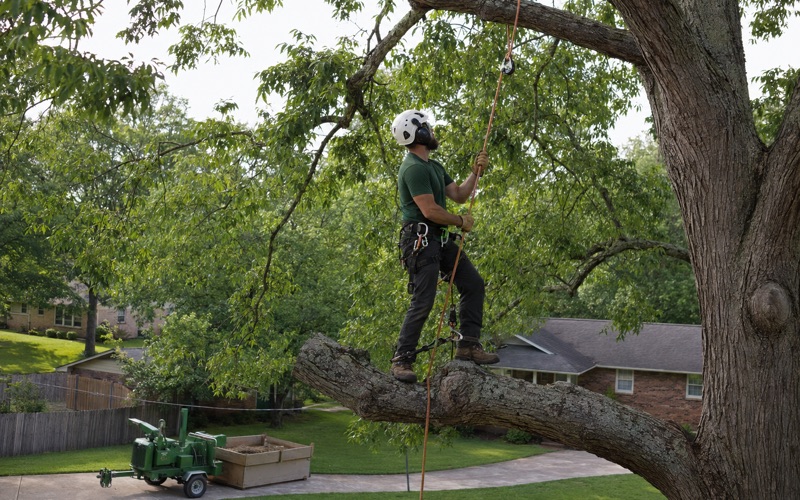
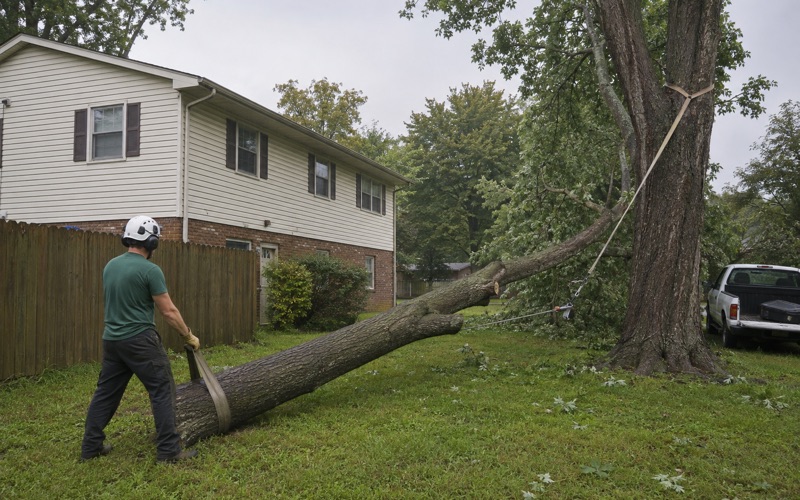
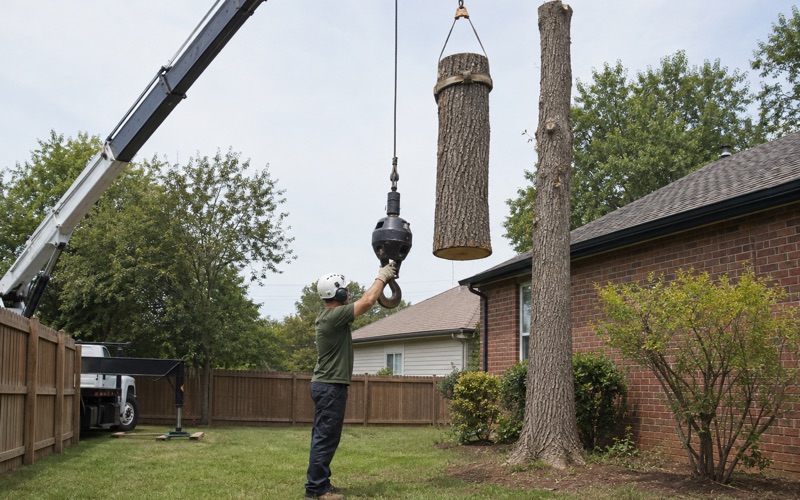
Where there is room, a directional felling notch and back cut is the cheapest safe answer and we use it. Where there is not, whether that means a shop, a pool or a neighbor’s fence inside the fall radius, the tree comes down in sections. Those pieces get rigged on a bull rope through a block at a sound anchor and controlled at the base with a Port-a-Wrap, or run out on a speed line when the landing area is offset from the stem. Every piece has a weight, every rope and block has a working load limit, and ANSI Z133 sets the clearances a crew works to around energized conductors.
Machines that fit through a gate
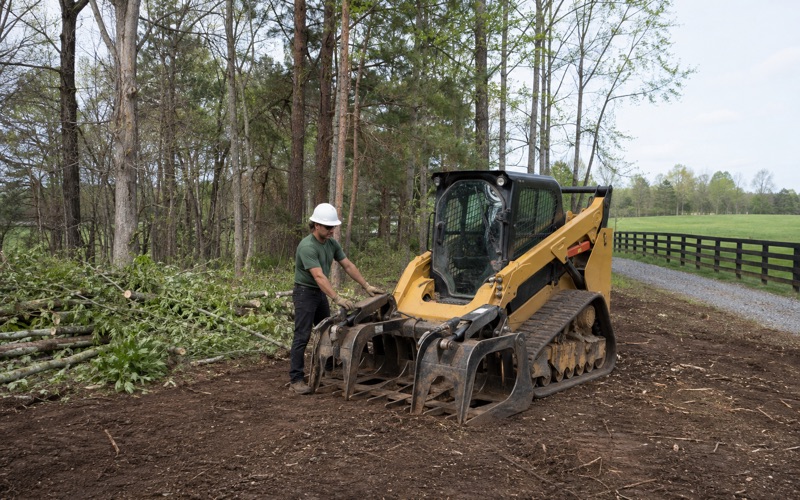
We run tracked lifts narrow enough for a residential gate for exactly this reason, and we bring crane capacity to trees standing over a roof where sectional dismantling off the stem is the slower and riskier answer. Which machine the job takes is a line you can read on our estimate rather than a surprise, because on a fenced rear yard it drives the price more than anything else about the tree.
Deep residual soil, and why grinding depth is a machine decision
The upland soils in this part of the Tennessee Valley are the red clayey Decatur and Dewey series with silt loam surface textures, weathered from limestone. Both run deep. The Decatur series has a solum more than 72 inches thick with limestone bedrock below about six feet, and the Dewey series has solum thickness and depth to bedrock of more than 60 inches.
Rock is not what stops the grinder
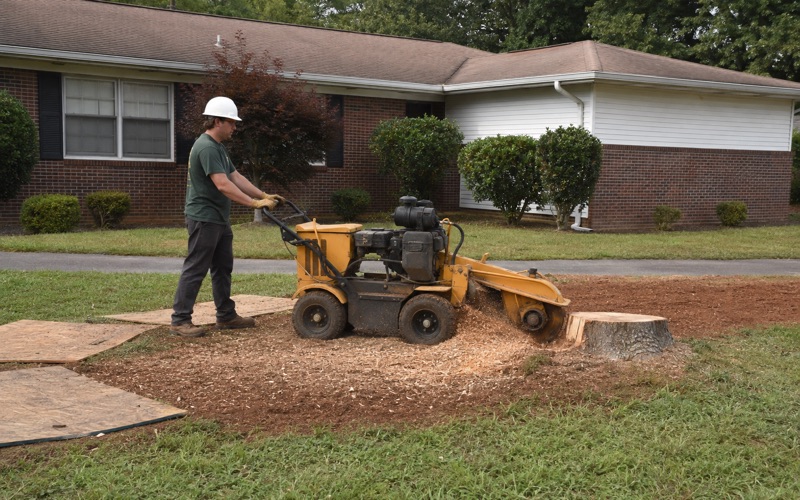
On a typical parcel here, bedrock is not the limit on how far down a stump can be taken. A grinder rated to cut 12 to 25 inches below grade reaches the bottom of its own cut, not rock, so grinding depth is a machine-class and price decision rather than a geological one. It is worth saying out loud, because the same trade in shallower ground a short drive away gives the opposite answer.
How deep you actually want to go is a use question. Sod laid over the void needs less than a replacement tree going into the same hole, and a patio slab or a fence post needs the lateral roots chased out past the stump itself. We ask what is going there before we set a depth, and the carbide teeth on the cutting wheel wear at a rate that depth decides.
Call before the wheel turns
Alabama’s One-Call requirement is written for excavation and does not name stump grinding in either direction. Notice has to be given at least two but not more than 10 working days before work begins, and it stays valid for 20 working days from the proposed start date. The exemptions cover a person excavating on their own property or easement where no other operator has facilities in the ground there. Our reading stays conservative: a stump within reach of a service lateral gets a locate, because a cutting wheel at that depth does not care what it finds.
What deep rooting does to how trees fail
Deep soil also changes the failure mode, and this is where an assessment written for thin soil over rock will mislead you. Trees rooted in this ground can hold a deep root plate, so a structurally sound tree tipping over whole is less automatic here, and trunk and union defects carry proportionally more of the risk. That is why our written condition and risk documentation spends its time on the decay column, the union and the root collar, and why resistance drilling earns its place on a trunk we cannot read from the outside.
Who has jurisdiction here, and which wire is yours
Moores Mill is an unincorporated census-designated place rather than a municipality. There is no mayor, no council and no city tree ordinance reaching a parcel here; the governing body is the Madison County Commission, and this community sits in District 1, whose office is at 9457 Moores Mill Road at 256-828-0726.
The service drop is the customer’s, and the utility says so
Huntsville Utilities is the electric distribution utility here, and it clears its own distribution lines at no cost to the customer, using natural trimming to laterals, meaning side trim, drop crotch and overhang, as an ISA recommended practice, with a planner leaving a door hanger before the work. The customer service wire is a different matter, and the utility’s published answer is blunt: “the responsibility of clearing trees from customer service wires (pole-to-house) rests entirely with the customer.”
That one sentence decides who pays for a very common job on this housing stock, where a limb has grown down into the drop running from the pole at the road to the weatherhead on a house built decades before its neighbor. We arrange the service-drop disconnect before anyone works near that wire, and we know which utilities around the valley will do it and which will not. Line Clearance answers at 256-535-1224 or trees@hsvutil.org, while an outage or a downed conductor goes to 256-53-LIGHT (256-535-4448).
Debris is the constraint nobody quotes
The Madison County Commission District 1 large debris page states “We do not pick-up debris generated by contractors,” and it names tree stumps among the items the district does not pick up. A crew that stacks your wood at the road and drives off has not finished the job. It has left you a pile the county has already said it will not collect, and arrangements for what the district does take start with a call to the district office.
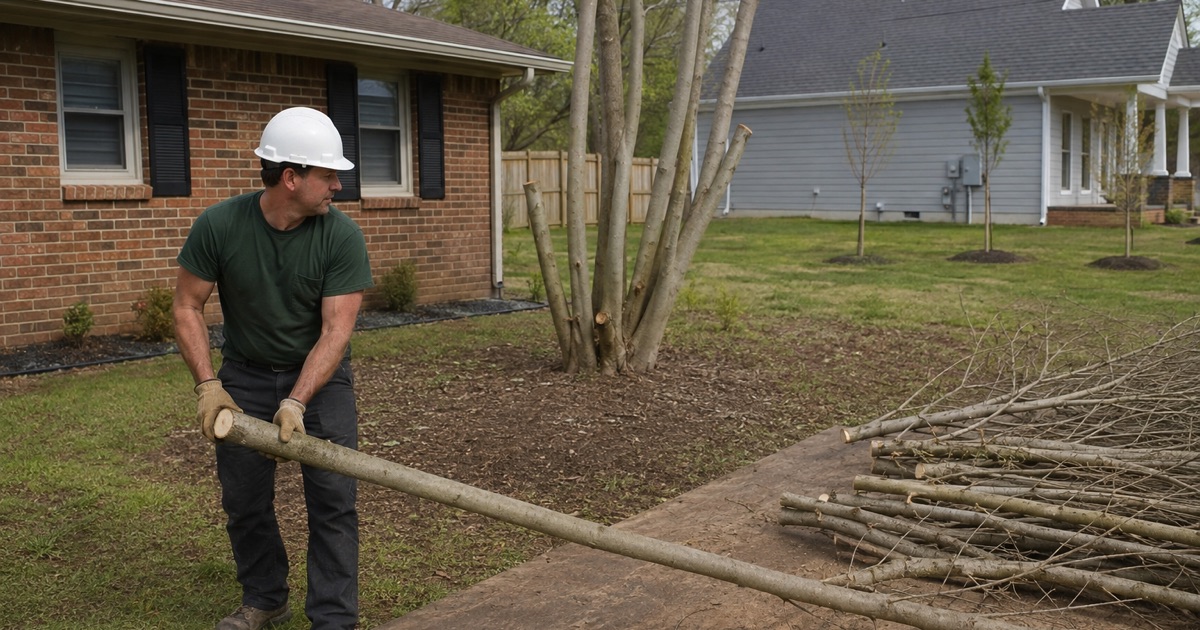
That is why the haul line on our estimate is written out rather than assumed. Grindings, chips and rounds go on the truck or stay on the property at your choice, and we explain the county rule that applies instead of absorbing it into a surprise charge later.
When it is an emergency
Fire and rescue out here is volunteer. More than 500 volunteers across 16 volunteer fire departments cover unincorporated Madison County, and one of those departments built its fourth station on Walker Lane beside Moores Mill Intermediate School. A tree on a structure or a tree on an energized line is a 911 call first, every time.
We take storm and hazard calls the same day, with the plain limits a safety standard puts on working aloft near energized lines in wind and ice. Once the scene is safe, the rest is the same three lines it always is: the takedown, the stump and the wood.
- 20+ Years in the Tennessee Valley
- Free Written Estimates
- Crane and Narrow-Access Equipment