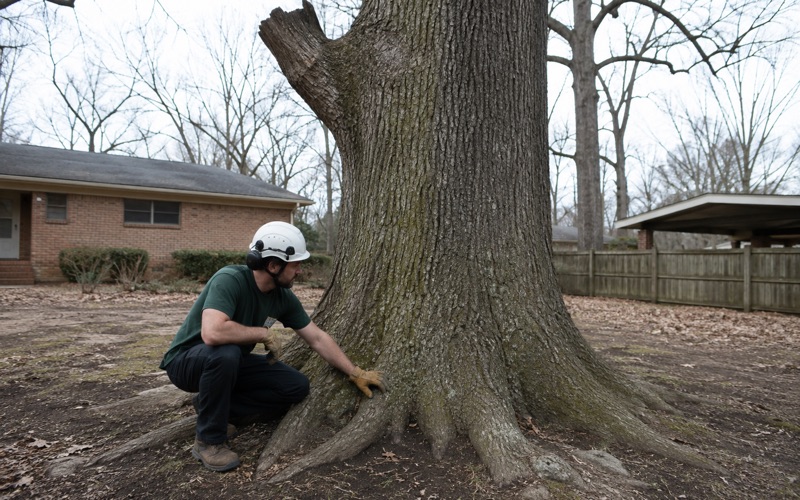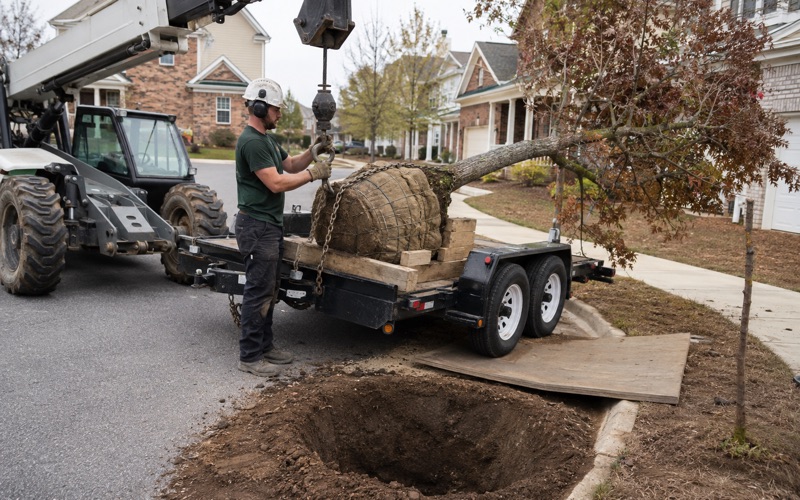
Madison Tree Removal Pros has been doing tree removal in New Market for more than twenty years, and on a New Market parcel our estimator walks the outside of the house before looking up into the canopy. Roughly a third of the homes here sit on piers rather than a continuous foundation, and that one fact reorders the job. It decides where the drop zone can be, how early the rigging has to start, and what a limb the size of a fence post actually does when it lands.
That is not a stylistic preference, it is a pricing one. Our written estimates itemize the takedown, the stump and the debris haul as three separate lines, because those are the three numbers competing quotes in this part of the county disagree about. Where a structure is more vulnerable than a brick ranch, the takedown line is carrying rigging time that a flat number somewhere else may simply be hiding.
Access gets measured before the tree is priced: gate width, carry distance to the truck, whether the chipper can reach the work, and where a tracked machine can sit without crossing a shallow service run. Every quote we hand over states plainly whether haul-away is included, so a low number and a high number can be compared honestly.
What a manufactured home changes about a removal
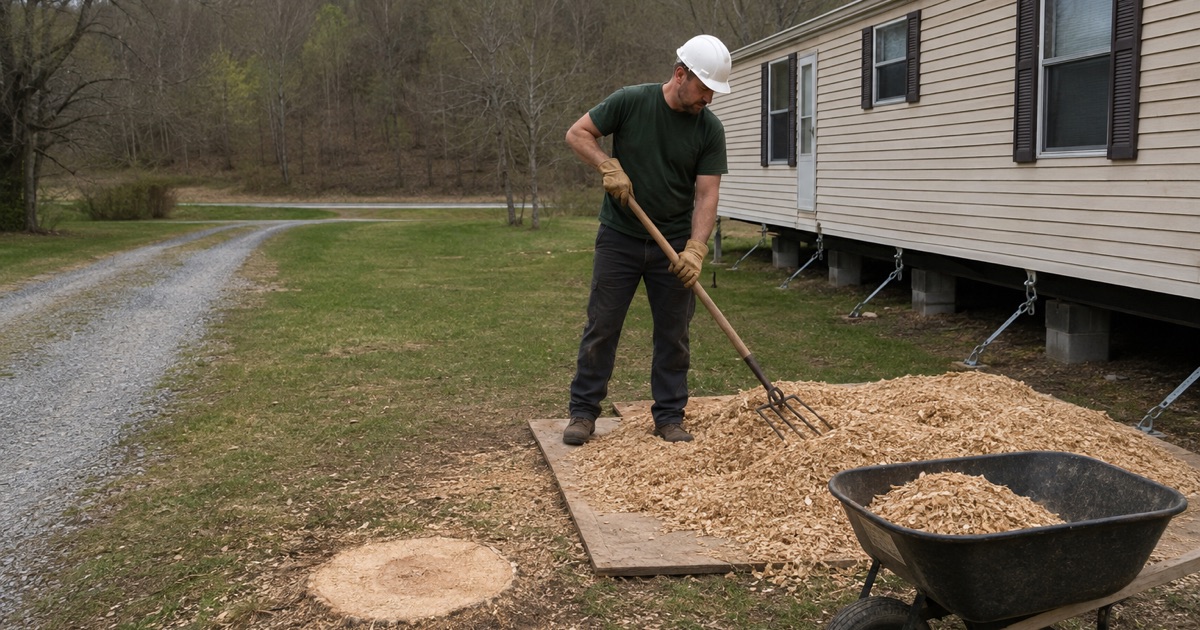
The 2024 five-year American Community Survey estimates count 622 housing units in New Market, of which 31.5 percent are manufactured homes and 68.5 percent are one-unit detached houses, in table B25024. Neither share is a rounding error, so we do not carry one set of assumptions across the whole community. The manufactured proportion is high enough that what sits under the structure is asked on every visit, and low enough that most roads hold both kinds of home within sight of each other.
What a falling limb actually damages
A site-built house sheds a moderate limb strike into its roof structure and the damage usually stops at sheathing and rafters. A manufactured home carries its load through a steel chassis and comparatively light roof framing, so an impact a stick-built roof absorbs can telegraph into the frame, rack a door out of square, or shift the unit on its supports. That is why we treat the entire footprint as a no-drop area instead of aiming for the far side of a ridge line. It also changes what gets photographed before work starts, because a claim argued months later is usually argued over what the structure looked like the day before.
Setback, drop zone and rigging
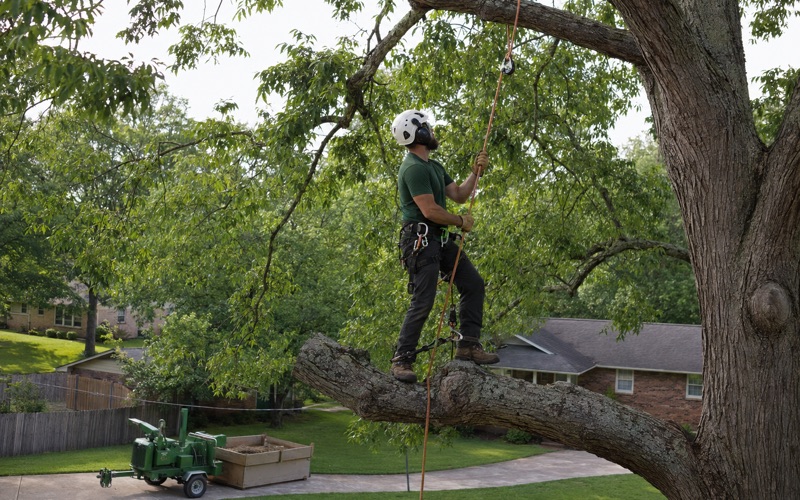
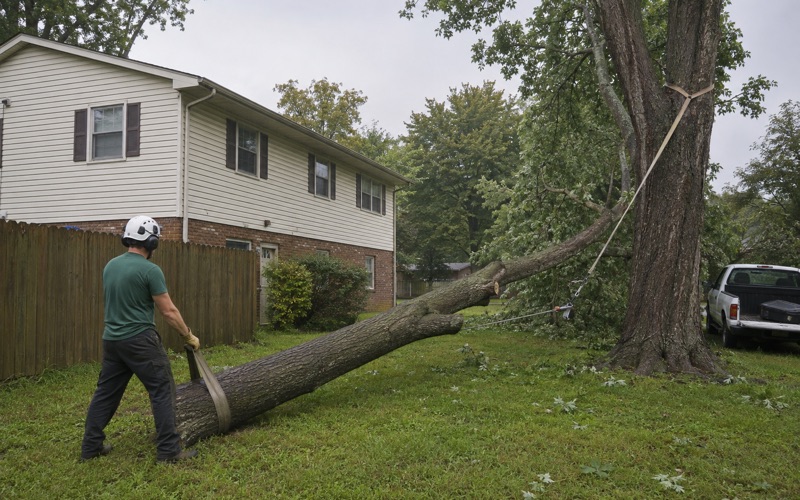
Setback here means the distance from the stem to the nearest thing that cannot take a hit, and on a lot with a home, an attached carport and a detached shop, that measurement gets taken three times. Where the free drop is short, the tree comes apart in sections on a bull rope, a rigging block and a Port-a-Wrap rather than through a directional felling notch and back cut. Sectional dismantling is slower and it shows up in the takedown line; we would rather explain that line than explain a repair. When the only clear ground is forty feet from the trunk, a speed line often moves brush for less than a longer carry would cost.
Looking for tree service closer to Huntsville? See Tree Service in Huntsville.
Piers, tie-downs and where a machine can sit
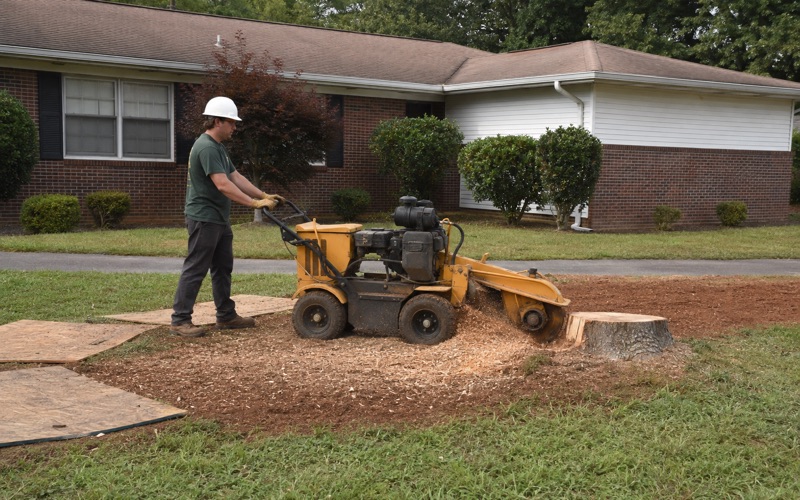
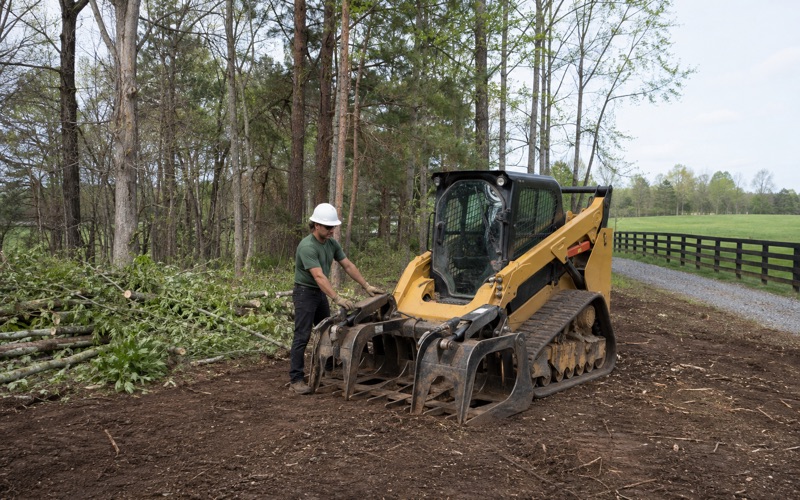
The setup under a manufactured home is a system rather than a slab: piers on footings under the main beams, and tie-downs running to ground anchors along the sides. Both are load paths and both sit exactly where a crew wants outriggers, ground mats or a compact loader. We locate the anchor line and the pier line before anything tracked crosses the yard, because a bent anchor is invisible from the road and gets discovered by somebody else later.
Where a crane can and cannot sit
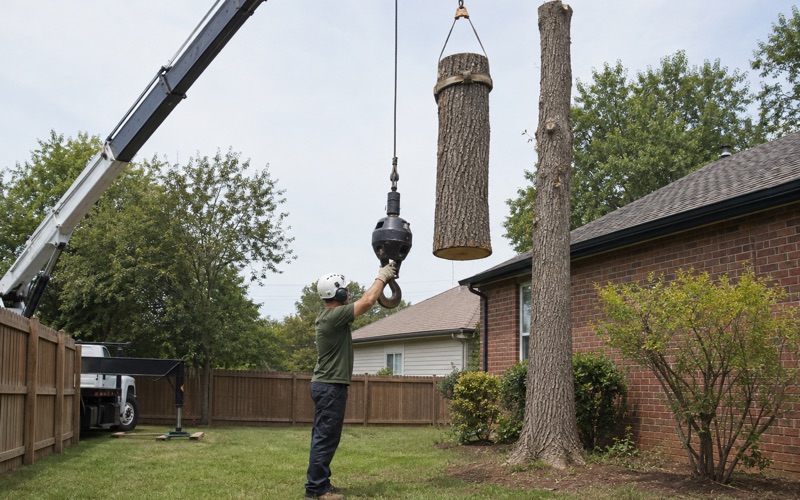
A crane needs firm, level ground and a swing radius clear of the structure, which on a long, narrow lot often means the driveway is the only viable setup position. When the driveway is on the wrong side of the house, a tracked spider lift fits through a standard gate and works from inside a fenced back yard where an aerial bucket truck never gets close, and a knuckleboom grapple truck loads from the shoulder. Settling that in the estimate is the point; an access problem found by a dispatched crew becomes a return trip somebody pays for.
Calling 811 before the grinder starts
Buried water, power and sewer runs to a manufactured home are frequently shallow, and they do not always take the route a plan drawing would predict. Alabama requires notice of intent to excavate at least two but not more than 10 working days before the work, valid for 20 working days from the proposed start date. The statute exempts a person excavating on their own property or easement where no other operator has facilities there, along with agricultural plowing under 12 inches, and it does not name stump grinding either way. We place the notice regardless before a cutting wheel goes below grade, because the conservative reading costs a phone call and the other reading costs a service lateral.
The service drop is the customer’s span
Huntsville Utilities is the electric distribution utility here, and its published answer decides who pays for a very common job. It performs line clearance on its own distribution lines at no cost to the customer, but states that “the responsibility of clearing trees from customer service wires (pole-to-house) rests entirely with the customer.” We arrange the disconnect before anyone works near that span, and ANSI Z133 sets hard limits on what may be attempted near an energized conductor in wind or ice no matter who owns the wire.
County ground: who signs off, and where the wood goes
New Market is an unincorporated census-designated place, so no municipal tree rule, brush rule or permit reaches a parcel here at all. The governing body is the Madison County Commission, and the District 1 office happens to sit in this community at 9457 Moores Mill Road. Unincorporated Madison County has no zoning ordinance limiting construction projects; it enforces building code instead, the 2018 International Residential Code with local amendments effective January 2021, and no county tree removal permit or diameter threshold appears in any county instrument.
The land disturbance rule is a stormwater rule
The requirement people most often mistake for a tree permit belongs to drainage, not to trees. Madison County Public Works enforces the Madison County Subdivision Regulations in unincorporated areas, and work disturbing one acre or more, or less than one acre where it is part of a development or sale of one acre or more, has to operate under ADEM General NPDES Permit No. ALR100000. Taking a single tree off a finished residential lot is not itself a trigger.
Contractor debris is not curbside debris
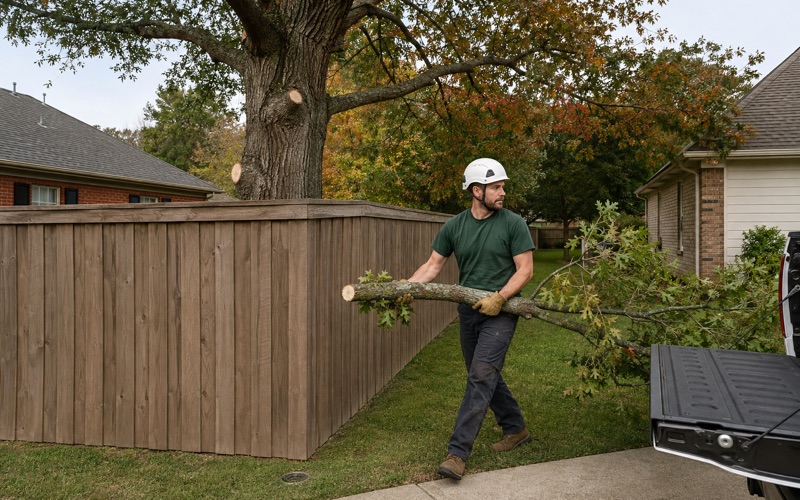
Large debris collection out here is administered by the commission district rather than a countywide department, and the District 1 rules are blunt about it: “We do not pick-up debris generated by contractors,” with tree stumps named among the items the district does not pick up. Wood stacked at the road after a hired job therefore stays at the road, and the stump and its grindings are ours to move either way. That is why the haul is its own line on the estimate, sitting next to a firewood credit: leave the rounds cut and stacked and the quote shows the difference, take them and it shows that too.
Valley floor and escarpment slope in one community
New Market straddles two EPA Level IV ecoregions, and that was established by point query rather than assumed off a map. The census-designated place centroid returns 68c Plateau Escarpment, while tested points to the northwest, north and east all return 71g Eastern Highland Rim. So the valley floor reads as oak-hickory with eastern redcedar on shallow limestone, while slope positions inside the same community carry a real escarpment assemblage: beech and yellow poplar with sugar maple, basswood, ash and buckeye on middle and lower slopes, mixed oak and chestnut oak above, and rare hemlock along rocky streamsides. Neither description covers the place as a whole, which is the practical point.
Grind depth is a floor-versus-slope question
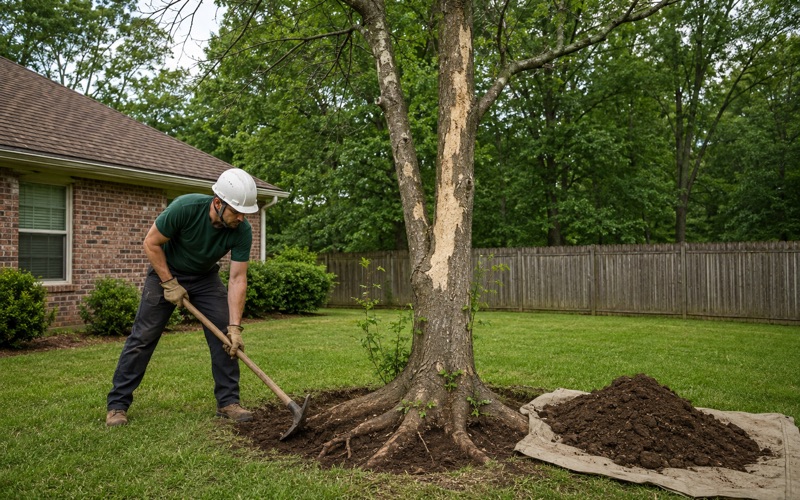
On the valley floor the upland soils are the deep red clays of the Decatur and Dewey series with silt loam surface textures. Decatur has a solum more than 72 inches thick with limestone bedrock deeper than six feet, and Dewey’s solum thickness and depth to bedrock both exceed 60 inches, so rock is not what stops a grinder there. A machine rated to cut 12 to 25 inches below grade reaches the bottom of its own cut, which makes depth a machine-class and pricing decision rather than a soil gamble. Uphill that assumption does not travel, and we say which side of the line a stump sits on before quoting a depth for it.
Old stock along Winchester Road and the Mountain Fork
The other New Market is the historic district listed on the National Register in 2004, about 450 acres roughly bounded by Mountain Fork, College Street, Davis Street and Winchester Road to Cochran Street, with Gothic Revival and Queen Anne houses and the Whitman-Cobb House of around 1861 still standing. Trees on that kind of ground are old and large, and often better documented than removed: crown cleaning and reduction, static cabling or threaded steel bracing rods through a weak union, and a written condition and risk report priced as its own deliverable instead of buried in a sales visit. The Mountain Fork of the Flint River runs through the northern part of the community, and the streamside stems there are the ones we check first for root-flare conks, included bark and co-dominant stems. Institutional grounds sit under the same logic at the Buckhorn High School and Hurricane Creek Elementary School campuses, where the school system rather than a homeowner owns the tree.
A cold hollow, and what it leaves behind
The coldest temperature ever recorded in Alabama, minus 27 degrees Fahrenheit, was measured at New Market on January 30, 1966. That is an event observation and a state record rather than a climatological normal, but it fits where the community sits: a valley around 791 feet at the toe of the plateau front, where cold air drains off higher ground and pools overnight on a clear, calm night. What that leaves in the trees is frost cracks and radial shakes on thin-barked species, dieback on marginally hardy landscape plantings, and split unions where included bark was already waiting. A hard freeze is a reason to have somebody walk the property, not just a weather story, and the forecast alone will not tell you much here since zone ALZ006 covers all of Madison County at once.
- 20+ Years in the Tennessee Valley
- Free Written Estimates
- Crane and Narrow-Access Equipment