Madison Tree Removal Pros has handled tree removal in Triana and across the wider Tennessee Valley for more than twenty years, and the answer we give a Triana caller most often is not the one they came for: the town is almost never the body that decides whether the tree comes down.
Our estimate is written, free of charge, and split into three lines — the takedown, the stump, and the debris haul — because those are the three numbers competing quotes here disagree about. Each one states plainly whether haul-away is included, so a low bid and a high bid can actually be set beside each other, and a firewood credit sits on the same sheet: leave the rounds cut and stacked and the figure moves one way, take them and it moves the other.
Access gets measured before the tree gets priced. Gate width, drop zone, carry distance back to the truck and whether a chipper can reach the work at all decide more about a job here than the species does, and on lots reached off Wall Triana Highway or Zierdt Road that walk is worth doing before a number goes on paper.
What the Town of Triana Regulates, and the One Clause That Proves It
The operative instrument inside the corporate limits is Zoning Ordinance No. 2021-03, adopted by the Town Council on June 14, 2021 under the authority of Title 11, Chapter 52, Articles 1 through 4, Code of Alabama. It modified the earlier 2019-02 ordinance, which had itself replaced one from 1968. Triana is an incorporated town under a mayor and Town Council, and that council is the body that adopts and amends the document.
We have read it front to back. Its table of contents runs twelve numbered sections, from Authority and Enactment Clause through Legal Status Provisions, and it contains no tree article, no landscape article, no vegetation article and no land-disturbance article. There is no removal permit, no diameter or caliper threshold, and no buffer or replacement requirement on private property anywhere in it.
The sight triangle is the whole of the town’s plant rule
The ordinance is not silent about growing things. It addresses one and stops. Section 6.5 provides that in any district requiring a front yard setback, no fence, wall, shrubbery, sign, marquee or other obstruction to vision between the heights of three and one-half feet and fifteen feet above street level is permitted within twenty-five feet of the intersection of the right-of-way lines of two streets. That is a corner-visibility rule about a hedge, and it is the entirety of the town’s regulation of vegetation.
The building permit reaches excavation, not stump grinding
Section 9.2 makes it unlawful to commence the excavation for or the construction of any building or other structure, or the moving, alteration or repair of any structure exceeding $3,500 in cost, until the Municipal Building Inspector has issued a permit; section 9.1 names that inspector as the enforcing officer. Nothing in either provision reaches a takedown, a root excavation or a stump ground out on a finished lot, and the penalty at section 9.5 runs from not less than two dollars to not more than one hundred dollars per offense, with each day a separate offense.
Two authorities sit beyond that. The Board of Adjustment, established by Ordinance 2018-08, hears appeals and may order abatement of a hazard or nuisance after a public hearing, which is the one municipal route by which a tree becomes the town’s business. Land disturbance is a state matter instead of a municipal one: ADEM’s construction general permit ALR100000 reaches sites disturbing one acre or greater, and a yard removal is nowhere near that line.
Looking for tree-removal closer to Harvest? See Tree-Removal in Harvest.
The Recorded Deed Is the Rule When the Town Has None
Section 12.1 of that same ordinance is the clause that actually governs most Triana lots. It provides that the ordinance shall not lower the restrictions of plats, deeds or private contracts where those are greater than its own provisions, and that where another ordinance imposes greater restrictions, compliance with those is mandatory. In a town whose zoning says nothing about trees, that sentence hands the decision to whatever is recorded against the parcel.
The document to find, then, is not at town hall. It is the plat and the covenants recorded with the Judge of Probate of Madison County, and on a platted subdivision lot it is entirely ordinary for a recorded deed covenant to require committee sign-off before a removal or to protect a tree by size or by where it stands.
How often that is worth checking follows from the housing stock. ACS 2024 five-year estimates put Triana at 1,696 total housing units, 83.8 percent owner-occupied and 89.0 percent one-unit detached, with 1,112 owner-occupied one-unit detached homes; only 15.8 percent of the stock was built before 1980.
What we put in writing, and why the wording matters
Where a removal has to be justified to somebody — a covenant committee, an adjuster, a neighbor who reads a leaning trunk differently than you do — we write the condition and risk documentation as its own deliverable, priced on its own line rather than folded into a sales visit. It records what was observed and what that observation means: co-dominant stems with included bark at a union, a decay column confirmed by resistance drilling, a bracket fungus at the root flare, epicormic sprouts along a stripped limb.
That vocabulary belongs to the trade, not to us. ANSI A300 is where the work itself is specified, ANSI Z133 governs how a crew is permitted to perform it, and designations such as the ISA Tree Risk Assessment Qualification and the ASCA Registered Consulting Arborist exist so a written finding reads the same way to every party who has to act on it. A documented hazard assessment is what moves a disagreement forward here.
Bluff Ground Between a River, a Refuge and an Arsenal
Triana covers roughly 2.824 square miles at an elevation near 604 feet, on a bluff above the north bank of the Tennessee River. Wheeler National Wildlife Refuge, established July 7, 1938 and covering 34,430.66 acres across Morgan, Limestone and Madison counties, holds the shoreline, the lower Indian Creek reach and the bottomland hardwood tracts off the south and west edges of town; Redstone Arsenal forms the boundary east and north. Both are federal ground on which a private crew has no authority, so we work to the property line and stop at it.
Inside that line the ground changes over a short distance. The town sits in EPA Level IV ecoregion 71g, the Eastern Highland Rim, within the Interior Plateau, and the river is not a boundary here — the valley floor reads the same on both banks. The forest is oak-hickory with cedar glades on the shallowest limestone soils, while the refuge’s bottomland stands run to red and white oaks, hickories, poplar, ash and tupelo.
What fails, and where
Rooting depth is not capped by rock on these deep residual soils, so the wide thin root plate that produces whole-tree windthrow on shallow limestone is not the default failure mode in Triana. Trunk failure, union failure and saturated-soil lean are the more common calls, and a bottomland parcel holding water behaves nothing like a bluff-top lot a few streets away.
Storm work splits along the same seam. The town lies in National Weather Service public forecast zone ALZ006, Madison, served by the Huntsville office with radar at KHTX, and that zone doubles as the fire weather zone. On April 27, 2011 the Huntsville forecast area recorded 39 tornadoes, out of 62 across Alabama that day. We answer storm and hazard calls the same day, with the limits a safety standard places on working near energized conductors in wind and ice stated up front rather than discovered on site.
Deep limestone residuum, and what it means for a stump
These are the Limestone Valleys and Uplands soils, formed mainly in residuum weathered from limestone: Decatur and Dewey through the valley, Bodine and Fullerton on the cherty limestone uplands. The Decatur series carries a solum more than 72 inches thick with limestone bedrock deeper than 6 feet, Dewey’s depth to bedrock and solum thickness both exceed 60 inches, and Bodine has bedrock deeper than 5 feet with 35 to 80 percent rock fragments in its control section.
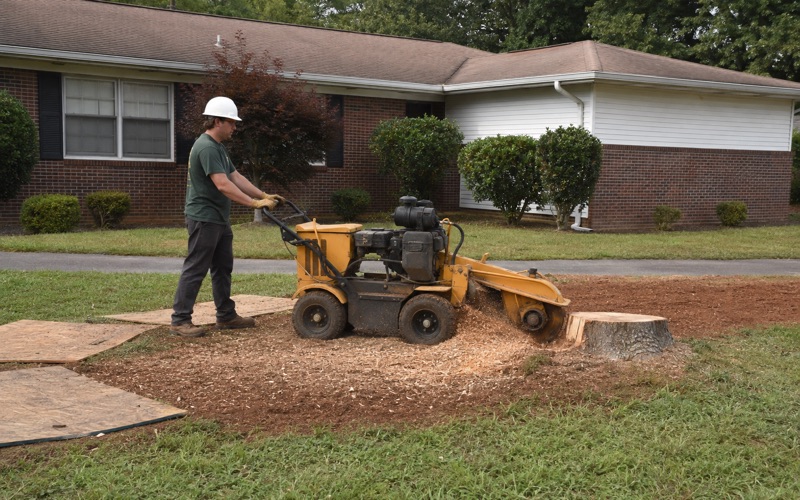
The practical consequence is the reverse of a shallow-glade situation. A stump grinder’s rated cut of roughly 12 to 25 inches below grade stops the job long before bedrock does, so grind depth in Triana is a machine-class question rather than a rock question. On Bodine ground the chert is a wear problem for the cutting wheel’s carbide teeth, not a refusal.
Where the Wood Goes, Since the County Takes None of It
Triana runs its own water, sewer and streets, but it collects no debris. The town’s public works page routes residents to Madison County Waste Control and Recycling on Wholesale Avenue in Huntsville for household garbage and large items, and the county’s terms shape every debris line we write.
The county does not pick up debris generated by contractors; a resident who hires someone for yard work is told the contractor is responsible for removing it from the property. Its large-debris pages name tree stumps first among the items not collected, cap green-waste limbs at less than 8 feet in length, and add a $50 service charge plus disposal fees where a load exceeds a standard pickup bed.
That is why haul-away is never a silent assumption on a quote from us. Grindings, chips and rounds leave with the trucks or stay exactly where you want them, marked as a choice on the estimate, and the firewood credit works off the same line. A pile left at the curb is not a disposal plan in Triana.
Ash and pine change the disposal answer
The Alabama Forestry Commission confirmed emerald ash borer in Madison County on June 6, 2025, along with Jackson County, the first confirmed observation in either; the pest had previously been documented in Etowah, Calhoun, St. Clair, Talladega and Shelby counties. The commission’s guidance is that infested ash trees which are cut down should preferably be burned or destroyed on-site to slow the insect’s dispersal. Where no collection route exists for the wood in the first place, that guidance and the county’s refusal point the same way, and ash becomes its own decision rather than another load.
Pines get read before they get quoted. Southern pine beetle is the commission’s named number one killer of pines in the state, and unmanaged loblolly and shortleaf stands are the susceptible ones. Under drought the pitch tubes may be very small or absent, leaving only reddish-brown boring dust to work from; S-shaped galleries under the bark indicate southern pine beetle, while Y- or H-shaped galleries indicate Ips.
The service drop is the customer’s span
Huntsville Utilities supplies electric and natural gas service to Triana and holds the distribution right of way. Its published position is that responsibility for clearing trees off the customer service wire — the pole-to-house span — rests entirely with the customer, and while it grinds stumps from the street-side removals it performs itself, it excludes back yard trees and trees removed at a customer’s request, leaving that grinding debris to the property owner. We arrange the service-drop disconnect with its line clearance desk before anyone works near the span, which is the detail most likely to stall a crew that did not plan for it.
- 20+ Years in the Tennessee Valley
- Free Written Estimates
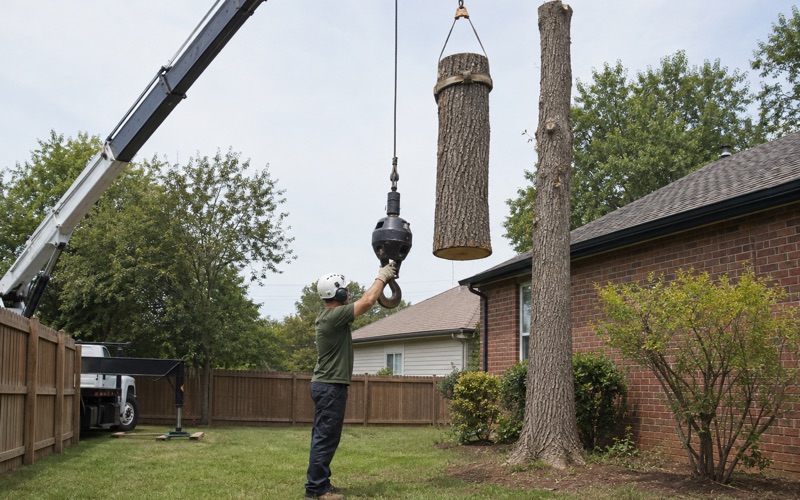
- Crane and Narrow-Access Equipment